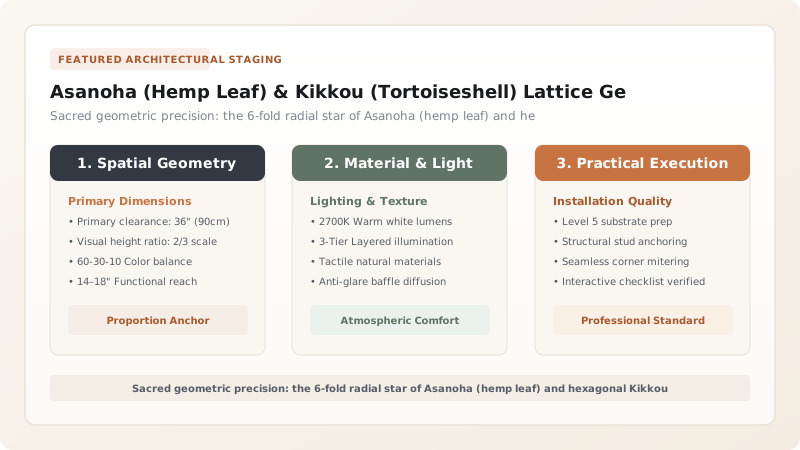
Asanoha (hemp leaf) and Kikkou (tortoiseshell) are the two most celebrated and sacred geometric patterns in Japanese Kumiko woodwork. Built within a 60-degree triangular Mitsukude base grid, Asanoha features six radiating diamond petals forming a stylized hexagonal star that symbolizes vitality, resilience, and protective warding. Kikkou forms interlocking hexagonal tortoiseshell cells symbolizing longevity, endurance, and prosperity. Both patterns require microscopic compound-angled infill splines fitted with zero glue.
At a Glance: Key Takeaways
- Geometric Foundation: 60-degree equilateral triangular base grid (Mitsukude Jigumi)
- Asanoha Symmetry: 6-fold radial star symmetry composed of 3 primary infill splines per cell
- Kikkou Symmetry: Hexagonal tessellation (tortoiseshell carapaces) with internal Y-infill
- Paring Angles: Strict 30°, 60°, and 120° mitered bevels cut against hardwood guide jigs
- Cultural Symbolism: Asanoha: rapid growth & health; Kikkou: longevity & 10,000-year blessing
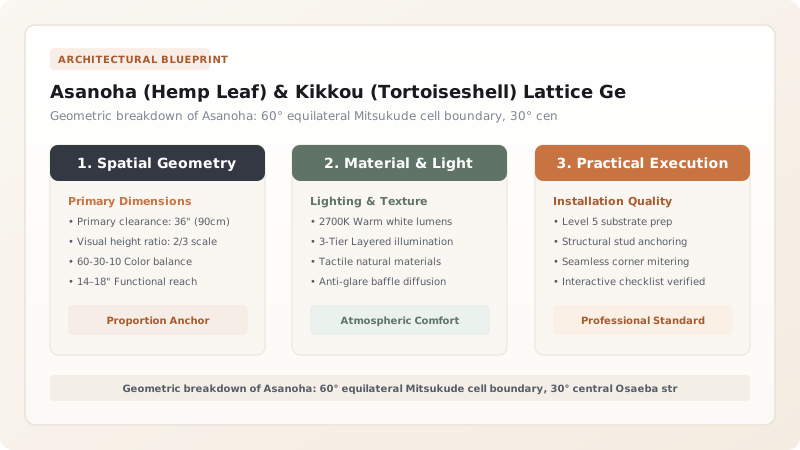
The Sacred Mathematics of Asanoha (The Hemp Leaf Motif)
Among the dozens of traditional Kumiko motifs recorded in Japanese pattern books (Moyō-shū), none commands greater cultural reverence or visual power than Asanoha (麻の葉). Based on a stylized representation of the fast-growing hemp leaf, this six-fold radial star pattern is constructed within the confines of an equilateral triangle. When multiple triangular cells are tiled across an architectural screen, the overlapping lines coalesce into a mesmerizing field of six-pointed stars surrounded by nested rhombuses.
The mathematical harmony of Asanoha arises from the precise division of 360 degrees into twelve 30-degree sectors. Each triangular cell of the Mitsukude grid contains three primary interior elements: one long central spine (Osaeba) and two angled side petals (Tsukeko). To achieve seamless closure, the ends of these miniature struts must be pared with microscopic compound angles—specifically 30-degree apex points and 60-degree shoulder miters. When executed with master-level precision, the converging wood fibers meet at a single, razor-sharp mathematical point without leaving a hair's breadth of gap.
Kikkou Geometry: The Hexagonal Tortoiseshell Blessing
While Asanoha radiates dynamic outward energy, Kikkou (亀甲) embodies meditative tranquility, structural permanence, and architectural equilibrium. Inspired by the hexagonal keratin scutes of the sacred sea turtle, Kikkou is a honeycomb tessellation based on regular hexagons, with internal angles of exactly 120 degrees. In the Shinto tradition, the turtle is an emblem of cosmic order and boundless longevity, believed to endure for ten thousand years.
In Kumiko joinery, Kikkou is achieved by selectively modifying the Mitsukude triangular grid. By removing certain interior struts and inserting three-way Y-shaped infill clusters (Mitsugumi), the artisan opens the rigid triangular lattice into undulating hexagonal rings. The pattern offers structural rigidity with minimal wood mass, allowing generous amounts of natural daylight to pass through the screen while framing views with serene geometric discipline.
Guide Blocks (Tsunagi) and the Precision Paring Craft
The human hand, no matter how steady, cannot reliably cut hundreds of identical 30-degree and 60-degree miters freehand to within 0.05 mm tolerances. To achieve repeatable perfection, Kumiko craftsmen rely on specialized hardwood guide blocks called tsunagi (繋ぎ) or jigane. These jigs are typically crafted from dense Japanese white oak (shira-kashi), cherry, or imported ebony—hardwoods that resist wear from sliding steel tools.
Each tsunagi features an angled channel planed to the exact target bevel angle. The craftsman places the gossamer-thin Hinoki spline into the bed, holding it firmly with finger pressure against an adjustable end-stop. A razor-sharp Japanese chisel (Tsuki-nomi) or a miniature hand plane is then slid directly along the hardened face of the guide block. The tool shears away a microscopic curl of wood, leaving a mirror-burnished end-grain bevel that matches its mating partner with optical perfection.
Visual Rhythm, Scale Hierarchy, and Architectural Framing
In traditional Japanese interior design, patterns like Asanoha and Kikkou are rarely applied uniformly across an entire wall. Doing so would overwhelm the senses and violate the principles of wabi-sabi and spatial quietude. Instead, master builders employ a rigorous hierarchy of scale and visual density across sliding Shoji panels and Ranma transoms.
Typically, the lower third of a Shoji partition (the Koshitsuki) features solid wood panelling to withstand foot scuffs. Directly above this plinth sits an open, calming field of square or rectangular grid work. At natural standing or seated eye level, the artisan inserts a horizontal band of dense Asanoha or Kikkou Kumiko, creating a focal zone of intense textural richness. Overhead, the lattice opens once again into wide geometric lines, guiding the eye toward ceiling beams and creating a harmonious gradient from solid earth to weightless light.
Comparison of Asanoha and Kikkou Pattern Geometry, Infill Counts & Difficulty
Use this reference table to calculate exact physical dimensions, ratios, and specifications before purchasing:
| Pattern Variation | Infill Pieces per Cell | Crucial Paring Angles | Fabrication Time (per 100 cells) | Mastery Difficulty |
|---|---|---|---|---|
| Standard Asanoha (Hemp Leaf) | 3 internal splines (1 long, 2 short) | 30° apex / 60° shoulder / 90° notch | 6 to 8 hours | Intermediate / Advanced |
| Yae-Asanoha (Double Hemp Leaf) | 6 to 9 nested internal splines | Compound 15°, 30°, and 60° bevels | 14 to 18 hours | Master Craftsman level |
| Standard Kikkou (Tortoiseshell) | 3 symmetrical Y-struts | 120° obtuse angles / 60° frame contacts | 5 to 7 hours | Intermediate |
| Kikkou-Asanoha Hybrid | Hexagon with internal Asanoha star | Multi-angle 30°/60°/120° intersections | 16 to 22 hours | Grandmaster level |
Practical Constraints
Every successful decoration project must account for physical and environmental constraints:
Extreme Multiplicative Angle Errors Across Triangles
An error of just 0.2 degrees on a 30-degree infill miter multiplies across the 6 converging points of the star, preventing the center from closing. Mitigation: Use fixed-angle brass-lined or dense ebony guide blocks that physically restrict chisel travel to the exact theoretical angle.
Fragility of Gossamer-Thin Spline Tips
The razor-sharp 30-degree tips of Hinoki infill splines are delicate and easily snap under clumsy assembly pressure. Mitigation: Handle infill pieces with wooden tweezers or broad fingertips, sliding tips into vertex corners before seating the body.
Execution Blueprint & Craftsmanship Sequence
Execute this professional sequence to achieve flawless results without backtracking:
Jigumi Triangle Dimension Verification
Measure the internal equilateral triangles of the Mitsukude frame with dial calipers to ensure all three interior sides match within 0.05 mm tolerance.
Infill Stock Preparation
Rip quarter-sawn Hinoki stock into thin ribbons, thickness-sanding them to 1.4 mm. Cut into manageable working lengths of 150 mm.
Fabrication of the Long Central Strut (Osaeba)
Place the spline in the 30° tsunagi guide block. With a sharp bench chisel, pare both ends into sharp 30-degree triangular arrowheads that seat into the triangle's corners.
Half-Lap Center Notching of Osaeba
Score and pare a shallow center half-notch on one face of the Osaeba to receive the intersecting secondary cross-splines.
Paring the Secondary Side Struts (Tsukeko)
Pare one end of the secondary strut to a 60-degree shoulder bevel and the other to a 30-degree point, ensuring exact length match using a stop block.
Sub-Assembly of the Asanoha Cluster
Interlock the secondary struts into the central Osaeba strut, creating a three-legged symmetrical tree or star cluster.
Press-Fitting into the Triangular Cell
Angle the cluster into the Mitsukude cell, seating the bottom tips into the frame corners, and push the center down until the assembly clicks flush with the outer plane.
Kikkou Hexagonal Variation Assembly
For Kikkou patterns, assemble three equal-length struts notched at 120-degree angles to form a three-way Y-shape, inserting them to lock adjacent hexagons into tortoiseshell shells.
Common Mistakes & Countermeasures
Avoid these costly errors that compromise aesthetics, ergonomics, and budget:
Paring the 30-degree apex miters with a dull chisel or saw blade
Making infill splines 0.1 mm too long within the triangular cell
Mixing wood with differing moisture contents between Jigumi and infill splines
Project Execution Checklist
Track your physical progress. Checkboxes persist automatically on this device:
Frequently Asked Questions
Why is the Asanoha (hemp leaf) pattern so culturally significant in Japan?
In traditional Japan, the hemp plant (Asa) was celebrated for its extraordinary growth rate, straight and upright stem, and natural resilience against pests and harsh storms. The Asanoha pattern was traditionally embroidered onto newborns' kimonos and incorporated into household screens to wish children strong, rapid, disease-free growth and to protect the family from evil spirits.
What is the symbolic meaning of the Kikkou tortoiseshell pattern?
The Kikkou pattern represents the hexagonal plates of a tortoise shell. In Japanese folklore and Shinto tradition, the tortoise is an auspicious creature said to live for ten thousand years (tsuru wa sennen, kame wa mannen). Incorporating Kikkou into architectural screens serves as a blessing for immense longevity, steadfastness, and perpetual wealth.
How are the microscopic angles kept consistent across hundreds of cells?
Artisans never cut Kumiko angles freehand. They use specialized wooden guide blocks called tsunagi or jigane, crafted from ultra-dense hardwoods like Japanese white oak (kashi) or ebony. The block is precision-planed to the exact angle (e.g., 30° or 60°), and the craftsman slides the chisel flat against the hardwood face, shaving the softwood spline to identical geometry every time.
Can Asanoha and Kikkou patterns be combined in a single screen?
Yes. Master Kumiko craftsmen frequently combine patterns, using dense Asanoha stars in focal eye-level bands or circular medallions, framed by open, calming Kikkou hexagons above and below. This creates dynamic contrast between dense geometric shadow and open, airy light transmission.