
Kyoto Karakami is the exquisite hand-printed washi paper that adorns the sliding fusuma doors of Japanese palaces, temples, and tea houses. Originating during the Heian period through Chinese imports and institutionalized during the Edo period by master workshops like Karacho (founded in 1624), Karakami is hand-printed using massive carved wild cherrywood (yamazakura) printing blocks. Artisans prepare shimmering natural pigment slurries formulated from ground muscovite mica (kirara), pulverized white oyster shell (gofun), and iron earth pigments, bound with viscous seaweed gelatin (funori). Rather than mechanical presses, the printer transfers pigments by gently stroking the paper with the palms of their hands, producing subtle, tactile mineral textures that reflect ambient candlelight with ethereal, shifting luster.
At a Glance: Key Takeaways
- Printing Matrix: Hand-carved wild cherrywood (yamazakura) blocks enduring centuries of ink transfer.
- Mica Chemistry: Pulverized natural muscovite mica crystals (kirara) creating soft celestial light reflections.
- Oyster Shell White: Traditional gofun (calcined, 10-year weathered sea oyster shells) for velvety matte opacity.
- Funori Seaweed Binder: Natural red algae extract providing low surface tension, reversibility, and flexibility.
- Palm Printing Technique: Pure hand-pressure transfer using linen sieves and gentle palm stroking without baren discs.
- Iconic Motif Repertoire: Pine needles (matsu), wisteria arabesques, flowing water (kanzezeisui), and autumn grasses.
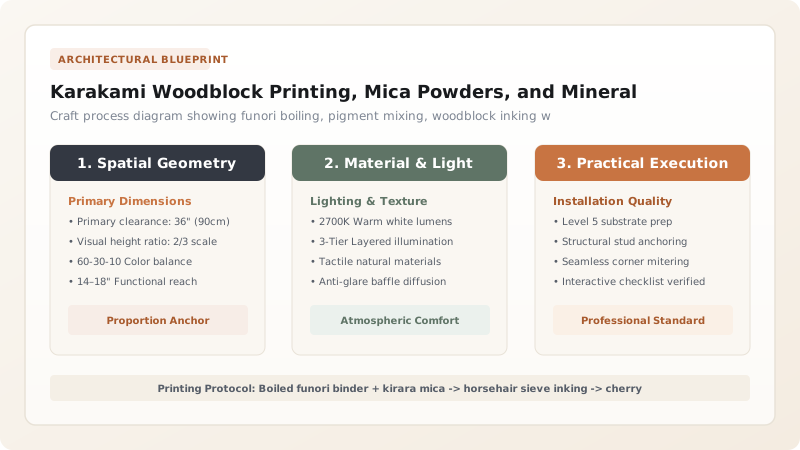
1. The Karacho Lineage and the Art of Carving Wild Cherry Woodblocks
While Ukiyo-e woodblock prints captured everyday urban theater on small sheets of paper using water-based inks and mechanical printing discs (baren), Karakami evolved as monumental architectural wallcoverings. Founded in Kyoto in 1624, the Karacho workshop has preserved over 650 hand-carved heirloom woodblocks, many dating to the Edo period.
The blocks are carved from seasoned Yamazakura (mountain wild cherry), prized for its dense, fine grain, dimensional stability, and resistance to wood-rot under water-based printing. Master carvers incised stylized, continuous arabesques with razor-sharp gouges. Because fusuma panels span large surfaces, the woodblock patterns are engineered with seamless repeating edge registers (tsunagi) that match perfectly when printed across four or eight adjacent sliding doors.
2. Kirara Mica Chemistry, Gofun Shell White, and Funori Seaweed Binders
The shimmering, non-metallic luster of Karakami is scientifically distinct from gold or silver leafing. It is created using kirara (pulverized natural muscovite mica flakes, $KAl_2(AlSi_3O_{10})(OH)_2$). Mica crystals are natural silicates that cleave into micro-platelets. When suspended in a transparent binder, these platelets lie parallel to the paper surface, acting as microscopic mirrors that reflect raking light with a soft, iridescent glow.
To bond the heavy mica platelets without dulling their luster, artisans formulate a delicate organic vehicle:
- Funori Algae: Dried red seaweed (Gloiopeltis) boiled in water to extract natural polysaccharides. Funori dries completely transparent, matte, and flexible, holding pigment without forming a shiny plastic film.
- Gofun Oyster Shell: Finely pulverized sea oyster shells weathered in seaside mounds for 10 to 15 years to leach out organic salts. It provides an unctuous, chalk-white matte body.
- Mineral Oxides: Natural earth cinnabar, lampblack soot, and indigo added in subtle quantities to achieve warm ivory, celadon, or charcoal backgrounds.
3. The Hand-Palm Transfer Technique and the Aesthetics of Dim Lighting
The inking and printing of Karakami involves a unique physical method. The artisan dips a wide, horsehair-covered wooden sieve (mabake) into the thick mica-funori paste, tapping it evenly across the relief carvings of the cherry block.
A sheet of dampened handmade Echizen or Kurotani kozo paper is laid gently across the block. Instead of using a hard circular baren pad (which would crush the delicate mineral platelets), the printer uses only the soft heel and palm of the hand. Stroking in gentle, sweeping rhythms, the warmth and supple flesh of the hand presses the paper into the carved wood grooves, picking up the rich, raised mineral paste. In the dim, indirect lighting of a traditional tatami room, the resulting pattern appears almost invisible in direct light, but suddenly bursts into shimmering golden life when illuminated by low evening candlelight or morning garden sunbeams.
Karakami Mineral Formulations and Classical Pattern Types
Use this reference table to calculate exact physical dimensions, ratios, and specifications before purchasing:
| Pattern Style | Primary Motif | Mineral Formulation | Light Response | Traditional Setting |
|---|---|---|---|---|
| Kanze-sui (Swirling Water) | Vortices of flowing mountain streams | Pure muscovite mica + light indigo | Fluid wave-like sparkle in raking light | Tea ceremony rooms & cooling summer halls |
| Matsu-kawa (Pine Bark) | Geometric fractured pine bark lozenges | Gofun oyster shell + amber ochre | Velvety chalk-white relief texture | Samurai reception suites (Shoin-zukuri) |
| Ko-aoi (Small Hollyhock) | Heian imperial floral arabesques | High-grade kirara mica + gold bronze | Warm golden celestial radiance | Buddhist temple sanctuaries & imperial villas |
| Hyotan (Gourds & Vines) | Undulating gourd vines and tendrils | Ground green earth + mica wash | Subtle emerald iridescence | Intimate residential living chambers |
| Kiku-karakusa (Chrysanthemum) | Stylized chrysanthemum flower crests | Pure bleached gofun + funori gel | Delicate embossed bas-relief luster | Formal audience halls and alcove surrounds |
Practical Constraints
Every successful decoration project must account for physical and environmental constraints:
Extremely Limited Number of Surviving Blocks
Color Batch Consistency
Traditional Studio Protocol for Hand-Printing Kyoto Karakami Paper
Execute this professional sequence to achieve flawless results without backtracking:
Funori Seaweed Binder Preparation
Simmer dried funori seaweed in soft water for 45 minutes; strain through fine silk gauze to yield a clear, viscous gelatinous vehicle.
Pigment and Mica Compounding
Grind calcined gofun shell white with pestle; blend in pulverized kirara mica powder and warm funori gel until creamy.
Cherrywood Block Cleaning
Wipe seasoned cherry woodblock with a damp linen towel to relax wood fibers and ensure uniform pigment absorption across relief carvings.
Mabake Sieve Inking
Dip horsehair mabake sieve into pigment trough; tap rhythmically across the relief surface of the woodblock to deposit a uniform froth.
Washi Registration and Placement
Carefully lower a sheet of raw mulberry washi onto the inked block, aligning corner pin marks to ensure accurate pattern repeats.
Palm Pressure Transfer
Glide warm bare palms across the back of the paper in circular and longitudinal strokes, pressing paper into inked relief contours.
Peeling and Shade Drying
Peel paper gently upward from one corner; hang sheets vertically on bamboo poles in a shaded, dust-free drying loft for 24 hours.
Common Mistakes & Countermeasures
Avoid these costly errors that compromise aesthetics, ergonomics, and budget:
Using synthetic acrylic mediums instead of boiled funori seaweed
Pressing paper onto the woodblock with a hard mechanical roller or baren
Printing on industrial wood-pulp paper
Project Execution Checklist
Track your physical progress. Checkboxes persist automatically on this device:
Frequently Asked Questions
How does Karakami differ from European hand-blocked wallpaper?
European wallpaper printing historically used thick oil or gouache paints pressed with heavy lever presses to create opaque, matte, solid color fields. Karakami uses sheer, watery seaweed pastes rich in translucent mica crystals, applied by bare hand palms to create a light-filtering, celestial surface that responds interactively to candlelight.
Why is wild mountain cherry (yamazakura) the only wood used for blocks?
Yamazakura has an exceptionally fine, dense cellular structure with no difference in hardness between earlywood and latewood growth rings. This allows carvers to cut hair-thin lines without splintering, while the wood remains perfectly flat and stable through centuries of water-based printing.
Can Karakami paper be cleaned if it gets dirty?
Because the pigments are bound with water-soluble funori seaweed, Karakami cannot be washed with water or cleaning liquids. Dust is removed with soft feather dusters (duster brushes). Stubborn spots are carefully blotted with soft white breadcrumbs, which lift dirt without abrading the delicate mica.


