
Chigaidana are traditional Japanese staggered display shelves found adjacent to the tokonoma alcove in formal shoin and sukiya interior architecture. Consisting of two or more horizontal polished timber planks mounted at differing elevations and overlapping in the center, they are structurally united by a delicate vertical strut bracket called an ebizuka (shrimp-back bracket) and framed by miniature sliding cabinets (tenbukuro and jibukuro). Chigaidana showcase precious tea utensils, incense burners, and scroll boxes with asymmetrical balance.
At a Glance: Key Takeaways
- Architectural Origin: Shoin-zukuri residential architecture of the Muromachi and Momoyama periods
- Shelving Structure: Two overlapping staggered horizontal planks linked by a central ebizuka post
- Upper & Lower Cabinets: Tenbukuro (upper ceiling cabinets) and Jibukuro (floor-level sliding cabinets)
- Joinery Refinement: Concealed blind sliding dovetails and mitered fukurin edge moldings
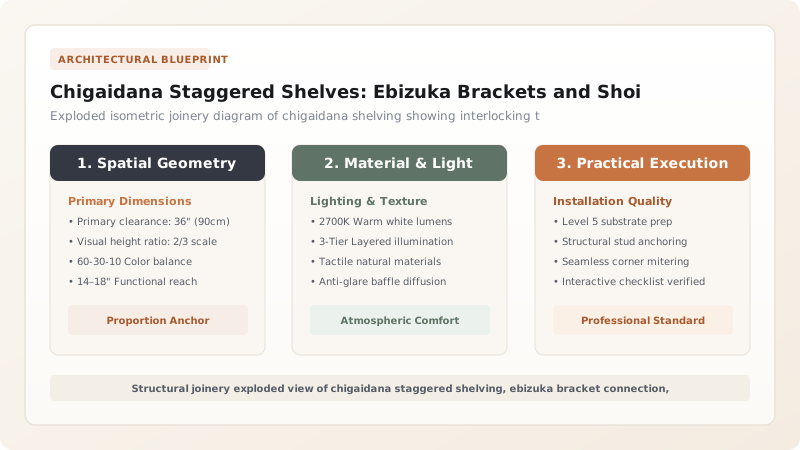
The Philosophy of Dynamic Asymmetry in Shoin Architecture
In Western classical architecture, monumental harmony is achieved through strict axial symmetry. In Japanese shoin and sukiya design, however, perfection is sought through dynamic, asymmetrical equilibrium. The chigaidana (literally 'staggered shelves') is the highest architectural manifestation of this principle.
Occupying the toko-waki (the secondary bay immediately adjoining the main tokonoma alcove), the chigaidana features two horizontal timber shelves set at unequal heights. By deliberately offsetting the planes, Japanese craftsmen avoided visual staticity, creating a sense of suspended motion and continuous spatial flow that mirrors natural mountain ledges.
The Ebizuka Strut: The Structural Linchpin
Where the upper and lower horizontal shelves overlap in the central span, they are connected by a single vertical wooden strut known as the ebizuka (literally 'shrimp mound,' so named for its subtle curved profile). Rather than a plain vertical dowel, the ebizuka is a masterwork of miniature sculpture.
Crafted from dense hardwoods like ebony, rosewood (shitan), or seasoned keyaki, the ebizuka is mortised into the underside of the upper shelf and tenoned into the top surface of the lower shelf. Its flared base and curved waist provide tensile and compressive rigidity, transferring shelf loads between the overlapping spans without requiring heavy wall-mounted diagonal knee braces.
Cabinet Enclosures: Tenbukuro and Jibukuro
The chigaidana shelving bay is framed above and below by miniature sliding cabinet compartments. At the ceiling line sit the tenbukuro ('heaven bags' or upper cabinets), while at the floor line sit the jibukuro ('earth bags' or lower cupboards).
These small compartments are enclosed by miniature sliding doors (fusuma) covered in hand-painted washi paper depicting seasonal birds, misty landscapes, or geometric gold-leaf dustings. Fitted with hand-chased shakudo bronze or silver flush pulls (hikite), they provide concealed storage for treasured calligraphy albums, silk scroll ribbons, and antique lacquer tea caddies.
Concealed Blind Joinery and Fukurin Edge Profiles
The technical brilliance of traditional chigaidana construction lies in the total invisibility of structural fasteners. Master millworkers (tateguya) secure the shelves into the timber wall studs using blind sliding dovetails (ari-sashi) cut on the rear and side edges of each shelf plank.
The exposed perimeter edges of the shelves are finished with delicate upturned lips or protective bead moldings known as fukurin. These carved raised edges prevent valuable rolled paper scrolls or circular ceramic incense containers from rolling off the smooth polished wood during tremors or accidental contact.
Chigaidana Timber Selection & Finishes: Hardwood Comparison
Use this reference table to calculate exact physical dimensions, ratios, and specifications before purchasing:
| Wood Species | Visual Grain & Color | Density & Workability | Historical Interior Application |
|---|---|---|---|
| Keyaki (Japanese Zelkova) | Dynamic flame grain; golden honey to deep amber | Very dense; excellent wear resistance; difficult to plane | Standard masterwork material for high-end sukiya and shoin bays |
| Kurogaki (Black Persimmon) | Dramatic ink-black veins on cream background | Extremely dense; brittle grain requiring razor-sharp hand planes | Prestigious accent wood used for ebizuka struts and shelf lips |
| Hinoki (Japanese Cypress) | Pristine creamy white; straight silky grain; fragrant | Moderate density; buttery cutting feel; light reflection | Formal shin-style imperial and monastic reception rooms |
| Tagayasan (Ironwood / Senna) | Dark chocolate-brown with deep golden pores | Ultra-heavy; virtually indestructible against gouging | Decorative corner edging and cabinet slide runners |
Practical Constraints
Every successful decoration project must account for physical and environmental constraints:
Tolerances required for simultaneous blind dovetail engagement
If wall studs are out of plumb by even 1 mm, the overlapping shelves and central ebizuka strut cannot slide into their locked home position without jamming. Mitigation: Use precision brass machinist gauges and test-fit all dovetail slots with hardwood dummy plugs prior to final assembly of delicate finished planks.
Load-bearing limitations of cantilevered sliding shelves
Excessive downward point loads on the unsupported outer corners can pry the sliding dovetails or crack the ebizuka tenons. Mitigation: Design internal sliding dovetails with a 1:6 taper ratio and restrict displayed objects to lightweight ceramics, lacquerware, and scrolls under 5 kg total weight.
Execution Blueprint & Craftsmanship Sequence
Execute this professional sequence to achieve flawless results without backtracking:
Dimensional Layout of the Toko-Waki Bay
Measure the secondary wall bay (approx. 910 to 1365 mm wide). Mark elevations for the upper shelf (typically 800 to 900 mm above floor) and lower shelf (typically 450 to 550 mm above floor), ensuring a central 150 to 200 mm horizontal overlap.
Selecting and Planing Shelf Stock
Select seasoned, quarter-sawn boards of keyaki or mulberry free of knots. Hand-plane the top surfaces with a smoothing plane (kanna) to a glass-like polish without applying synthetic sanding grits.
Carving Fukurin Edge Lip Moldings
Miter and carve delicate upturned lips (approx. 5 mm high) along the front and side exposed edges of each shelf, rounding the outside corners with a smooth organic contour.
Milling Blind Sliding Dovetails in Wall Studs
Route tapered female sliding dovetail slots into the lateral alcove studs. Mill matching male sliding dovetails along the rear and end margins of the shelf planks.
Shaping and Mortising the Ebizuka Strut
Carve the ebizuka post from black persimmon or ebony, shaping the flared waist with micro-gouges. Cut miniature square tenons at top and bottom to lock into the overlapping shelf boards.
Dry-Fitting the Shelving Assembly
Slide the rear dovetails of both shelves partially into the wall slots, insert the ebizuka tenons into the overlapping shelf pockets, and slide the entire unit back into home position simultaneously.
Fabricating Upper Tenbukuro and Lower Jibukuro Frames
Construct miniature mortise-and-tenon outer frames for the ceiling and floor cabinets. Install grooved tracks (kamoi and shikii) lined with waxed hardwood for sliding door travel.
Fitting Sliding Doors and Hand-Forged Hardware
Mount miniature papered fusuma doors fitted with patinated shakudo bronze hikite finger pulls. Apply raw beeswax paste across the shelves and buff with a dry cotton cloth.
Common Mistakes & Countermeasures
Avoid these costly errors that compromise aesthetics, ergonomics, and budget:
Fastening chigaidana shelves with modern metal L-brackets or pocket screws
Overcrowding the staggered shelves with decorative bric-a-brac
Project Execution Checklist
Track your physical progress. Checkboxes persist automatically on this device:
Frequently Asked Questions
What items are traditionally displayed on the chigaidana?
In traditional Japanese interior etiquette, the chigaidana is reserved for displaying scholarly and artistic treasures. This includes writing boxes (suzuribako), rolls of antique paper, silk poetry albums, ceramic or bronze incense burners (kōro), and decorated lacquer tiered boxes. Everyday utensils or functional tea bowls are never stored on exposed shelves.
Which shelf is higher: the left or the right?
The shelf closest to the tokonoma alcove is almost always the higher shelf. Because the tokonoma is the supreme focal point of the room, the staggered shelving hierarchy slopes gracefully downward away from the alcove toward the secondary room walls, creating a descending visual cascade that honors the sacred alcove.
How are the miniature sliding cabinet doors constructed?
The sliding cabinet doors (fusuma) for the tenbukuro and jibukuro are miniature versions of room dividers. They feature an ultralight internal wooden grid (honegumi) covered in multiple layers of Japanese kozo washi paper. The outer face is decorated with hand-painted mineral tempera motifs or gold-leaf clouds and finished with a lacquer-finished wood frame.
Can chigaidana shelving be incorporated into modern custom cabinetry?
Yes. Custom architectural millworkers frequently design modern adaptations of chigaidana for contemporary apartments and homes. Floating cantilevered hardwood shelves linked by a sculpted brass or blackened steel strut provide stunning display platforms for art books, ceramics, and architectural models while infusing modern interiors with Japanese spatial subtlety.


