
Double-leaf limestone masonry and lime milk whitewash (latte di calce) define the durability and hygrothermal comfort of the Apulian trullo. The 2-meter-thick perimeter walls combine outer and inner unmortared stone leaves with an insulating rubble core, while overlapping chianche shingles shed Mediterranean winter rain and annual coats of pure slaked lime wash reflect summer solar heat.
At a Glance: Key Takeaways
- Wall Thickness: 1.8 to 2.5 meters thick with crushed limestone core (pietrisco)
- Roof Shingle Medium: Chianche / Chiancole (thin flat grey stratified limestone slabs)
- Whitewash Formula: Slaked high-calcium lime putty (calce viva) diluted with water (latte di calce)
- Thermal Lag: 12 to 14 hours phase shift; dampens 40°C summer extremes to 20°C indoors
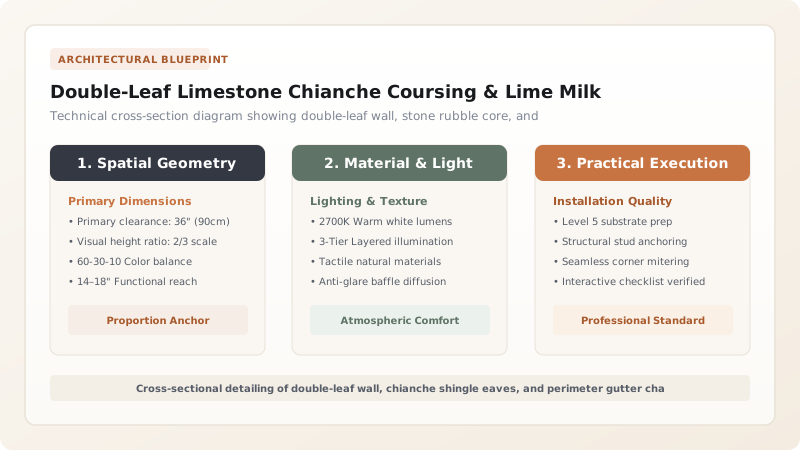
Anatomy of the Apulian Double-Leaf Wall
A trullo’s monumental thermal stability begins with its thick double-leaf dry-stone perimeter wall (muro a sacco). The exterior leaf is built with rough, unworked limestone boulders featuring a noticeable inward slope (batter) of 1:10, providing gravitational resistance against outward cone thrust.
The interior leaf is constructed with flatter, more regular stones to create smooth interior wall surfaces. Between the two leaves lies an expansive cavity packed with small broken stone spalls, limestone gravel (pietrisco), and sandy red Mediterranean terra rossa earth. This composite assembly forms a breathable thermal cushion up to 2.5 meters thick.
Chianche and Chiancole Shingle Coursing
The exterior envelope of the conical roof is clad in thin slabs of layered limestone known locally as chianche (or smaller pieces called chiancole). Extracted from natural geological stratifications in local quarries, these slabs measure only 3 to 5 cm in thickness but possess high flexural density.
Artisans lay the chianche in overlapping concentric courses starting from the eaves and working up toward the pinnacle. Each stone is laid with an outward downward pitch of 10 to 15 degrees. When torrential rains strike, water cascades from shingle to shingle like scales on a fish, never reaching the dry corbelled vault beneath.
Rainwater Harvesting and Cornice Gutters
Puglia has no major rivers; throughout history, survival depended entirely on capturing every drop of rainfall. The base of the trullo roof incorporates an integrated stone rainwater collection system.
Master masons carve projecting stone eaves known as gronde that form a continuous circumferential channel around the base of the cone. Rainwater draining off the chianche is collected in this stone gutter and channeled through internal gravity pipes directly into an underground rock-cut cistern excavated beneath the house floor.
The Protective Science of Latte di Calce
The radiant, gleaming white appearance of trulli is achieved through latte di calce (lime milk)—a traditional wash made by slaking calcium-rich quicklime (calce viva) in water. Applied annually in spring before Easter, this wash performs vital biological, chemical, and physical functions.
High chemical alkalinity (pH 12–13) sanitizes the porous stone, killing bacteria, mold, and insect pests. Optically, the pure white calcite crystals reflect up to 90% of solar radiation (high albedo effect), preventing the massive stone walls from absorbing scorching summer heat.
Wall Finishes: Traditional Lime Milk (Latte di Calce) vs Modern Acrylic Masonry Paint
Use this reference table to calculate exact physical dimensions, ratios, and specifications before purchasing:
| Performance Property | Traditional Apulian Lime Milk Wash | Modern Acrylic/Latex Exterior Paint |
|---|---|---|
| Vapour Permeability | 100% breathable (Class I vapour-open mineral crystal) | Low permeability; forms plastic film that traps moisture |
| Thermal Albedo | Ultra-high solar reflectance; keeps stone walls cold | Moderate reflectance; synthetic resins absorb infrared heat |
| Antimicrobial Action | Naturally antiseptic (pH 12+ inhibits mold and lichen) | Relies on synthetic chemical biocides that leach out over time |
| Aging Characteristics | Petrifies into calcite limestone; wears into soft patina | Blisters, bubbles, and peels away in large unsightly sheets |
| Environmental Impact | 100% natural, biodegradable mineral slaked from limestone | Petroleum-derived polymers releasing microplastics and VOCs |
Practical Constraints
Every successful decoration project must account for physical and environmental constraints:
Labor required for annual spring whitewashing cycles.
Lime wash naturally chalks over 12 months, requiring annual renewal to maintain pure white brilliance. Mitigation: Add 5% natural linseed oil or skim milk (casein) to the final coat to improve rain-wash durability.
Quarry exhaustion of thin, split-grade chianche limestone beds.
Authentic thin chianche slabs are increasingly scarce, raising material costs during roof restoration. Mitigation: Salvage and dress sound chianche from collapsed rural trulli and agricultural dry-stone field walls.
Execution Blueprint & Craftsmanship Sequence
Execute this professional sequence to achieve flawless results without backtracking:
Foundation Trench Clearing
Clear topsoil down to clean Cretaceous limestone bedrock, cutting shallow keyed steps to anchor wall footing stones.
Outer Leaf Masonry Coursing
Lay large unmortared limestone blocks with a 1:10 inward batter, bedding stones with three-point physical contact.
Inner Leaf Matching Assembly
Stack the inner stone leaf parallel to the outer skin, establishing level beds for interior door and alcove lintels.
Pietrisco Rubble Cavity Infill
Fill the center gap with crushed limestone spalls and terra rossa, tamping firmly every 20 cm of vertical wall height.
Projecting Gronda Gutter Installation
Set hand-carved limestone gutter blocks around the wall perimeter to form the continuous rainwater harvesting cornice.
Chianche Shingle Overlap Lapping
Course thin grey chianche slabs up the cone with a 15-degree outward tilt, overlapping lower courses by at least 8 cm.
Calce Viva Slaking and Maturation
Slake pure calcium oxide nodules in water, straining through wire mesh and allowing the lime milk to rest for 48 hours.
Lime Milk Application and Buffing
Apply three thin, saturated coats of lime milk to the vertical walls using wide horsehair brushes, buffing to a luminous white matte finish.
Common Mistakes & Countermeasures
Avoid these costly errors that compromise aesthetics, ergonomics, and budget:
Applying modern acrylic elastomeric paint over historic trullo walls.
Whitewashing the grey chianche roof shingles.
Project Execution Checklist
Track your physical progress. Checkboxes persist automatically on this device:
Frequently Asked Questions
How do trullo owners get fresh drinking water in dry Puglia?
Every trullo was engineered as a giant rainwater collector. Rain striking the clean limestone roof shingles cascades into perimeter gutters, passes through a charcoal sand filter, and fills a cold subterranean stone cistern beneath the kitchen floor.
Why does lime whitewash make trulli so much cooler inside?
Pure slaked lime forms micro-crystalline calcite that reflects up to 90% of visible sunlight and infrared heat. Combined with the two-meter-thick stone walls, this prevents exterior daytime heat from penetrating into the dwelling.
Are chianche roof shingles mortared onto the cone?
No. Authentic chianche shingles are laid completely dry without mortar. Their weight, downward outward pitch, and precise overlap keep them secure even during torrential winter thunderstorms.
What is the difference between chianche and chiancole?
Both are flat limestone slabs from the same geological beds. 'Chianche' refers to larger, thicker slabs used for floor paving and roof eave bases, while 'chiancole' refers to thinner, smaller shingles used on the steep upper cone.


