Formulating the dark undercoat (intonaco scuro) for authentic sgraffito requires blending aged slaked lime putty (grassello di calce) with volcanic pozzolana, sharp quartz aggregate, and 6% to 10% natural vine carbon black pigment (nero di vite). This creates a hydraulic, intensely black, warp-resistant matrix that provides permanent visual contrast beneath a razor-thin (1.2 mm) white Carrara marble dust intonachino skim coat.
At a Glance: Key Takeaways
- Undercoat Binder: Aged Pit-Slaked Lime Putty (Grassello di Calce, CL-90-S)
- Hydraulic Modifier: Finely milled volcanic Pozzolana (increases water resistance)
- Black Pigment: Nero di Vite (German Vine Carbon Black, C.I. Pigment Black 8)
- White Skim (Intonachino): Aged Lime Putty + Micronized Carrara White Marble Dust (0–0.2 mm)
- Layer Ratio: 15 mm Arriccio + 6 mm Black Intonaco + 1.2 mm White Skim
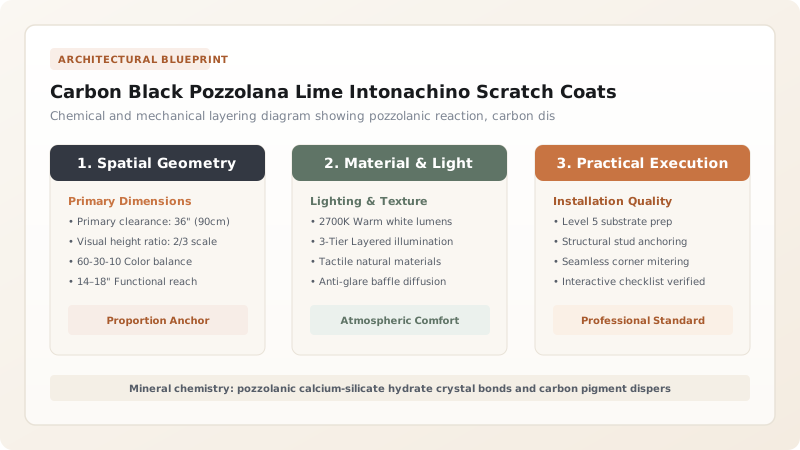
The Chemistry of the Sienese Black Intonaco
The enduring brilliance of Tuscan Renaissance sgraffito rests upon the mineral durability of its dark undercoat (intonaco scuro). If the undercoat were simply painted black, the surface paint would weather away in decades. In genuine sgraffito, the dark color is integrated throughout the entire 6-mm body of the plaster.
Sienese builders formulated this layer using a ternary binder system: non-hydraulic slaked lime putty (grassello), washed quartz river sand, and volcanic pozzolana. The amorphous reactive silicas in pozzolana react with free calcium hydroxide to form insoluble calcium silicate hydrates (C-S-H), creating an exterior mortar capable of withstanding rain and freezing winter cycles without losing its intense charcoal hue.
The Pigment Standard: Nero di Vite vs Industrial Lampblack
Selecting the black pigment requires strict chemical discipline. Modern petroleum-derived lampblacks are greasy, hydrophobic, and repel water, causing plaster to clump and weaken. Sienese masters relied on Nero di Vite (vine black), produced by calcining grapevine twigs in sealed crucibles.
Vine black is an amorphous carbon containing microscopic potassium salts and residual porous cell structures. When soaked in water prior to mixing, it disperses effortlessly throughout the wet lime matrix. Added at 6% to 10% by volume, it imparts an unyielding, velvety, non-reflective blue-black tone that creates the perfect optical shadow floor beneath the white carving layer.
The White Intonachino: Carrara Marble Dust and Suction Dynamics
Directly over the firm, wet black intonaco sits the top white skim: the Intonachino Bianco. Formulated from 1 part aged lime putty and 1 part micronized Carrara marble dust (graded 0.05 mm to 0.20 mm), this layer contains zero sand or coarse grit.
The marble dust provides crystalline calcite platelets that pack together under steel trowel pressure, yielding a glass-smooth porcelain face. Crucially, the white skim must be applied at precisely the right moment of underlying suction: if the black layer is too wet, the white skim will absorb black pigment and turn muddy grey; if the black layer is too dry, the white skim will de-bond and flake off under the carving tool. The plasterer applies the white coat when the black undercoat is leather-hard—dry to the palm but cold and plastic under thumb pressure.
Hydraulic Bonding and Anti-Checking Control
Because pure lime plaster shrinks as water evaporates, applying multiple wet coats can trigger spiderweb shrinkage crazing (cavillature). Sienese plasterers controlled this through strict aggregate grading and pozzolanic hydration.
The base arriccio uses coarse sand (0.5–2.0 mm); the black intonaco uses medium sand (0.2–0.8 mm); the white skim uses microscopic marble flour (<0.2 mm). This progressive reduction in aggregate grain size creates a tiered capillary gradient that draws water smoothly outward to evaporate, eliminating tensile surface stresses and ensuring that hairline cracks never form across the finished sgraffito relief.
Plaster Layer Formulations for Exterior Renaissance Sgraffito
Use this reference table to calculate exact physical dimensions, ratios, and specifications before purchasing:
| Stratum Layer | Thickness | Binder / Aggregate Ratio | Pigment Addition | Surface Texture & Role |
|---|---|---|---|---|
| 1. Arriccio (Scratch) | 12 mm to 15 mm | 1 part Grassello : 2.5 parts Coarse River Sand | Zero pigment (Natural buff) | Rough scratched key; absorbs wall moisture |
| 2. Intonaco Scuro (Black) | 5 mm to 6 mm | 1 part Grassello : 0.5 Pozzolana : 2 Medium Sand | 8% Nero di Vite (Vine Black) | Dense hydraulic dark body; carved shadow floor |
| 3. Intonachino Bianco | 1.0 mm to 1.5 mm | 1 part Aged Grassello : 1 part Carrara Marble Dust | Zero pigment (Pure white calcite) | Porcelain-smooth carving face; 100% white reflection |
| Defective Modern Blend | 3 mm to 5 mm | Portland cement + white sand + chemical acrylic | Synthetic carbon black slurry | Brittle, tears under stylus, delaminates within 5 yrs |
Practical Constraints
Every successful decoration project must account for physical and environmental constraints:
Pozzolanic Reaction Accelerating Setting Time
Pozzolana induces hydraulic set, shortening the carving window from 12 hours to 6–8 hours in warm weather Mitigation: Calibrate pozzolana content to 15% of binder volume in summer, keeping work bays under continuous damp canvas shades
Fine Marble Dust Trowel Blistering
Over-troweling the fine white skim can trap microscopic air bubbles beneath the surface Mitigation: Burnish with light, confident strokes using a polished Japanese stainless steel finishing trowel held at 10°
Execution Blueprint & Craftsmanship Sequence
Execute this professional sequence to achieve flawless results without backtracking:
Substrate Salt Testing and Pre-Hydration
Test historic masonry for efflorescent salts. Soak brickwork with potable water for 24 hours until capillary suction is fully tempered.
Arriccio Base Plastering and Keying
Trowel 15 mm of 1:2.5 lime and coarse sand. Scratch horizontal wave keys with a plaster comb. Allow to carbonate for 14 days.
Vine Black Pigment Slurrying
Soak dry Nero di Vite pigment powder in hot distilled water with 1% alcohol for 12 hours, stirring into a lump-free, saturated black paste.
Black Intonaco Mixing and Troweling
Blend lime putty, pozzolana, medium sand, and black pigment slurry in a mortar box. Trowel a uniform 6-mm coat over pre-wetted arriccio.
Leather-Hard Suction Verification
Monitor black intonaco until water sheen vanishes and thumb pressure leaves an impression of no more than 1 mm without sticking.
White Marble Intonachino Skim Laying
Trowel a razor-thin 1.2-mm coat of pure lime putty and fine Carrara marble dust over the black base, burnishing with a flexible stainless float.
Immediate Transfer and Incision Initiation
Immediately transfer spolvero cartoons and commence stylus incision carving while the multi-layer sandwich remains in full fresco plasticity.
Common Mistakes & Countermeasures
Avoid these costly errors that compromise aesthetics, ergonomics, and budget:
Adding dry pigment powder directly into the dry mortar mix
Applying the white marble skim onto a completely dried black intonaco
Using gray sand in the white intonachino skim coat
Project Execution Checklist
Track your physical progress. Checkboxes persist automatically on this device:
Frequently Asked Questions
Why is pozzolana added to exterior lime plaster?
Pure slaked lime (air lime) hardens only by reacting with atmospheric carbon dioxide, which takes months in deep plaster. Volcanic pozzolana contains reactive silica and alumina that react with lime chemically in the presence of water, imparting hydraulic strength, rapid water resistance, and frost immunity to exterior facades.
Can black iron oxide pigment be used instead of vine black?
Synthetic black iron oxide (Fe3O4) is chemically stable and lightfast, but it produces a heavier, warmer, slightly brownish-black tone. Traditional Renaissance masters preferred Nero di Vite because its pure amorphous carbon yields a cool, luminous blue-black shade with superior visual contrast against white marble.
What happens if sgraffito plaster freezes during curing?
Freezing water inside uncarbonated plaster expands by 9%, shattering the delicate calcium silicate crystal bridges and causing the entire sgraffito facade to turn to loose powder when thawed. Exterior sgraffito must never be executed if temperatures threaten to drop below 5°C within 30 days.
How thin should the white intonachino coat be?
Strictly 1.0 mm to 1.5 mm. If thinner than 1.0 mm, the dark undercoat can show through as a shadowy haze. If thicker than 2.0 mm, the carving stylus must displace excessive plaster, resulting in jagged, chipped edges rather than razor-sharp incisions.