Sgraffito (derived from the Italian sgraffiare, 'to scratch') and Grisaille facade decoration is a celebrated decorative plaster technique perfected in Renaissance Siena, Florence, and Rome during the 15th and 16th centuries. A dark undercoat plaster pigmented with vine black, carbon black, and volcanic pozzolana is overlaid with a fine, razor-thin white lime intonachino coat. While the white layer remains fresh and wet, cartoon designs are transferred via charcoal pouncing (spolvero) and carved away with steel styluses and gouges, revealing the dark plaster beneath in dramatic chiaroscuro relief.
At a Glance: Key Takeaways
- Origins & Era: Siena & Tuscany, Italy (Early Renaissance to Cinquecento, 1450–1580)
- Base Scratch Layer: Hydraulic Lime, Pozzolana, Coarse Sand & Vine Carbon Black
- Top Intonachino: Aged Pit-Slaked Lime Putty (Grassello) & Fine White Marble Dust
- Design Transfer: Spolvero (Pricked paper cartoons pounced with charcoal dust)
- Carving Window: Strict Giornata window (8 to 12 hours while plaster is fresco-soft)
In-Depth Guides in this Directory
Explore specialized subtopic blueprints, technical dimensions, and execution checklists:
Carbon Black Pozzolana Lime Intonachino Scratch Coats
Technical formulation guide for sgraffito dark intonaco: vine carbon black, volcanic pozzolana, aged grassello lime putty, and marble dust intonachino skims.
Spolvero Charcoal Pricking & Iron Stylus Incision Relief
Technical guide to Renaissance cartoon pricking (spolvero), pounce bag transfer, iron stylus carving angles, and background clearing in sgraffito facades.
Grisaille Tonal Shadowing & Calcified Silicate Wash Preservation
Technical guide to monochrome grisaille fresco shadowing on sgraffito facades, limewater glazing, and potassium silicate conservation treatments.
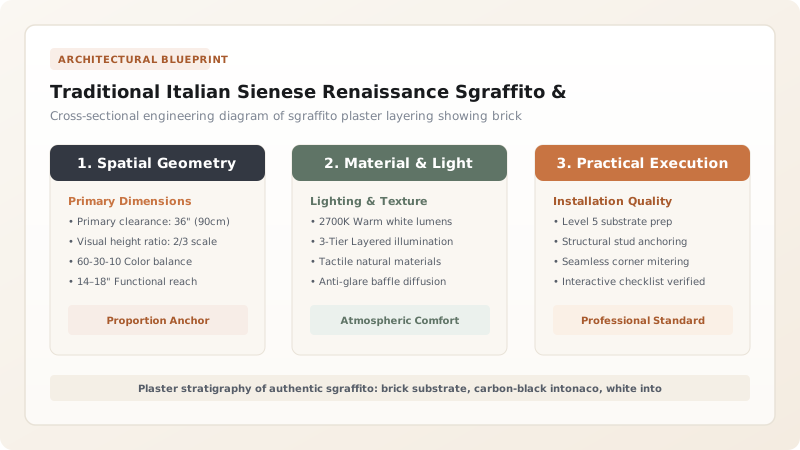
The Chiaroscuro Facades of the Tuscan Renaissance
Walking through the steep medieval lanes of Siena—along the Via di Città or surrounding the Piazza del Campo—one encounters noble palazzi whose exterior walls are not clad in costly cut stone, but wrapped in breathtaking tapestries of etched monochrome plaster. Known as Sgraffito (from the Italian sgraffiare, 'to scratch') and often enriched with monochrome Grisaille fresco washes, this technique transformed urban facades into monumental civic canvases.
Pioneered by Renaissance masters such as Baldassarre Peruzzi, Polidoro da Caravaggio, and Andrea Feltrini, sgraffito offered an ingenious alternative to expensive stone relief carving. By applying contrasting coats of pigmented lime plaster and incising linear patterns through the wet surface, artists achieved monumental depth, simulating classical Roman rustication, acanthus arabesques, coats of arms, and mythological friezes that endure for centuries.
The Stratigraphy of Sgraffito: Two-Tone Plaster Chemistry
Authentic Renaissance sgraffito is a multi-layered mineral system built directly over solid brick or stone masonry:
- The Arriccio (Base Leveling Coat): A 15-mm coarse scratch coat composed of 1 part pit-slaked lime putty (grassello di calce) and 2.5 parts sharp river sand, keyed with wavy trowel ridges.
- The Dark Intonaco (Black Base): A 6-mm layer of lime and pozzolana mortar heavily tinted with natural pigment: burned vine charcoal (nero di vite), chimney lampblack, or crushed roasted bone black. This dark stratum provides the permanent shadow layer.
- The White Intonachino (Skim Coat): A razor-thin (1.0 mm to 1.5 mm) veil of pure white lime putty mixed with crushed Carrara marble dust (polvere di marmo). Formulated with zero cement, this skin dries to a luminous, porcelain-like white.
The Spolvero Transfer and the Giornata Carving Window
Sgraffito is an unforgiving, high-stakes craft executed strictly a fresco (into wet, uncarbonated plaster). The artist cannot stop and resume the next day; the work must be completed within a single giornata (a day's plastering section, typically 8 to 12 hours) before the lime cures.
To transfer intricate Renaissance cartoons rapidly, the artist uses the spolvero technique. The full-scale design is drawn on heavy paper, and every line is pricked with a fine needle to form thousands of microscopic perforations. The paper is pressed against the freshly laid white intonachino, and a fabric bag filled with pulverized charcoal dust (bambagia) is tapped along the lines. When the cartoon is removed, a crisp dotted charcoal outline remains on the damp plaster, guiding the carver's hand.
Stylus Carving Dynamics and Grisaille Tonal Modeling
Using hardened forged steel styluses, scraping loops, and miniature spatulas, the artisan cuts along the dotted charcoal lines. Holding the stylus at a 60° angle, the tool slices through the white intonachino, shaving it away in continuous curls to expose the rich charcoal-black plaster beneath.
In broad background fields, flat scrapers hollow out the white coat down to the dark floor. For figurative medallions and narrative friezes, the work is enhanced with Grisaille: while the plaster is still wet, the artist paints translucent washes of carbon black diluted in limewater across the white surfaces, creating three-dimensional tonal shading, muscular chiaroscuro, and architectural shadows that simulate sculptural stone high relief.
Facade Plaster Techniques: Tuscan Sgraffito vs Grisaille Fresco vs Modern Stucco
Use this reference table to calculate exact physical dimensions, ratios, and specifications before purchasing:
| Plaster Technique | Layering Stratigraphy | Execution Window | Visual Contrast / Depth | Historical Lifespan |
|---|---|---|---|---|
| Renaissance Sgraffito | Dark carbon intonaco + white marble intonachino | Strict Giornata (8–12 hrs while damp) | High 3D incision relief (1.5 mm depth) | 400 to 500+ years in exterior weather |
| Monochrome Grisaille | Single white intonaco with painted black fresco wash | Buon Fresco window (12–16 hrs) | Subtle tonal chiaroscuro gradation | 300+ years; sensitive to heavy acid rain |
| Scagliola Facade Inlay | Carved plaster mortises filled with colored selenite | Multi-stage studio inlay and polishing | Glass-smooth faux marble appearance | Interior only; dissolves in exterior rain |
| Modern Acrylic Synthetic Stucco | Single coat painted with synthetic latex paint | Unlimited; applied dry over foam/mesh | Flat, lifeless; lacks genuine incision depth | 10 to 15 years; peels, blisters, fades |
Practical Constraints
Every successful decoration project must account for physical and environmental constraints:
Tight Time Constraint of the Plaster Setting Window
The artisan must complete complex hand-carving before the wet plaster carbonates into stone Mitigation: Erect canvas sunshades to prevent rapid solar drying and mist surrounding wall sections with atomized water
Modern Urban Acid Rain and Air Pollution Decay
Sulfur dioxide in city air converts calcite into gypsum (CaSO4), eroding fine incision edges Mitigation: Apply breathable potassium silicate micro-coatings or ethyl silicate consolidants to protect restored historic facades
Execution Blueprint & Craftsmanship Sequence
Execute this professional sequence to achieve flawless results without backtracking:
Masonry Substrate Pre-Wetting and Arriccio Laying
Saturate historic brick wall with clean water for 24 hours. Trowel on a 15-mm leveling coat of lime putty and coarse sharp sand (arriccio), scratching diamond keys.
Dark Carbon Intonaco Formulation
Mix 1 part mature slaked lime putty, 2 parts river sand, 0.5 part pozzolana, and 8% natural vine black pigment by volume. Trowel 6 mm thick over cured arriccio.
White Marble Intonachino Skim Application
While black intonaco is firm but damp, trowel a 1.2-mm veil of pure lime putty and fine Carrara marble dust, floating to a silky smooth plane.
Spolvero Paper Cartoon Pricking
Draw full-scale Renaissance acanthus or architectural grotesques on heavy parchment. Prick all layout lines with steel needles at 2-mm spacing.
Charcoal Pouncing Transfer
Align cartoon over damp white plaster. Pounce perforated lines with a charcoal dust pounce bag, leaving clear dotted outlines upon paper removal.
Incised Sgraffito Stylus Carving
Carve along dotted contours with sharp iron styluses, slicing through the 1.2 mm white skim at a 60° bevel to expose the dark undercoat.
Grisaille Tonal Shading (Optional)
Paint translucent washes of vine black in limewater over white field areas to create deep volumetric shadows and three-dimensional shading.
Atmospheric Carbonation Curing
Shield fresh sgraffito from direct sun and driving wind with damp burlap curtains for 7 days, allowing lime to slowly carbonate into pure calcite.
Common Mistakes & Countermeasures
Avoid these costly errors that compromise aesthetics, ergonomics, and budget:
Adding Portland cement or chemical retarders to the sgraffito plaster
Applying the white intonachino skim too thick (> 3 mm)
Carving after the plaster has passed its fresco plasticity window
Project Execution Checklist
Track your physical progress. Checkboxes persist automatically on this device:
Frequently Asked Questions
How did Renaissance artists keep the dark plaster black without fading in sunlight?
By using elemental carbon black (vine black or lampblack) instead of synthetic dyes or organic inks. Carbon is chemically inert and completely lightfast; ultraviolet sunlight has zero effect on pure carbon atoms embedded within a calcified lime matrix.
Can sgraffito be executed on interior walls?
Yes. Sgraffito was widely used inside Renaissance courtyards, loggias, grand entrance vestibules, and fireplace hoods. In interior settings, colored pigments like red iron oxide, yellow ochre, and cobalt smalt were sometimes used in place of black.
What is the difference between sgraffito and relief carving?
Relief carving subtracts mass from a solid block of stone using chisels. Sgraffito is a chromatic incision craft: it carves through a paper-thin surface skin of wet plaster to expose an underlying contrasting color, creating the optical illusion of monumental 3D relief with minimal physical depth.
How is historic sgraffito conserved and cleaned?
Conservators clean sgraffito using ammonium carbonate poultices or low-pressure micro-abrasive mineral powder dusting, followed by consolidation with barium hydroxide or ethyl silicate to re-bind calcified plaster without altering color.