
Scollops are the wooden staples that hold Irish thatched roofs together. Sourced from 1-to-2-year-old coppiced hazel (Corylus avellana) or willow (Salix), each rod is split down its pith, twisted 180° in the center to create a flexible hinge, and bent into a sharp hairpin staple (gad). Driven over horizontal ledgers, they clamp thatch securely into the turf under-roof without iron nails.
At a Glance: Key Takeaways
- Coppice Hazel Harvesting: Straight, knot-free 1-year shoots harvested during winter when wood fibers are tough and pliable.
- Pith Splitting: Cleaving rods cleanly down the center using a specialized thatching knife (scollop knife).
- The 180° Fiber Twist: Twisting the central hinge zone to separate longitudinal grain fibers into an unbreakable flexible rope.
- Beveled Point Shaving: Cutting sharp 45° entry chisels on the staple ends to penetrate dense thatch and turf scraw.
- Herringbone Cross-Scolloping: Decorative diagonal diamond lattice pinning stabilizing the exposed ridge crest.
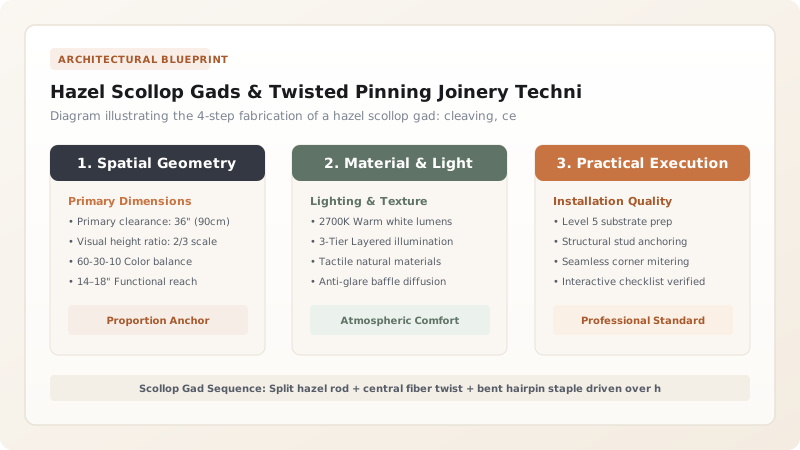
1. Coppicing Silviculture: Sourcing the Perfect Scollop
The entire structural integrity of an Irish thatched roof depends on the coppice woodland. The ideal scollop material is one-to-two-year-old hazel (Corylus avellana) or sally willow (Salix alba / Salix viminalis).
Coppiced stools produce long, straight, unbranched shoots (whips) measuring 12mm to 18mm in diameter and 1.2 to 1.8 meters long. Harvesting must occur in mid-winter (November to February) when sap is down. Winter-cut rods retain optimal cellular moisture and toughness; rods cut in summer are brittle, sap-filled, and snap during twisting.
2. The Physics of the 180-Degree Fiber Twist
Bending a solid 15mm hazel rod in half like a staple would instantly snap the outer wood fibers in flexural tension. The thatcher avoids this through a masterly mechanical manipulation known as the twist:
- The thatcher splits the seasoned hazel rod down the center pith using a curved knife, yielding two half-round rods (ledgers or gads).
- Holding the split rod firmly with both hands spaced 50mm apart at the center, the thatcher applies intense torsional shear, twisting the wood 180 degrees around its longitudinal axis.
- This shear stress separates the tight crystalline cellulose bundles into thousands of individual, flexible micro-fibers, converting rigid solid wood into a fibrous 'wood rope' without severing the tensile outer bark.
- The rod is then bent sharply in half into a hairpin U-shape (gad). The twisted fibers act as an indestructible living hinge that never breaks.
3. Driving Dynamics & The Cross-Herringbone Ridge
To secure a course of thatch, a long horizontal rod (the róidín or ledger) is laid across the dressed straw. The thatcher straddles the ledger with the legs of the hairpin gad, pushing it firmly into the thatch.
Using a heavy wooden mallet, the thatcher drives the gad into the thatch at an angle of 45 degrees to the roof pitch, forcing the sharp points deep through the thatch and into the dense, fibrous root network of the underlying turf scraw. The barbed, twisted center of the gad snaps down tight over the ledger, exerting continuous spring clamping pressure.
Along the exposed ridge crest, thatchers weave these scollops into complex geometric patterns: herringbone, diamond chevron, and cross-lattices. This decorative lattice provides critical wind-shear reinforcement along the roof apex where negative Bernoulli updraft suction forces are greatest.
Coppice Timber Species for Thatched Roof Joinery
Use this reference table to calculate exact physical dimensions, ratios, and specifications before purchasing:
| Wood Species | Coppice Rotation Cycle | Twisting Pliability | Rot Durability in Thatch |
|---|---|---|---|
| Hazel (Corylus avellana) | 2 years (15–18mm diameter) | High (resilient spring-back tension) | 10 to 15 years (standard choice) |
| Sally / Osier Willow (Salix viminalis) | 1 year (12–15mm diameter) | Exceptional (very pliable; zero snapping) | 8 to 12 years (softer than hazel) |
| Ash (Fraxinus excelsior) | 2 years (young shoots) | Moderate (requires hot water soaking) | 12 to 18 years (very tough) |
| Bramble / Briar (Rubus fruticosus) | Wild harvesting | Extreme (used for emergency repairs) | 3 to 5 years (temporary only) |
Material & Forestry Constraints
Every successful decoration project must account for physical and environmental constraints:
Coppice Supply
A single cottage re-thatch requires 2,000 to 3,500 scollops; thatchers maintain rotational coppice woodlands dedicated to thatching.
Hand Blistering
Twisting thousands of hazel rods requires heavy leather palm guards to prevent severe torsional skin blisters.
Protocol for Crafting and Driving Hazel Scollop Gads
Execute this professional sequence to achieve flawless results without backtracking:
Coppice Rod Grading
Select straight, knot-free 2-year hazel rods; trim side shoots flush with a billhook.
Center Pith Cleaving
Start a split at the butt end with a draw-knife; guide the split cleanly down the center to produce two half-round rods.
Point Sharpening
Chisel a 45° beveled entry point onto both ends of each 600mm half-round rod.
Center Torsional Twisting
Grasp rod at midpoint; twist 180° to delaminate grain fibers into an elastic wooden hinge.
Hairpin Bending
Bend the rod into a 70mm wide hairpin staple (gad), ensuring bark faces outward.
Driving over Horizontal Ledgers
Position gad over horizontal ledger; drive into thatch and scraw at 45° angle with wooden mallet until head seats flush.
Common Mistakes & Countermeasures
Avoid these costly errors that compromise aesthetics, ergonomics, and budget:
Using dried, brittle hazel rods without pre-soaking
Driving scollops perpendicular (90 degrees) to the roof pitch
Project Execution Checklist
Track your physical progress. Checkboxes persist automatically on this device:
Frequently Asked Questions
How many scollop gads are needed to thatch an Irish cottage?
A standard three-room Irish cottage (approx. 100 square meters of roof area) requires approximately 2,500 to 4,000 hazel scollops, depending on whether it is fully reed-thatched or directional wheat straw.
Can modern steel wire staples replace hazel scollops?
Steel staples rust rapidly in Atlantic salt air, staining the thatch black and failing within 8 years. Natural hazel scollops flex with the roof, do not rust, and decompose naturally when the thatch is stripped for re-roofing decades later.


