Lime hydraulic mortar hearth surround and tight-joint setting is the specialized architectural masonry discipline required to install Connemara marble around active fireplaces. Subjected to intense radiant heat cycles from peat (turf) and hardwood fires, 30 mm marble hearth slabs require a flexible bedding system. Setting is executed with non-staining white natural hydraulic lime (NHL 2) mortar, completely avoiding grey Portland cement that causes moisture staining and green stone curling. Hearth perimeters incorporate 6 mm ceramic fiber expansion joints, while vertical surrounds are secured with concealed grade 316 stainless steel tie anchors.
At a Glance: Key Takeaways
- Hearth Slab Thickness: 30 mm solid Connemara marble with epoxy-fiberglass mesh backing
- Mortar Specification: Non-staining white natural hydraulic lime (NHL 2) and washed silica sand (1:2)
- Expansion Joint Detailing: 6 mm perimeter expansion gap packed with ceramic fiber rope and silicone-free mastic
- Mechanical Fasteners: Concealed grade 316 stainless steel wire ties anchored into chimney masonry
- Joint Tolerance: Tight 1.5–2.0 mm joints grouted with breathable hydraulic lime grout
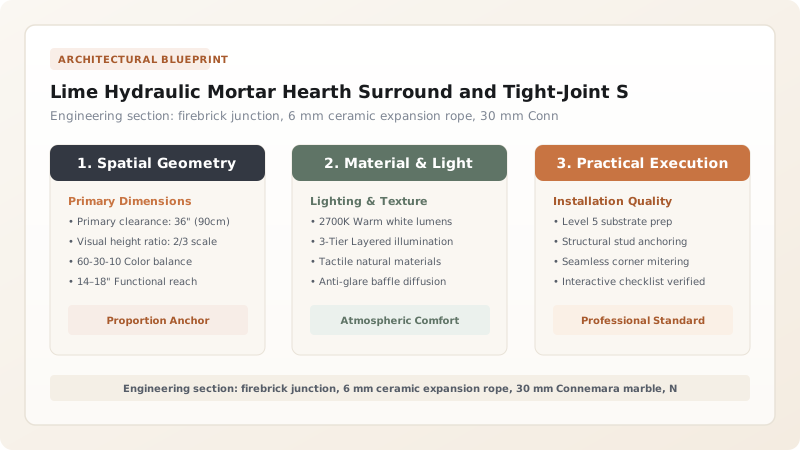
Thermal Dynamics and Fireplace Radiant Heat Cycling
The installation of natural stone in a fireplace hearth represents one of the most demanding challenges in architectural masonry. An open domestic hearth is a site of severe thermodynamic cycles. In traditional Irish homes, where open hearth fires fueled by dense, slow-burning sods of highland peat (turf) or seasoned hardwood were maintained continuously throughout the damp winter months, the radiant temperature at the firebox threshold routinely reaches between 150°C and 250°C. Meanwhile, the outer perimeter of the hearth slab, situated just 60 centimeters away on the living room floor, remains at ambient room temperature (18°C to 22°C).
This extreme thermal gradient generates profound internal stresses within the stone. Connemara marble—composed of anisotropic serpentine minerals, calcite crystals, and chlorite veins—possesses differing coefficients of linear thermal expansion along its various mineral axes (calcite expands nearly five times faster along its optical c-axis than perpendicular to it). As heat radiates into the stone, the interior portion expands rapidly while the cool outer perimeter resists movement. If the slab is rigidly confined within a masonry floor recess or locked against the chimney breast without expansion allowances, the resulting compressive stress exceeds the stone’s tensile shear strength, inevitably triggering diagonal shear fractures along natural serpentine slip planes. Mitigating these thermal forces requires an integrated system of resilient expansion joints and flexible bedding mortars.
Natural Hydraulic Lime (NHL) vs Non-Staining Polymer Mortars
The chemical composition of the bedding mortar is the single most critical factor in preventing the premature failure and aesthetic ruin of Connemara marble. A common and catastrophic error in modern construction is the use of standard grey Portland cement mortar or grey polymer thin-set. Standard Portland cement contains high concentrations of water-soluble alkalis (sodium and potassium hydroxides) and uncalcined iron compounds. When a porous metamorphic stone like Connemara marble is bedded in wet grey cement, the alkaline water is drawn into the stone's micro-capillary network. As the moisture evaporates from the exposed face, the dark alkalis and iron oxidize, producing permanent dark grey water stains and brown rust discolorations that permanently ruin the emerald green stone.
Furthermore, rapid water absorption from grey cement into the underside of serpentinite marble causes a notorious phenomenon known as "green stone curling," where differential moisture expansion causes the edges of the slab to curl upward, breaking mortar bonds. Professional installation mandates the exclusive use of non-staining natural hydraulic lime mortar (NHL 2) formulated with white lime and pure washed silica sand (1:2 ratio), or specialized white, rapid-curing polymer-modified mortars formulated with calcium aluminate cements. Natural hydraulic lime (NHL 2) offers a low modulus of elasticity, providing a soft, forgiving bed that yields slightly under thermal expansion cycles. It contains zero staining pigments, breathes freely to release moisture vapor, and achieves an unbreakable mechanical and chemical bond with the calc-silicate marble matrix.
Mechanical Tie-In Anchors and Chimney Breast Fastening
While horizontal hearth slabs rely primarily on gravity and full-coverage mortar bedding, vertical fireplace surrounds—including the marble side jambs (pilasters), inner slip panels, and horizontal mantel lintel—must be mechanically tied to the structural chimney masonry. Relying solely on mortar or adhesive paste to hold heavy vertical marble panels against a hot chimney breast is dangerous; over decades of radiant heating and cooling, thermal expansion differentials will inevitably fatigue the adhesive bond, posing a catastrophic falling-stone hazard.
Authentic stone masonry specifies concealed mechanical tie anchors. Prior to installation, stonemasons drill angled 8 mm holes into the top and rear edges of the 20 mm or 30 mm marble jambs, spaced at approximately 400 mm vertical centers. Pre-bent wire ties fabricated from grade 316 (marine-grade) stainless steel or heavy brass are inserted into these holes and secured with high-temperature epoxy resin. Matching pockets are cut into the underlying brick or rubble stone chimney breast. During setting, the stainless steel ties are embedded into these masonry pockets using non-shrink hydraulic lime-pozzolana grout. These ties provide complete structural restraint against forward tipping while retaining sufficient lateral ductility to accommodate subtle building settling and thermal expansion without inducing stress concentrations in the marble.
Tight-Joint Tolerances and Expansion Gap Detailing
The visual hallmark of a classical Irish marble fireplace is the precision of its jointing. In historic country houses, wide, ungainly grout lines were considered an amateurish defect; master masons executed tight, razor-fine joints measuring strictly between 1.5 and 2.0 millimeters in width. Achieving these surgical tolerances requires that all mating stone edges be diamond-sawn square, dressed with fine diamond honing blocks, and dry-fitted on site before any mortar is mixed.
Crucially, this tight-joint aesthetic must be paired with invisible expansion engineering. While the internal joints between marble jambs and lintels are set tight, a continuous 6 mm expansion gap must be provided around the entire outer perimeter of the hearth footprint—where the marble meets timber floorboards, adjacent tiles, or baseboards—as well as at the interface between the marble hearth and the firebox firebrick. This expansion perimeter is packed with high-temperature ceramic fiber rope (rated to 1200°C) and sealed flush with a neutral-cure, non-staining silicone-free stone mastic color-matched to the adjacent floor. The tight interior stone joints are then packed with a breathable lime grout formulated from white hydraulic lime (NHL 2) and ultra-fine Connemara marble dust (0.1 mm), carefully tooled flush with a damp boxwood jointer. This creates an imperceptible, stone-on-stone appearance that withstands centuries of roaring peat fires without cracking or spalling.
Hearth Components, Mortar Formulations & Thermal Tolerances for Connemara Marble
Use this reference table to calculate exact physical dimensions, ratios, and specifications before purchasing:
| Hearth Component | Stone Thickness | Mortar Formulation | Mechanical Anchor Spec | Operating Temp Range |
|---|---|---|---|---|
| Front Hearth Slab (Floor) | 30 mm solid slab | NHL 2 White Lime : Sand (1:2) | Bedded on screed + perimeter expansion | 20°C to 80°C (ambient/radiant) |
| Inner Hearth / Firebox Lip | 30 mm solid slab | NHL 3.5 Refractory Lime Mortar | Stainless steel angle clips | 80°C to 200°C (direct radiant heat) |
| Vertical Jamb Columns | 20–30 mm profiled | White polymer stone thin-set | Ø 6 mm 316 SS wire ties @ 400 mm O.C. | 20°C to 100°C (convective heat) |
| Overmantel Lintel / Frieze | 30 mm reinforced slab | Concealed epoxy dowel pins | Ø 10 mm 316 SS threaded rods to lintel | 20°C to 90°C (rising heat) |
| Hearth Curb / Border | 40x60 mm solid curb | NHL 2 hydraulic lime bed | Interlocking brass dowels | 20°C to 60°C (foot traffic/spill) |
Practical Constraints
Every successful decoration project must account for physical and environmental constraints:
High radiant heat output from traditional Irish turf (peat) fires exceeding 250°C at hearth lip
Direct flame impingement causes thermal shock fracturing in calc-silicate serpentinite stone. Mitigation: Install a refractory cast-iron fireback and ensure minimum 200 mm clearance between fire and marble lip.
Uneven settling of historic stone chimney breasts and lime-rubble masonry walls
Differential masonry movement exerts bending loads on rigid marble surrounds, causing joint failure. Mitigation: Use flexible stainless steel wire ties that allow 2–3 mm of independent masonry settling movement.
Execution Blueprint & Craftsmanship Sequence
Execute this professional sequence to achieve flawless results without backtracking:
Subfloor Preparation & Moisture Inspection
Clean the masonry or concrete fireplace subfloor, ensuring complete removal of soot, dust, and old mortar. Verify dryness (<4% moisture) and level tolerances (<2 mm over 2 m).
Thermal Expansion Perimeter Detailing
Fix 6 mm thick ceramic fiber expansion strips around the outer perimeter of the hearth recess and against the firebrick opening to absorb lateral thermal expansion.
White Hydraulic Lime Mortar Mixing
Mix non-staining white natural hydraulic lime (NHL 2) with clean, washed silica sand in a 1:2 ratio with pure water, achieving a buttery, non-slump consistency.
Bedding & Back-Butter Application
Trowel a 15 mm notched bed of lime mortar across the subfloor. Thoroughly back-butter the entire reverse face of the 30 mm Connemara marble hearth slab to ensure 100% void-free contact.
Hearth Slab Placement & Leveling
Lower the marble slab into the mortar bed using heavy-duty vacuum suction cups. Settle the slab with gentle rubber mallet taps, checking level across both axes.
Vertical Jamb Anchor Drilling
Drill 8 mm holes at 45-degree angles into the rear edges of the vertical marble jambs. Insert pre-bent grade 316 stainless steel wire ties and lock with structural epoxy.
Chimney Breast Fastening & Grouting
Position the vertical jambs and lintel against the chimney breast, mortaring the stainless steel wire ties into pre-drilled masonry holes with non-shrink hydraulic lime grout.
Tight-Joint Pointing & Curing
Pack the tight 1.5–2.0 mm stone joints with white hydraulic lime grout blended with fine Connemara marble dust. Tool the joints flush and allow 14 days of curing before lighting fires.
Common Mistakes & Countermeasures
Avoid these costly errors that compromise aesthetics, ergonomics, and budget:
Setting Connemara marble hearths with rigid grey Portland cement mortar
Omitting perimeter thermal expansion gaps around the fireplace hearth slab
Using carbon steel or non-stainless anchors for vertical marble fireplace surrounds
Project Execution Checklist
Track your physical progress. Checkboxes persist automatically on this device:
Frequently Asked Questions
Why is grey Portland cement strictly forbidden for installing Connemara marble?
Connemara marble is a calc-silicate metamorphic rock containing porous calcite and serpentinite minerals. Grey Portland cement contains high concentrations of soluble alkalis, unhydrated iron oxides, and dark mineral pigments. When mixed with water, these soluble alkalis migrate through the stone via capillary action. As moisture evaporates from the polished face, the dark alkalis and iron oxidize, producing permanent, unsightly brown and grey water stains. Furthermore, the rapid chemical hydration of Portland cement creates moisture gradients that cause thin green marble slabs to warp and curl at the edges ("green marble curling").
How does an expansion joint protect a marble hearth from cracking?
All natural stones expand when heated. A 30 mm Connemara marble hearth slab directly exposed to fireplace heat will expand by several tenths of a millimeter across its width during a fire. If the slab is set tightly against immovable stone chimney walls or hardwood floors, this thermal expansion is blocked. The resulting compressive stress creates massive internal shear forces that inevitably cause the marble to buckle or fracture along natural serpentine bedding planes. A 6 mm perimeter expansion joint cushioned with compressible ceramic fiber rope allows the stone to expand and contract freely without stress buildup.
How do concealed stainless steel wire ties secure vertical marble fireplace surrounds?
Vertical marble fireplace surrounds (jambs and lintels) cannot rely on mortar adhesion alone to remain secured to the chimney breast, as thermal cycling will eventually break the mortar bond. Stonemasons drill angled holes into the concealed rear edges of the marble and insert grade 316 stainless steel wire ties (or brass dowels) locked with epoxy. The protruding ends of these flexible wire ties are embedded into mortar pockets cut into the structural brick or stone masonry of the chimney breast. This mechanical connection holds the heavy stone permanently in place while allowing subtle thermal movement.