Traditional Irish Connemara marble hearth and flooring represents one of the rarest, most prized decorative metamorphic stone traditions in the world. Formed over 600 million years ago during the Precambrian Dalradian orogeny in County Galway, western Ireland, this serpentinite-rich calc-silicate marble displays mesmerizing swirls of apple green, olive, moss, sepia, cream, and white calcite. Celebrated in Irish country manors and estates for grand open hearths and checkerboard entrance halls, authentic Connemara marble is diamond-sawn into 20–30 mm slabs, bedded in non-staining natural hydraulic lime (NHL 2) mortar to accommodate thermal cycling, and finished to a tactile honed satin luster nourished with warm beeswax and turpentine.
At a Glance: Key Takeaways
- Geographic Epicenter: Connemara region (Streamstown, Lissoughter, Recess), County Galway, Ireland
- Geological Age: Precambrian Dalradian Supergroup (>600 million years old)
- Primary Mineralogy: Serpentinite (antigorite, lizardite), calcite, dolomite, and chlorite
- Hearth Setting Mortar: Non-staining natural hydraulic lime (NHL 2) or white polymer-modified thin-set
- Traditional Finish: Honed satin (400–800 grit) with hand-buffed virgin beeswax-turpentine patina
In-Depth Guides in this Directory
Explore specialized subtopic blueprints, technical dimensions, and execution checklists:
Serpentine Green Connemara Marble Quarrying and Slabbing Techniques
Technical guide to Precambrian Dalradian serpentinite geology, diamond wire quarry extraction, gang-saw slabbing, and fiberglass resin backing of Connemara marble.
Lime Hydraulic Mortar Hearth Surround and Tight-Joint Setting for Connemara Marble
Technical installation manual for Connemara marble hearths. Covers thermal expansion management, non-staining NHL 2 hydraulic lime bedding, and concealed stainless steel tie anchors.
Honed Satin Finishing and Natural Beeswax Hearth Patina for Connemara Marble
Technical manual on wet-diamond honing, breathable penetrating sealers, and virgin beeswax-turpentine patination for Connemara marble hearths and flooring.
Geological Origins: The Serpentine Marble of Connemara
Nestled in the rugged, storm-swept highlands of County Galway in western Ireland, the Connemara region harbors one of the oldest, rarest, and most visually captivating decorative stones on earth. Connemara marble is a calc-silicate serpentinite rock formed over 600 million years ago during the late Precambrian Dalradian orogeny. Long before the emergence of complex terrestrial life, ancient marine sediment basins containing impure dolomitic limestones, magnesium-rich muds, and volcanic ash were engulfed in monumental tectonic collisions. As the ancient Iapetus Ocean closed, these sedimentary strata were buried deep within the earth's crust, subjected to immense regional metamorphism with temperatures exceeding 500°C and pressures exceeding several kilobars.
Under these extreme hydrothermal conditions, the original carbonates underwent profound chemical reorganization. Magnesium and silica reacted to form rich concentrations of serpentine-group minerals—principally antigorite, lizardite, and chrysotile—along with emerald-green chlorite and fibrous tremolite. These serpentine minerals were violently folded, sheared, and recrystallized alongside white calcite and cream dolomite. The resulting stone exhibits an incomparable aesthetic: dynamic, swirling ribbons and undulating bands of vivid apple green, deep olive, moss green, sepia, and pristine white, capturing the wild, primeval landscape of western Ireland in a solid crystalline matrix.
Quarrying Traditions in Galway: Wire Sawing & Block Extraction
The systematic extraction of Connemara marble dates back to the early 19th century, when quarries were opened in the remote townlands of Streamstown, Lissoughter, and Recess. Early quarrying was an arduous, hazardous enterprise: master quarrymen relied on hand-drilling, feather-and-wedge splitting, and low-velocity black powder charges to dislodge monumental blocks from the steep mountain outcrops. However, because Connemara marble possesses complex internal schistosity and natural serpentine slip planes, excessive explosive shock produced pervasive micro-fractures, rendering large blocks unusable for architectural slabbing.
In modern artisanal quarrying, high-impact explosives have been entirely replaced by diamond wire sawing and low-vibration extraction. Diamond-impregnated steel cables are threaded through precision-drilled intersecting boreholes in the quarry face, slicing through the dense metamorphic rock with surgical accuracy. The extracted monolithic blocks—often weighing 15 to 25 tons—are transported to specialized sawing mills where multi-blade gang saws and large-diameter circular diamond saws slice them into slabs. Because thin slabs of serpentinite marble can be brittle along natural chlorite seams, the backs of 20 mm and 30 mm slabs are reinforced with high-strength epoxy resin and structural fiberglass mesh, ensuring that large, continuous slabs can be handled, transported, and installed without risk of fracture.
Hearth Surround Engineering & Hydraulic Lime Setting
For centuries, Connemara marble has occupied the place of honor in Irish country estates, castles, and manor houses as the crowning material for monumental fireplace surrounds and hearths. The hearth of an Irish home—traditionally fueled by dense sods of fragrant highland peat (turf) or seasoned oak—was the physical and spiritual center of domestic life. However, installing natural serpentinite marble around an active open fire demands rigorous architectural engineering to manage cyclic thermal expansion.
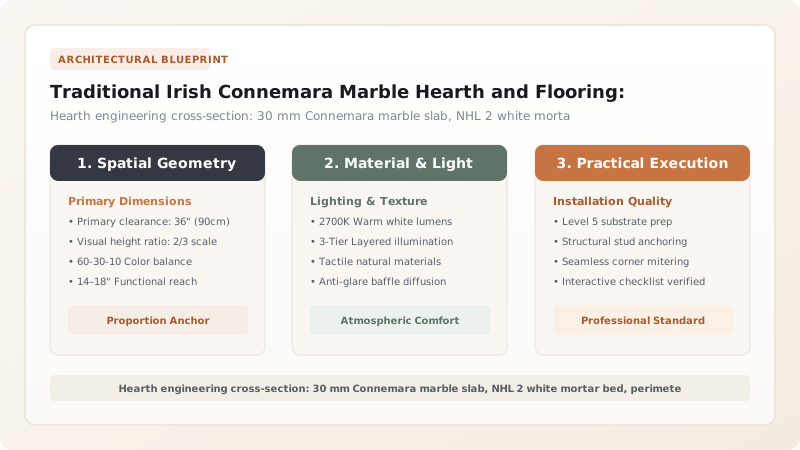
When a fireplace is lit, the inner edge of the hearth slab can reach temperatures of 150°C to 200°C, while the outer edge facing the room remains at ambient room temperature (20°C). This severe thermal gradient causes the stone to expand non-uniformly. If the slab is rigidly mortared against chimney breast masonry or trapped between timber floorboards without expansion joints, internal tensile stresses will inevitably snap the slab along its natural serpentine veining. Authentic installation requires a continuous 6 mm thermal expansion gap around the hearth perimeter, packed with resilient ceramic fiber rope. Furthermore, setting must be executed exclusively with non-staining natural hydraulic lime (NHL 2) mortar or specialized white, rapid-setting polymer mortars. Standard grey Portland cement must never be used: its high alkali content and grey pigments leach into the porous calc-silicate matrix, causing permanent dark staining and moisture-induced green stone curling.
Honed Satin Finishing & Beeswax Maintenance Protocols
The ultimate sensory beauty of Connemara marble is unlocked through its surface finish. While commercial stone yards frequently polish marble to a high-gloss, mirror-like finish using synthetic crystallization chemicals and oxalic acid, this treatment is completely inappropriate for authentic Connemara marble hearths. Acidic polishers chemically attack the delicate calcite and serpentine minerals, creating an artificial, plasticized sheen that dulls rapidly and scratches easily under fireplace soot and iron fire tools.
Traditional Irish stonemasons employ a progressive wet-honing protocol using diamond abrasive pads, progressing from 120-grit up to 400-grit and finishing at 800-grit. This creates a refined, tactile "honed satin" surface—a finish that feels smooth and velvety to the touch like fine leather, reflecting ambient firelight with a warm, diffuse glow. To nourish the stone and enhance the optical depth of the swirling green veins, the honed marble is treated with a breathable penetrating fluoropolymer sealer, followed by hand-buffing with warm paste wax formulated from pure virgin beeswax and natural gum spirits of turpentine. The warm beeswax penetrates the microscopic crystalline pores, saturating the serpentine minerals and intensifying their emerald chatoyancy while providing an organic, heat-resistant barrier that repels turf smoke soot and ash for generations of hearthside warmth.
Connemara Marble Grading, Slab Thickness & Hearth Engineering Standards
Use this reference table to calculate exact physical dimensions, ratios, and specifications before purchasing:
| Marble Grade / Variety | Color & Mineral Character | Recommended Thickness | Setting System | Thermal Tolerance |
|---|---|---|---|---|
| Streamstown Light Green | Vivid apple & mint green ribbons with white calcite veins | 20 mm floor / 30 mm hearth | NHL 2 white hydraulic mortar bed | Up to 180°C radiant surface heat |
| Lissoughter Dark Green | Deep forest, moss, and emerald green with dark chlorite bands | 30 mm hearth curb & slab | White rapid-setting polymer mortar | Up to 220°C direct radiant heat |
| Recess Sepia / Cream | Warm olive-amber, sepia ribbons, and cream dolomite | 20 mm interior flooring | Semi-dry lime-sand screed bed | Ambient to 50°C underfloor radiant |
| Book-Matched Feature Slabs | Mirrored symmetrical serpentine veining | 20 mm wall cladding / overmantel | Mechanical stainless steel tie anchors | Up to 150°C overmantel convection |
| Tumbled Cobbles / Pavers | Weathered edges, mixed green and grey tones | 40–50 mm hearth apron / terrace | Hydraulic lime-sand paving mortar | High thermal shock resistance |
Practical Constraints
Every successful decoration project must account for physical and environmental constraints:
High thermal shock and cyclic expansion from turf (peat) and hardwood open fireplace fires
Rigidly confined marble slabs crack across natural serpentine bedding planes under thermal stress. Mitigation: Install flexible silicone-free ceramic rope expansion gaskets around all hearth slab perimeters.
Natural structural fragility and micro-fractures along chlorite-rich schistose shear zones
Slabs can fracture during handling, transport, or wet cutting on site. Mitigation: Reinforce slab undersides with vacuum-infused epoxy resin and structural fiberglass mesh backing.
Execution Blueprint & Craftsmanship Sequence
Execute this professional sequence to achieve flawless results without backtracking:
Quarry Selection & Slab Inspection
Procure authentic Connemara marble slabs from County Galway. Inspect veining orientation, verify 30 mm thickness for hearths, and check mesh backing integrity.
Hearth Subfloor & Chimney Breast Preparation
Ensure the masonry fireplace subfloor is structurally sound, level, and free of soot. Clean with wire brushes and vacuum all loose debris.
Dry-Laying & Book-Match Alignment
Dry-lay the hearth slabs and surround pieces in front of the fireplace opening. Align serpentine veining across joints to create harmonious, flowing green ribbons.
Perimeter Expansion Gap Detailing
Install 6 mm thermal expansion foam strips or ceramic fiber rope around the entire outer perimeter of the hearth footprint and against fireplace firebrick.
White Hydraulic Lime Mortar Application
Mix white natural hydraulic lime (NHL 2) with washed silica sand. Comb an even 15 mm notched bed onto the subfloor and back-butter the marble slab with a flat trowel.
Setting & Leveling the Hearth Slab
Carefully lower the heavy marble slab into the mortar bed using suction cups. Tap gently with a rubber mallet to achieve 100% mortar coverage and perfect level.
Mechanical Tie Anchoring of Vertical Surrounds
Secure vertical marble jambs and lintels to the chimney breast masonry using concealed grade 316 stainless steel wire ties embedded in non-shrink lime grout.
Honing, Sealing & Beeswax Buffing
Wet-hone surfaces with diamond pads up to 400–800 grit. Apply a breathable penetrating sealer, followed by hand-buffing warm virgin beeswax and turpentine for a satin sheen.
Common Mistakes & Countermeasures
Avoid these costly errors that compromise aesthetics, ergonomics, and budget:
Setting Connemara marble hearths using gray Portland cement or high-slump grey thin-set
Applying high-gloss synthetic polyurethane or epoxy topical sealers over hearth marble
Cleaning Connemara marble with acidic cleaners, vinegar, or citrus-based detergents
Project Execution Checklist
Track your physical progress. Checkboxes persist automatically on this device:
Frequently Asked Questions
What makes Connemara marble geologically unique compared to Italian or Carrara marble?
While classic Carrara marble is a pure white calcium carbonate marble formed from ancient coral reefs, Connemara marble is a calc-silicate serpentinite marble over 600 million years old (Precambrian Dalradian age). It was formed when impure limestones containing magnesium and silica were subjected to intense tectonic metamorphism, heat, and fluid pressure during the Caledonian orogeny. This extreme pressure converted the minerals into serpentine (antigorite and lizardite), chlorite, and tremolite, interwoven with bands of white calcite and cream dolomite, producing its unique kaleidoscopic array of green ribbons found nowhere else on earth.
Can Connemara marble withstand the intense heat of an open turf or wood fireplace?
Yes, authentic 30 mm Connemara marble has been used successfully in Irish manor hearths for centuries. However, it must be engineered correctly. Marble is a natural rock that expands when heated. If a slab is trapped tightly between rigid masonry walls without expansion joints, the thermal gradient between the hot firebox edge and the cooler outer room edge will cause thermal stress cracking. By leaving a 6 mm perimeter expansion joint cushioned with ceramic fiber rope and bedding the stone in flexible hydraulic lime mortar, the marble absorbs intense radiant heat without cracking.
Why is beeswax used instead of modern polyurethane or varnish on Connemara marble?
Modern synthetic polyurethane or varnish forms an impermeable plastic film on the surface of the stone. When exposed to the radiant heat of an open fireplace, synthetic coatings blister, peel, turn hazy yellow, and trap internal moisture, leading to stone degradation. Natural beeswax blended with pure gum spirits of turpentine is vapor-permeable and heat-resilient. It penetrates the microscopic pores of the honed marble, enhancing the optical depth and chatoyancy of the green serpentine veins while providing a soft, tactile, satin luster that can be easily refreshed across generations.