
Pa'ssura is the sacred tradition of incised geometric wood carving that completely encases the exterior walls and gables of Toraja tongkonan architecture. Carved freehand into dense ironwood using small gouges, pa'ssura comprises dozens of codified symbolic motifs representing cosmic order, clan lineage, and agricultural fertility. The carvings are illuminated exclusively with four ritual mineral colors: red hematite, yellow clay, calcined white lime, and soot black.
At a Glance: Key Takeaways
- Artistic Medium: Incised relief carving into uru and teak boards (5–8 mm incision depth)
- Motif Count: Over 70 distinct traditional geometric, floral, and faunal patterns
- The Four Colors: Litter (red), Kuning (yellow), Putih (white), and Itam (black)
- Ritual Master: Pandai passura (hereditary master woodcarver initiated into clan lore)
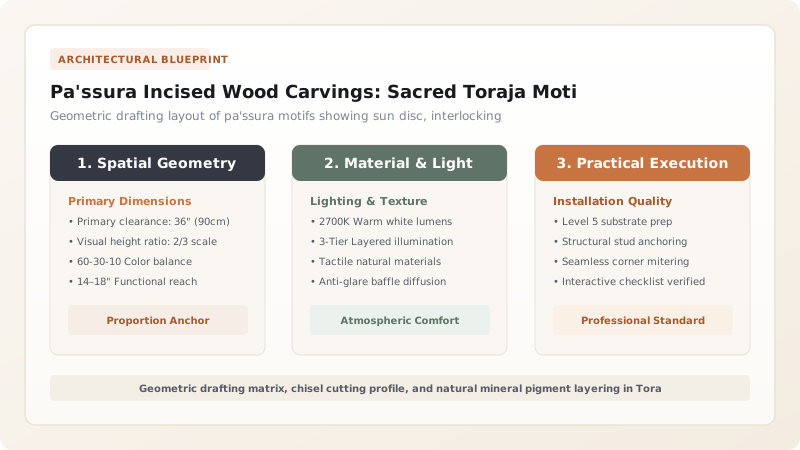
The Living Lexicon: Architecture as Ancestral Scripture
In traditional Toraja society, where language was historically oral, the walls of the tongkonan served as the tribe's illuminated manuscript. The word pa'ssura derives from sura, meaning writing or letter. To carve the facade of an ancestral house is literally to 'write' the history, values, and spiritual cosmology of the clan.
Every motif has a designated location on the facade governed by strict customary law (adat). Placing an aristocratic symbol on a commoner's house or carving a funerary motif on an agricultural storage bin is considered a severe spiritual transgression that disrupts the harmony between mortals and ancestors.
The Primary Motifs: Sun Discs, Buffalo Heads, and Aquatic Swirls
Among the dozens of pa'ssura patterns, several form the foundational vocabulary of the tongkonan facade. Preeminent is the pa'bare' allo (the sun disc), positioned prominently on the upper triangular gable. Representing the supreme deity Puang Matua and the radiant brilliance of truth, it radiates circular geometric rays framed by geometric border bands.
Equally vital is the pa'tedong (the water buffalo head), an emblem of cosmic prosperity, sacrificial devotion, and ancestral wealth. Flanking these are geometric interlocking lattices such as pa'doti siluang (diamond lozenge patterns signifying unbreakable clan bonds) and pa'reppo sangbua (scalloped crests representing bountiful rice plants heavy with grain).
The Chemistry of the Four Sacred Mineral Pigments
Pa'ssura carvings are painted strictly in four natural colors, each endowed with deep cosmological symbolism. No other hues are permitted on an authentic tongkonan.
Black (Itam) is derived from pure cooking-pot wood soot or crushed charcoal, representing death, darkness, and the underworld. White (Putih) is formulated from crushed, calcined riverbed lime or fine calcium carbonate clay, signifying purity, honesty, and celestial spirits. Red (Litter) comes from crushed volcanic hematite earth or red ochre clay, representing human blood, bravery, and vitality. Yellow (Kuning) is made from yellow volcanic clay or turmeric extract, symbolizing divine blessing, imperial honor, and abundant harvest.
Chisel Techniques of the Pandai Passura
The hereditary woodcarver (pandai passura) executes these complex patterns without paper blueprints or mechanical measuring instruments. Using only a string line, a wooden compass, and a bone scriber, the master scores the geometry directly onto planed ironwood panels.
Using small curved and V-shaped hand chisels (pahat) struck with a lightweight wooden mallet (palu-palu), the artisan carves crisp 6 mm deep V-grooves. The recessed backgrounds are chipped away to leave the geometric relief ribbons standing proud. Once carved, the raw wood is primed with crushed lime wash before the mineral pigments—bound with natural tree resins or buffalo-skin gelatin—are meticulously applied by hand.
The Four Sacred Toraja Pigments: Source, Meaning, and Chemistry
Use this reference table to calculate exact physical dimensions, ratios, and specifications before purchasing:
| Pigment Color | Raw Material Source | Cosmological Symbolism | Traditional Binder Medium |
|---|---|---|---|
| Red (Litter) | Crushed volcanic hematite rock and red iron oxide clay | Human vitality, bravery, ancestral bloodline, and fire | Buffalo-skin gelatin glue (lem kulit kerbau) |
| Yellow (Kuning) | Subterranean yellow ochre clay and wild turmeric juice | Divine blessing, royalty, wisdom, and ripe rice harvests | Natural tree gum resin (damar) dissolved in alcohol |
| Black (Itam) | Wood soot collected from cooking pots and pine charcoal | The underworld, physical death, nocturnal quiet, and soil | Water mixed with buffalo bone glue |
| White (Putih) | Calcined limestone putty and ground river clam shells | Celestial purity, truth, creator spirits, and daylight | Slaked high-calcium lime water (air kapur sirih) |
Practical Constraints
Every successful decoration project must account for physical and environmental constraints:
Rapid fading and rain-washout of water-soluble mineral pigments
Unsealed natural earth pigments on windward exterior walls can erode under relentless monsoon rainfall, requiring periodic repainting every 5 to 7 years. Mitigation: Fortify natural pigment binders with boiled natural tree damar varnish or micro-crystalline beeswax emulsions that repel liquid moisture while permitting vapor breathability.
Fungus and mildew growth on carved timber grooves in humid cloud forests
Deep incised chisel channels accumulate damp atmospheric dust, fostering black mildew that obscures intricate carving details. Mitigation: Incorporate natural clove oil (eugenol) or tea-tree botanical extracts into the final protective varnish to inhibit fungal spore growth naturally.
Execution Blueprint & Craftsmanship Sequence
Execute this professional sequence to achieve flawless results without backtracking:
Selecting and Planing Uru Wood Facade Boards
Select seasoned heartwood planks of uru or teak free of knots. Hand-plane the face boards smooth to provide an even, stable ground for precision chisel incisions.
Geometric Layout Using Traditional String and Compass
Draft vertical and horizontal gridlines onto the wood using soot-blackened cord. Scribe concentric circles and interlocking diamond axes using a brass or bone compass.
Incising Boundary Lines with V-Gouges
Trace all geometric lines using a narrow 4 mm V-shaped carving chisel, cutting 5 to 7 mm deep into the timber to establish clean, razor-sharp perimeter boundaries.
Chipping Recessed Spandrels and Background Relief
Chop away background timber between motifs using flat chisels, leaving the main symbolic figures standing proud in crisp low relief.
Preparing Natural Mineral Pigment Batches
Pulverize volcanic hematite, yellow clay, wood soot, and slaked lime in stone mortars. Blend each powdered pigment with warm animal-skin glue binder until a smooth brushable consistency is reached.
Applying Base Black Outlines into Incised Grooves
Fill the deep V-grooves with dense black soot pigment using narrow bamboo brushes, establishing a dark shadow line that accentuates geometric separation.
Coloring Relief Motifs with Red, Yellow, and White
Hand-paint the raised relief faces with red hematite, yellow ochre, and white lime, following strict traditional color codes for sun rays, horn spirals, and foliage.
Protective Sealing with Natural Damar Varnish
Allow mineral pigments to cure for 7 days. Brush two thin coats of clarified natural damar tree resin over the entire carved facade to seal pigments against monsoon rain wash-off.
Common Mistakes & Countermeasures
Avoid these costly errors that compromise aesthetics, ergonomics, and budget:
Using commercial synthetic acrylic or spray paints for pa'ssura motifs
Carving aristocrat-restricted pa'ssura motifs on unauthorized lineage buildings
Project Execution Checklist
Track your physical progress. Checkboxes persist automatically on this device:
Frequently Asked Questions
What is the meaning of the pa'bare' allo sun motif?
The pa'bare' allo represents the sun, the ultimate source of life and cosmic order, associated with the creator deity Puang Matua. It symbolizes wisdom, supreme justice, leadership, and clan prosperity, and is traditionally reserved for the upper gables of paramount noble tongkonan houses.
Can a person learn pa'ssura carving if they are not from Toraja?
While technical woodworking skills can be learned by anyone, true pa'ssura mastery requires deep philosophical initiation into Toraja customary law (Aluk Todolo), genealogies, and ritual chants. Hereditary master carvers (pandai passura) spend years apprenticing under elder masters to understand the spiritual responsibilities of the craft.
How are the mineral pigments kept from washing away in heavy rains?
Traditionally, artisans mix the pulverized minerals with gelatinous glue boiled from fresh water buffalo hide (lem kulit kerbau) or sap from the breadfruit tree (getah sukun). Once cured, this organic binder creates a remarkably durable, water-resistant bond that clings to the raw wood grain for decades.
Can pa'ssura carved panels be incorporated into modern interior decor?
Yes. Master Toraja carvers create custom wall relief panels, headboards, framed architectural screens, and decorative door portals for luxury residential interiors, bringing authentic Indonesian geometric craftsmanship and ancestral warmth into contemporary spaces.


