Warli earthen wall painting is an ancient indigenous tribal mural tradition practiced by the Warli community of the North Sahyadri range in Maharashtra (Palghar, Dahanu, and Thane districts). Painted predominantly by married women (suvasinis) on the red mud walls of wattle-and-daub huts during weddings and harvest rituals, Warli art utilizes a striking, minimalist visual vocabulary. The background is primed with a mixture of cow dung (gobar) and red ochre clay (geru), upon which intricate white designs are painted using a chewed green bamboo twig (baharu) dipped in a paste of ground rice flour and water bound with natural tree gum. The iconography centers on the cosmic Tarpa dance, sacred marriage squares (Lagna Chowk), and triangular geometric representations of human and natural harmony.
At a Glance: Key Takeaways
- Origin & Community: Warli Tribe (North Sahyadri Range, Palghar & Dahanu, Maharashtra, India)
- Substrate & Priming: Karvi reed wattle-and-daub walls primed with cow dung (gobar) and red ochre (geru)
- Pigment & Medium: Ground white rice paste (tandulche peeth) bound with acacia tree gum (babul gond)
- Painting Instrument: Baharu (green bamboo twig with chewed, fibrous brush tip)
- Core Iconography: Opposing triangular human forms, concentric Tarpa dance spirals, Palghat goddess
In-Depth Guides in this Directory
Explore specialized subtopic blueprints, technical dimensions, and execution checklists:
Geru Red Ochre and Cow Dung Earthen Wall Priming for Warli Murals
Technical guide to priming earthen mud walls for Warli painting. Learn about gobar lepan (cow dung slurry), geru red ochre clay, and substrate stabilization.
Chewed Bamboo Brush and Rice Flour Paste Pigment Preparation in Warli Art
Learn the artisanal tools of Warli painting. Discover how to chew green bamboo twigs (baharu) into brushes and grind white rice flour paste with babul gond.
Tarpa Dance Concentric Circles and Triangular Human Forms in Warli Iconography
Explore Warli iconography: the Tarpa dance concentric spiral, dual-triangle human forms, sacred Lagna Chowk wedding squares, and the Palghat fertility goddess.
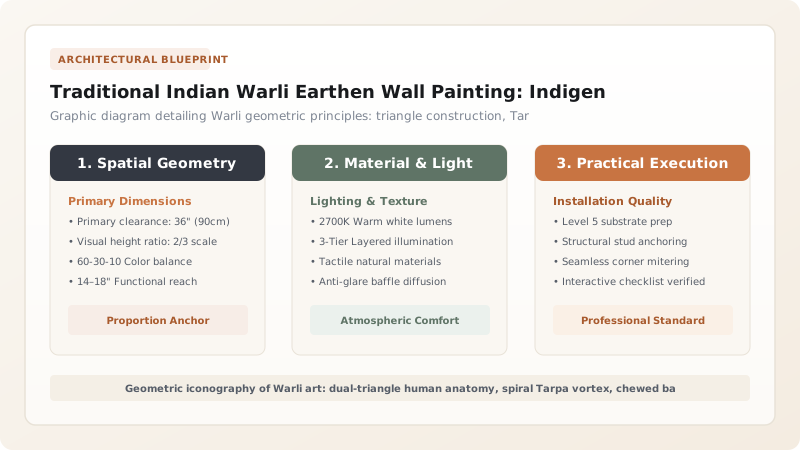
Cosmology and Indigenous Origins in the Sahyadri Foothills
Deep in the rugged foothills of the North Sahyadri mountain range, spanning the Palghar, Dahanu, and Thane districts of Maharashtra, the Warli tribe has preserved a mural painting tradition whose visual origins trace back to the Mesolithic rock shelters of Central India. Unaffected by the grand imperial court arts of the Mughals or the intricate temple stone-carving traditions of Deccan dynasties, Warli art developed as a direct, unmediated expression of an animistic forest-dwelling people living in intimate symbiosis with the natural cosmos.
Unlike many religious folk arts that depict mythological pantheons of anthropomorphic gods, Warli art venerates nature itself—the sun, the moon, the cyclical monsoons, wild beasts, sacred trees, and the communal rhythms of village life. Historically, painting was not a commercial or decorative profession but a sacred communal ritual. The artists were primarily married women, known as suvasinis (or dhavleris), who gathered on the eve of weddings and seasonal harvest celebrations to invoke divine blessings of fertility, protection, and agricultural abundance through sacred marks on the domestic hearth.
The Earthen Substrate: Karvi Reeds, Gobar, and Geru
The physical canvas of a Warli painting is inseparable from vernacular rural architecture. Tribal homes are constructed using wattle-and-daub techniques, where a structural armature of split bamboo or karvi (Carvia callosa) reeds is plastered with a thick paste of red forest clay, chopped rice straw, and fresh cow dung. This earthen envelope breathes naturally, providing passive thermal comfort against oppressive tropical heat while buffering monsoon humidity.
To prepare the wall for sacred painting, the women apply two essential conditioning layers. First comes the gobar lepan—a fluid wash of fresh cow dung and water applied with the palms in rhythmic circular strokes. Beyond its symbolic purity in Hindu and tribal folklore, cow dung functions as a superb biological primer: its fine digested cellulose fibers seal surface dust, while natural enzymes and mild ammonia act as natural insect and termite repellents. Once dry, the surface is coated with a saturated slip of geru (hydrated ferric oxide red ochre clay), creating a warm, velvety terracotta red background that serves as the perfect visual foil for white line work.
The Ephemeral White Pigment: Rice Flour and Babul Gond
Against the rich, earthy red of the geru background, Warli art is rendered exclusively in luminous white. The pigment is completely organic, prepared from short-grain white rice (tandul). The raw rice is soaked in fresh stream water for twelve hours to soften the starch granules, then ground by hand on a traditional granite grinding stone (pata-varvanta) until it forms a creamy, micro-fine paste.
Because raw rice starch would dry brittle and flake off the mud wall under seasonal humidity swings, the artisans incorporate a natural adhesive binder: babul gond (gum arabic harvested from the native Acacia nilotica tree). Dissolved in warm water and strained through muslin cloth, the gum resin binds the rice starch platelets together, imparting elasticity, preventing crazing, and allowing the painted line to grip the porous earthen substrate tenaciously. The applicator is equally organic: a freshly cut green bamboo twig (baharu), approximately the thickness of a pencil, whose tip is flattened and chewed with the teeth until its fibers separate into a delicate, flexible brush capable of rendering lines as fine as a millimeter.
Sacred Geometry: Triangles, Spirals, and the Universal Circle
The visual grammar of Warli art is rooted in three elemental geometric primitives: the circle, the triangle, and the square. The circle is derived from the observation of the celestial sun and moon; the triangle represents mountains and conical tree tops; and the square represents the sacred human enclosure or plowed agricultural plot. In depicting human and animal figures, Warli artisans deploy an iconic convention: two inverted triangles touching at their sharp apexes.
This dual-triangle figure is a profound philosophical statement. The upper triangle symbolizes the torso, the celestial sky, and the masculine principle; the lower triangle represents the pelvis, the generative earth, and the feminine principle. Their point of contact at the waist represents cosmic balance, dynamism, and perpetual movement. When these figures join hands in the monumental, swirling vortex of the Tarpa dance, the entire composition transforms into a living mandala—a rhythmic celebration where humans, animals, plants, and celestial spirits participate as equals in the unbroken cycle of universal existence.
Warli Tribal Wall Murals vs Other Indian Vernacular Folk Art Traditions
Use this reference table to calculate exact physical dimensions, ratios, and specifications before purchasing:
| Artistic Feature | Warli Painting (Maharashtra) | Madhubani / Mithila (Bihar) | Pithora Painting (Gujarat/MP) |
|---|---|---|---|
| Substrate & Base | Earthen mud/karvi wall primed with cow dung & red geru | Mud walls or handmade paper primed with cow dung | Lime-whitened or earthen walls of tribal homes |
| Color Palette | Monochromatic white pigment on terracotta red/brown background | Multicolor; vibrant mineral and vegetable dyes (red, yellow, blue, green) | Vibrant multi-color ritual palette featuring sacred red, yellow, green |
| Primary Applicator | Chewed green bamboo twig (baharu) or dried palm spine | Fine bamboo nibs, cotton-wrapped sticks, and fingers | Fine bamboo twigs and bird feather brushes |
| Human Figure Geometry | Two inverted triangles touching at apex; highly stylized stick limbs | Elongated profiles with prominent almond eyes and floral detailing | Stylized equestrian riders (horses) and ancestor deities |
| Sacred Function | Ritual fertility chowks for weddings and harvest celebrations | Ceremonial nuptial chamber (Kohbar) and temple worship | Propitiatory vows (mannat) to appease ancestral deities (Baba Pithora) |
Practical Constraints
Every successful decoration project must account for physical and environmental constraints:
Monsoon Humidity and Driving Rains Dissolving Outdoor Mud Murals
Heavy Sahyadri precipitation (exceeding 2,500 mm) washes away rice flour pigment on exterior walls. Mitigation: Paint sacred murals strictly on interior sheltered walls, or incorporate 2% natural tree resin (dammar/babul) into the pigment.
Insect and Rodent Attack on Edible Rice Flour Pigment
Flour-eating insects and mice nibble away the painted white lines, destroying intricate murals. Mitigation: Incorporate bitter neem leaf extract (Azadirachta indica) or copper sulfate crystals into the rice paste formulation.
Execution Blueprint & Craftsmanship Sequence
Execute this professional sequence to achieve flawless results without backtracking:
Substrate Surface Preparation
Clean the dried mud-and-dung plaster of the wattle-and-daub wall, repairing any micro-fissures with a paste of fine river silt, chopped straw, and fresh cow dung.
Cow Dung Priming Coat (Gobar Lepan)
Apply a thin, uniform wash of fresh cow dung slurry across the wall with circular palm motions, creating an antiseptic, smooth, and flexible underlayer.
Red Ochre Clay Slip Application (Geru)
Dissolve natural red ochre clay (geru) in water, applying two saturated washes over the dry cow dung base using a soft cotton rag to achieve a deep, radiant terracotta red.
Rice Flour Pigment Grinding and Formulation
Soak raw short-grain white rice in water for 12 hours, then grind it on a traditional stone grinding slab (pata-varvanta) to a silky, lump-free consistency.
Natural Tree Gum Binder Addition (Babul Gond)
Dissolve raw acacia gum (babul gond) in lukewarm water, straining out impurities, and blend it into the rice paste at a 1:10 ratio to prevent cracking and flaking.
Baharu Bamboo Brush Preparation
Cut fresh, green bamboo twigs (approx. 15 cm long), flatten one end on a stone, and chew the fibers until they form a fine, flexible bristle tip.
Sacred Central Motif Painting (Chowk or Tarpa)
Dip the baharu into the white rice paste and paint the central sacred emblem—either the Lagna Chowk with goddess Palghat or the spiral Tarpa dance—without pencil outlines.
Perimeter Narratives and Curing
Expand outward from the center, painting scenes of daily village life, flora, fauna, and celestial bodies, allowing the organic rice pigment to cure naturally in ambient air.
Common Mistakes & Countermeasures
Avoid these costly errors that compromise aesthetics, ergonomics, and budget:
Using commercial white acrylic or emulsion paint over authentic earthen mud walls
Applying geru red ochre directly over raw, unsealed dry mud plaster without a cow dung primer
Painting human figures using solid rectangular blocks rather than two inverted intersecting triangles
Project Execution Checklist
Track your physical progress. Checkboxes persist automatically on this device:
Frequently Asked Questions
Who traditionally paints Warli murals and on what occasions?
Warli murals were traditionally created exclusively by married women known as suvasinis (or savasinis), led by an elderly priestess called the Dhavleri. The paintings are primarily executed during major lifecycle transitions, especially weddings (where the sacred Lagna Chowk is painted to bless the couple) and post-harvest festivals like Diwali and Holi to honor fertility and nature spirits.
What is the symbolic meaning of the two inverted triangles in Warli human figures?
In Warli cosmology, the human body is rendered as two triangles touching at their sharp apexes. The upper, inverted triangle represents the torso, sky, and masculine life force, while the lower, upright triangle represents the pelvis, earth, and feminine reproductive energy. Their intersection at the waist symbolizes the delicate cosmic balance of the universe, movement, and the harmony between human beings and the natural world.
Why is cow dung (gobar) used as the primary wall primer?
Fresh cow dung contains fine digested cellulose fibers and natural bactericidal properties. When applied as a thin slurry (lepan), it binds the loose mud particles of the wall, fills microscopic pores, repels termites and insects, and provides a smooth, elastic, and moisture-buffering background with a rich earthy aroma and greenish-brown undertone.
How did Warli art transition from tribal huts to modern global recognition?
In the early 1970s, during a severe drought in Maharashtra, the All India Handicrafts Board sought to document and preserve tribal crafts. Master artist Jivya Soma Mashe began painting Warli motifs on paper and canvas rather than solely on ritual mud walls. His extraordinary mastery, along with international exhibitions in France, Japan, and the UK, catapulted Warli painting onto the global contemporary art stage.