
Gilding with 22-karat pure gold leaf (Thanga Thagadu) is the defining visual and spiritual climax of classical Tanjore painting. Unlike paper-thin Western gold leaf, Tanjore gold foil is thicker and backed with fine parchment paper, allowing it to be cut precisely with shears to fit around embedded Jaipur glass gems and over complex gesso reliefs. Adhered with diluted gum arabic and burnished with polished agate stones, the pure gold creates an eternal, tarnish-free celestial glow that reflects flickering oil lamps with divine warmth.
At a Glance: Key Takeaways
- Burnishing Tool: Smooth natural agate stone burnisher (Dog-tooth or pencil shape)
- Foil Backing: Parchment paper carrier allowing precision scissor contouring
- Gold Quality: 22-karat genuine gold foil (Thanga Thagadu), 91.6% purity
- Jewel Setting: Faceted high-lead Jaipur colored glass gems (Rubies, Emeralds, Diamonds)
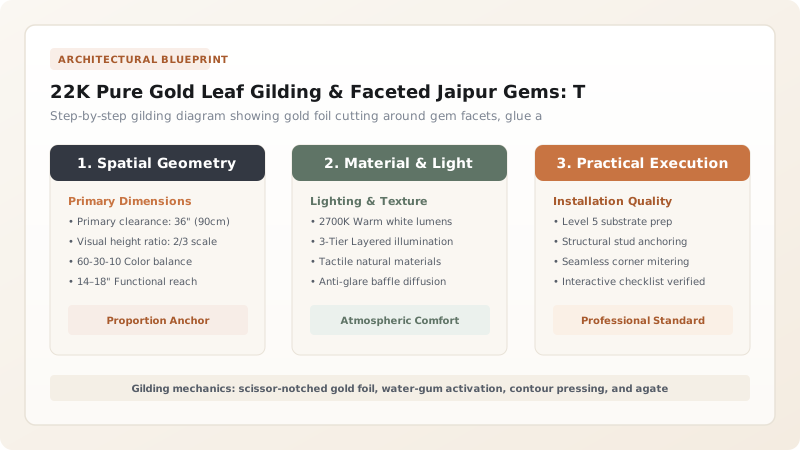
Metallurgical Science: The Purity and Gauge of Thanga Thagadu
In classical Tanjore painting, the gold used is not delicate Western 'transfer leaf' (which disintegrates on touch), but Thanga Thagadu (gold foil). Beaten by hereditary goldsmiths in Thanjavur and Jaipur, the foil is crafted from 22-karat gold (91.6% pure gold alloyed with 8.4% copper and silver for tensile strength and rich warm color).
The gold is beaten between layers of ox-gut parchment until it reaches a calibrated thickness of roughly 10 to 15 microns. Crucially, the foil is mounted onto a light parchment paper backing using vegetable starch. This backing gives the gold foil structural body: an artist can hold it with fingers, trace complex contours on the back, and slice it with fine embroidery shears without tearing the delicate metallic film.
Artisanal Execution: Contour Cutting and Windowing Around Gems
Applying gold over a jewel-encrusted surface requires surgical precision. If gold covers the top of the faceted Jaipur gems, their refractive sparkle is lost; if gaps are left between the gold and the gems, ugly white gesso lines will be exposed.
Master gilders lay a sheet of gold foil over the raised relief, gently pressing with a dry cotton puff so the faceted profile of the embedded gems telegraphs onto the paper backing. The artisan lifts the foil and, using micro-curved scissors or fine leather punches, cuts tiny circular or diamond-shaped windows corresponding to each gem. The foil is then test-fit over the relief until every gem protrudes crisply through its designated aperture, with the gold foil hugging the gem's girdle perfectly.
Adhesion Dynamics: Water Activation and Contour Tacking
To adhere the gold foil to the rock-hard Sukkan gesso, artisans use a dilute solution of pure gum arabic and water. Using a soft sable brush, the artisan applies a thin, uniform sheen of moisture over the gesso relief. If too much water is applied, the gesso softens into mud; if too little, the gold fails to bond.
The cut gold foil is positioned precisely over the damp gesso. Using dry cotton balls and soft wooden sticks wrapped in velvet, the gilder gently presses the foil down into every recessed crevice, fluted pillar groove, and scalloped floral relief. The flexible foil stretches slightly, molding itself over the three-dimensional contours like liquid gold.
Optical Finishing: Agate Stone Burnishing and Divine Illumination
Once the gum adhesive has set for approximately two hours, the gold is ready for its final transformation: burnishing (Kallu Theithal). Raw, newly applied gold foil has a semi-matte, slightly dull sheen.
The gilder lubricates the gold surface with a microscopic whisper of talcum powder or soapstone dust, then rubs the gold with a polished agate stone burnisher. Using firm, circular, and reciprocating strokes, the ultra-hard agate stone compresses the gold atoms, collapsing microscopic surface irregularities. Within seconds, the gold transforms into a mirror-like, blindingly reflective sheet of solid golden light. Under the flickering flame of an oil lamp in a Hindu prayer room, this burnished gold catches light from every angle, creating an ethereal, pulsing aura around the divine deity.
Gold Foil Grades & Characteristics in Sacred Indian Art
Use this reference table to calculate exact physical dimensions, ratios, and specifications before purchasing:
| Foil Typology | Metallic Composition | Thickness / Gauge | Tarnish Resistance | Spiritual & Aesthetic Value |
|---|---|---|---|---|
| Authentic 22K Thanga Thagadu | 91.6% Pure Gold + 8.4% Cu/Ag | 12–15 microns (Paper-backed) | 100% tarnish-free forever (Generations) | Supreme devotional radiance; traditional Tanjore canon |
| 24K Pure Gold Leaf (Western) | 99.9% Pure Gold | 0.2 microns (Ultra-thin leaf) | 100% tarnish-free; zero corrosion | Too fragile for high-relief gesso; tears easily |
| Imitation Brass Leaf (Varak) | 85% Copper + 15% Zinc | 15 microns (Synthetic leaf) | Rapid oxidation; turns green/black in 2 years | Prohibited for sacred icons; commercial craft only |
| Silver Leaf (Velli Thagadu) | 100% Pure Elemental Silver | 10 microns (Paper-backed) | Tarnishes to black patina unless varnished | Utilized for Shiva silver icons and moon deities |
Practical Constraints
Every successful decoration project must account for physical and environmental constraints:
High Financial Cost of Certified 22K Gold Foil
A single large Tanjore painting can consume 50 to 100 sheets of pure gold foil, representing significant material expenditure. Mitigation: Accurately pattern-cut foil templates to eliminate scrap waste and reserve 22K gold strictly for sacred relief areas (crowns, arches, jewelry).
Extreme Fragility of Burnished Gold Foil Surfaces
Burnished gold foil is soft (pure gold) and easily scratched by fingernails, jewelry, or cleaning cloths. Mitigation: Never apply abrasive polishes or clear synthetic varnishes over gold; enclose the finished painting permanently in a sealed glass teak shadow-box.
Scarcity of Skilled Agate Stone Burnishing Artisans
Agate burnishing requires exact manual touch—too little pressure leaves gold dull; too much pressure tears the foil off the gesso. Mitigation: Train apprentices under hereditary master gilders, practicing pressure control on sample gesso relief moldings before touching sacred icons.
Execution Blueprint & Craftsmanship Sequence
Execute this professional sequence to achieve flawless results without backtracking:
Checking and Cleaning Cured Gesso Relief Surfaces
Inspect the dry Sukkan gesso relief. Dust away loose particles and ensure all embedded Jaipur glass gems are firmly seated and grease-free.
Tracing Gem Profiles onto Gold Foil Backing Paper
Place paper-backed 22K gold foil over the relief, rubbing lightly with a cotton ball to emboss the outlines of underlying glass gems onto the back.
Windowing Gem Apertures with Micro-Scissors
Cut precision windows through the gold foil corresponding to each gem using fine curved scissors or leather punches, verifying a snug fit around stones.
Applying Dilute Gum Arabic Adhesive Sheen
Brush a light, even wash of dilute gum arabic water onto the gesso relief using a sable brush, avoiding excess puddling in corners.
Molding and Pressing Gold Foil into Relief Crevices
Lay the windowed foil over the damp relief. Press firmly into every carving groove and pillar flute using velvet-tipped wooden molding sticks.
Pressure Burnishing with Polished Agate Stone Tools
Allow glue to firm for 2 hours. Dust lightly with talcum and rub with a smooth agate burnisher until the gold achieves a deep, mirror-like specular luster.
Common Mistakes & Countermeasures
Avoid these costly errors that compromise aesthetics, ergonomics, and budget:
Using Chemical Imitation Gold (Brass) Foil to Cut Costs
Burnishing Gold While the Gum Adhesive Is Still Wet
Covering the Glass Gems Completely with Gold Foil
Project Execution Checklist
Track your physical progress. Checkboxes persist automatically on this device:
Frequently Asked Questions
Why is 22K gold used instead of 24K pure gold for Tanjore paintings?
While 24K gold is pure, it is extremely soft and fragile. Alloyed 22K gold (91.6% purity with minor copper and silver) provides greater tensile strength, allows the foil to be beaten thicker without tearing, and possesses a warm, deep reddish-gold luster ideal for temple deities.
Will real gold foil on a Tanjore painting ever tarnish or turn black?
No. Genuine 22K gold is chemically inert and does not react with oxygen, moisture, or incense smoke. Century-old Tanjore paintings preserved in South Indian temples retain their brilliant, mirror-like golden shine to this day.
What is an agate stone burnisher and why is it used?
An agate burnisher is a tool made from a natural, ultra-smooth piece of agate stone mounted on a wooden handle. Rubbing the agate over the gold applies intense localized pressure without scratching, compressing the metal crystals into a flawless mirror reflection.
Can I touch the gold foil with my bare hands?
While touching dry gold foil is harmless, natural oils and acids from human skin can dull its high-gloss mirror sheen. Master artisans handle gilded areas with clean cotton gloves or soft cloth pads and enclose the painting behind glass.


