
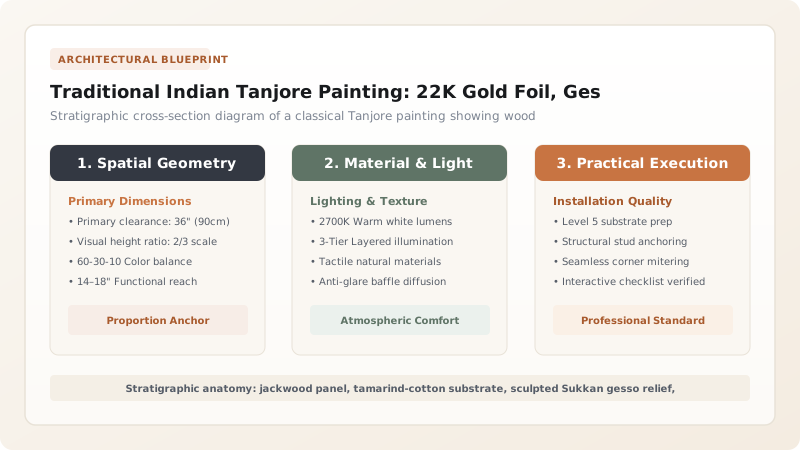
Tanjore painting (Thanjavur Oviyam) is an opulent classical South Indian devotional art form originating during the late 16th-century Maratha court rule in Thanjavur, Tamil Nadu. Renowned for its extraordinary three-dimensional relief, radiant gilded illumination, and jewel-encrusted surfaces, a master Tanjore painting is constructed on seasoned jackwood (Palagai) lined with unbleached cotton fabric using boiled tamarind-seed paste. Artisans sculpt architectural arches and deity jewelry using Sukkan gesso (unslaked limestone paste and Arabic gum), encrusting the raised reliefs with faceted Jaipur cut glasses and 22-karat pure gold foil that glitters with divine luster under oil lamp illumination.
At a Glance: Key Takeaways
- Canvas Sizing: Unbleached organic cotton (Kada) pasted with boiled tamarind-seed paste
- Gilding Medium: 22-karat genuine gold foil (Thanga Thagadu) burnished with agate stones
- Relief Gesso (Muckuck): Pulverized unslaked limestone (Sukkan) + pure gum arabic solution
- Wooden Substrate: Seasoned Jackfruit wood (Artocarpus heterophyllus, Palagai) or Teak
In-Depth Guides in this Directory
Explore specialized subtopic blueprints, technical dimensions, and execution checklists:
Jackwood Board Sizing & Tamarind Seed Paste: Traditional Tanjore Canvas Craft
Master artisan guide to classical Tanjore painting canvas preparation: seasoning jackfruit wood boards (Palagai), boiling tamarind seed paste, and fabric sizing.
Sukkan Limestone Gesso Relief: Arabic Gum Formulation & Tanjore Embossing
Technical study of Tanjore painting gesso relief (Muckuck): formulating Sukkan limestone paste with pure gum arabic, piping techniques, and stone setting.
22K Pure Gold Leaf Gilding & Faceted Jaipur Gems: Tanjore Illumination
Master gilder's guide to 22K gold foil application in Tanjore painting: Thanga Thagadu handling, trimming around Jaipur gems, agate burnishing, and preservation.
Historical Genesis: The Nayakas, Marathas, and Sacred Iconography
Tanjore painting evolved in the fertile Kaveri delta of Tamil Nadu following the fall of the Vijayanagara Empire in 1565. Migrating master artisans—primarily the Raju and Naidu communities—were embraced by the Thanjavur Nayakas and later by the Maratha rulers, reaching its artistic zenith under King Serfoji II (1798–1832).
Surrounded by the monumental Dravidian temple architecture of the Brihadisvara Temple, artisans fused South Indian Vijayanagara temple frescoes with Maratha decorative opulence, Deccani miniature techniques, and European academic naturalism. The resulting style—Thanjavur Oviyam—was created not as passive secular decoration, but as consecrated domestic shrines (Puja Mandir icons). The paintings featured plump, divine deities with wide, compassionate eyes (Meenatchi fish eyes) encased inside monumental gilded temple mandapam pavilions.
The Foundation: Jackwood Palagai and Tamarind Seed Sizing
A true Tanjore painting begins with the Palagai (wooden plank). Traditional artists insist exclusively on seasoned wood from the Jackfruit tree (Artocarpus heterophyllus, Tamil: Pala Maram). Jackwood possesses natural antimicrobial properties, zero sap-stain vulnerability, and dimensional stability that resists warping across South India's humid monsoons.
To bond the canvas to the wood, artists do not use synthetic adhesives. They collect seeds from the sour tamarind fruit (Tamarindus indica), roast and peel the outer husks, crush the white kernels into flour, and boil it into a translucent, starch-rich paste. This organic Tamarind Seed Paste is spread over the jackwood, and layers of unbleached organic cotton fabric (Kada) are pressed down. Once dry, this composite canvas creates a resilient, flexible membrane that breathes with the wood without delaminating.
Three-Dimensional Sculpting: Sukkan Limestone Gesso and Jaipur Gems
The defining visual hallmark of Tanjore art is its sculptural, tactile relief work, known in Tamil as Muckuck. This is not flat paint; deity crowns (Kireedam), necklaces, temple pillars, and ceremonial arches project up to 8 millimeters from the canvas surface.
The gesso paste is prepared using Sukkan (finely pulverized unslaked river limestone or uncalcined chalk) blended with pure natural Gum Arabic (acacia tree resin) and copper sulfate (a natural fungicide). Working with fine wooden styluses or squeeze cones, the artist applies the paste in successive raised layers. While the gesso remains leather-hard, faceted semi-precious stones—historically uncut Burmese rubies, emeralds, and diamonds, later replaced by faceted Jaipur colored glass gems—are pressed firmly into the putty, mechanically locking them into the matrix as it cures.
Illumination and Painting: 22K Gold Foil and Sacred Pigments
Once the gesso stone reliefs have cured rock-hard, the artwork is illuminated with genuine 22-Karat Gold Leaf (Thanga Thagadu). The gold foil is backed with paper for handling, trimmed with precision scissors, and glued over the sculpted gesso using diluted gum arabic. Using smooth agate or polished bone burnishers, the artisan rubs the gold firmly into the intricate carvings, forcing it around the faceted glass gems and into delicate gesso recesses.
Finally, the deity's skin, silk garments (Pitambara), and divine backdrops are painted with vibrant colors. Traditionally, master artists ground their own pigments from crushed natural minerals: white from conch shells (Sankhu), yellow from turmeric and orpiment, black from mustard-oil lamp soot, and vibrant blue from crushed lapis lazuli. The deity's eyes are always painted last in a sacred ceremony called Netro-militam (opening of the eyes), transforming the artwork into a living embodiment of the divine.
Tanjore Painting Material Hierarchy: Authentic vs. Commercial Substitutes
Use this reference table to calculate exact physical dimensions, ratios, and specifications before purchasing:
| Process / Element | Classical Authentic Method | Commercial Modern Shortcut | Durability / Longevity | Visual & Spiritual Impact |
|---|---|---|---|---|
| Wooden Substrate | Seasoned Jackfruit wood (Pala Maram) | Commercial MDF, plywood, or particle board | Authentic: 100+ years; Modern: warps/swells in humidity | Jackwood is sacred; emits sweet aroma; resists termites |
| Canvas Sizing Paste | Boiled tamarind-seed kernel paste | Polyvinyl acetate (Fevicol PVA) synthetic glue | Authentic: fully reversible; Modern: acidic, brittle | Tamarind starch moves naturally with timber expansion |
| Relief Gesso (Muckuck) | Sukkan unslaked lime + pure Gum Arabic | French chalk + synthetic acrylic binder | Authentic: rock-hard stone bond; Modern: chips & cracks | Sukkan yields crisp, micro-detailed sculptural relief |
| Gilded Illumination | Genuine 22K pure gold foil (Thanga Thagadu) | Imitation brass / aluminum chemical foils | Authentic: tarnish-free forever; Modern: oxidizes black | Pure gold reflects warm, divine candlelight in Puja rooms |
Practical Constraints
Every successful decoration project must account for physical and environmental constraints:
Extreme Humidity Swings and Canvas Delamination
South Indian monsoon humidity swings from 40% to 95% RH, causing non-traditional substrates to warp and crack brittle gesso work. Mitigation: Ensure jackwood is seasoned for a minimum of 2 years and seal the reverse side of the board with raw linseed oil and beeswax.
Scarcity of Hand-Pounded 22K Traditional Gold Foil
The specialized craft of beating pure gold between ox-gut membranes into paper-thin Thanga Thagadu foil is preserved by very few goldsmith guilds. Mitigation: Establish certified partnerships with traditional gold-beating hereditary artisans in Thanjavur and Jaipur to secure authentic certified foil.
Oil Smoke and Camphor Incense Soot in Puja Shrines
Devotional paintings kept in active prayer rooms accumulate oily soot from sesame-oil brass lamps (Diya) and camphor combustion. Mitigation: Frame finished Tanjore paintings inside traditional deep teakwood shadow-box frames fitted with high-transparency museum-grade UV conservation glass.
Execution Blueprint & Craftsmanship Sequence
Execute this professional sequence to achieve flawless results without backtracking:
Preparing and Seasoning the Jackwood Palagai Board
Select seasoned, quarter-sawn jackfruit wood free of knots. Surface the timber flat with hand planes to a finished thickness of 20 to 25 mm.
Cooking Tamarind Paste and Mounting Cotton Canvas
Roast and de-husk tamarind seeds, grind into flour, and simmer into translucent paste. Apply paste to the board and stretch unbleached organic cotton (Kada) fabric drum-tight.
Applying Sukkan-Lime Primer and Sanding Glass-Smooth
Blend fine chalk powder with diluted gum arabic. Brush 4 coats over the fabric, allowing each coat to dry. Wet-sand with fine abrasive paper to a marble-smooth finish.
Sketching Deity Iconography and Sculpting Gesso Relief
Transfer the divine cartoon using charcoal pouncing. Mix Sukkan limestone powder and gum arabic into a thick paste and sculpt raised jewelry and arches in relief.
Embedding Jaipur Glass Gems and Applying 22K Gold Foil
Press faceted glass gems into wet gesso. Once cured, apply diluted gum water and lay 22K pure gold foil sheets over reliefs, burnishing with an agate stone.
Detailing Mineral Colors and Opening the Eyes (Netro-militam)
Paint deity skin, silk drapes, and lotus thrones with fine gouache and mineral pigments. Paint the black pupils of the deity's eyes in the final sacred stroke.
Common Mistakes & Countermeasures
Avoid these costly errors that compromise aesthetics, ergonomics, and budget:
Using Imitation Gold Foil (Chemical Brass Leaf)
Using Commercial Acrylic Wall Putty for Gesso Reliefs
Mounting Canvas Directly onto Plywood Using PVA Wood Glue
Project Execution Checklist
Track your physical progress. Checkboxes persist automatically on this device:
Frequently Asked Questions
Why is jackfruit wood (Pala Maram) considered sacred for Tanjore paintings?
In Tamil culture, the Jackfruit tree is one of the three auspicious royal fruits (Mukkani: Mango, Banana, Jackfruit). Spiritually, it represents auspiciousness and divine presence; physically, its timber is exceptionally stable, termite-proof, and resistant to warping.
How can you tell if a Tanjore painting uses real gold foil?
Genuine 22K gold foil has a warm, deep, soft metallic glow that does not change under varying light angles, feels cool to the touch, and never tarnishes or turns greenish-black over decades. Imitation foil has a harsh, brassy, glittery shine that oxidizes rapidly.
What are Jaipur gems in Tanjore painting?
Jaipur gems are precision-cut, faceted colored glass stones produced by traditional gem-cutters in Jaipur, Rajasthan. Available in ruby-red, emerald-green, and diamond-clear hues, they are embedded into the wet gesso to simulate precious temple jewels that sparkle under lamp light.
How do you clean an antique Tanjore painting?
Never use water, detergents, or chemical solvents on a Tanjore painting. Simply dust gently with a soft camel-hair brush. If framed behind glass, clean the exterior glass surface only with a damp microfiber cloth, keeping moisture away from the timber frame edges.


