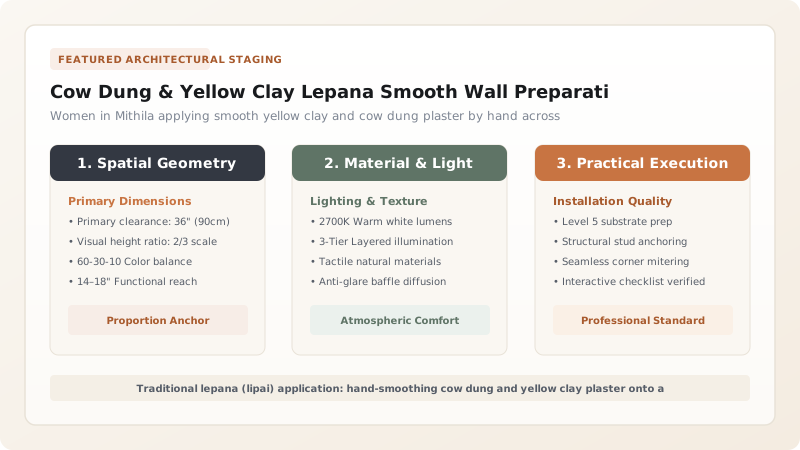
Lepana (or lipai) is the traditional earthen wall preparation technique that creates the velvety, crack-free canvas required for Madhubani murals. A precise slurry of fresh zebu cow dung (gobar), fine alluvial yellow clay (pila mitti), chopped rice husk (bhusa), and neem leaf extract is applied in multi-directional hand sweeps across raw mud or sun-dried brick walls. The cow dung's natural cellulose fibers and bactericidal enzymes prevent drying shrinkage, repel termites, and impart a warm, non-reflective olive-ochre ground that permanently binds natural mineral pigments.
At a Glance: Key Takeaways
- Substrate Mixture: Fresh zebu cow dung (gobar) + alluvial yellow silt (pila mitti) + fine sand
- Fiber Reinforcement: Crushed wheat straw, rice chaff (bhusa), or shredded jute fibers
- Natural Biocide: Steeped neem leaf (Azadirachta indica) water extract
- Application Method: Rhythmic bare-hand plastering and circular palm-swiping (lipai)
- Finished Surface Quality: Velvety, dust-free, non-glare matte ground with warm greenish-tan undertone
The Sacred Materiality of Cow Dung in Vedic & Mithila Architecture
In the Western architectural lexicon, animal manure is frequently perceived with revulsion as waste. In the ancient cultural and ecological landscape of Mithila, however, the dung of the indigenous humped zebu cow (Bos indicus, known locally as Gau Mata) is revered as a sacred, purifying architectural substance (Pavitra). Mentioned extensively in the ancient Vastu Shastra and agrarian folk traditions, gobar is understood not as waste, but as an extraordinarily refined vegetal building composite.
Zebu cattle graze on wild native grasses, herbs, and straw. Their complex ruminant digestive tract grinds these plant fibers into microscopic, highly lignified cellulose filaments coated with digestive enzymes, mucus, and bile salts. When expelled, cow dung is an organic polymer matrix pre-loaded with natural adhesives. When combined with inorganic mineral soils, it produces an elastic, breathable, and highly durable composite plaster that human beings have used to shelter themselves across the Indian subcontinent for over five millennia.
Soil Science: Sourcing Pila Mitti & Mineral Rheology
Cow dung cannot stand alone; it requires a mineral skeleton. In the Mithila floodplain, builders dig deep into the alluvial terraces of the Kamla, Bagmati, and Kosi rivers to harvest pila mitti (alluvial yellow clay) or chikni mitti (sticky clay). Formed by millennia of glacial silt deposits carried down from the Himalayas, this soil is exceptionally rich in illite and montmorillonite clay minerals with fine grain sizes below 2 microns.
When excavated, the clay is thoroughly sun-dried on jute tarpaulins to shatter its moisture memory, then crushed with heavy wooden mallets into a fine, flour-like powder. It is sifted through woven brass wire screens to remove quartz pebbles, gravel, and un-degraded plant debris. When mixed with water, the microscopic plate-like clay crystals align, providing exceptional hydraulic plasticity and workability that allows the mixture to be spread across vertical walls without slumping or sagging.
The Kinematics of Lipai: Hand-Plastering & Surface Burnishing
The act of applying the finishing plaster is known as lipai (or lepana). It is a kinetic ritual performed exclusively with bare hands, requiring deep neuromuscular intimacy with the material. The artisan kneels or stands before the damp wall with a shallow brass basin of freshly blended slurry—equal parts strained cow dung, sifted yellow clay, and neem-infused water, adjusted to the consistency of thick, velvety cream.
Dipping her right palm into the bowl, the artisan applies the slip to the wall in broad, rhythmic, overlapping figure-eight strokes. The heel of the palm exerts firm compressive pressure, forcing the slurry into microscopic surface crevices, while the flexible fingers feather out the trailing edge. The motion leaves a subtle, undulating textural relief across the wall—a series of concentric, light-catching ridges that mimic the gentle ripples of water in a holy pond. As the slip begins to lose its initial moisture sheen, the artisan rubs the surface with a smooth water-rounded agate stone or a wad of coarse cotton cloth, burnishing the clay platelets into a smooth, non-glare matte finish.
Biological Shielding: Thermal, Acoustic & Antimicrobial Performance
Beyond its aesthetic beauty as an olive-ochre painting ground, a cured lepana wall is a high-performance bioclimatic building envelope. The thick earthen substrate provides substantial thermal inertia; during the scorching 45°C dry heat of a Bihar summer (Loo), the interior of a mud-and-lepana cottage remains up to 8°C cooler than the searing exterior air. Conversely, during the chilly, damp winter nights of January, the earthen walls slowly radiate stored heat back into the living chamber.
Furthermore, the high cellulose and fiber content of cow dung acts as an efficient acoustic damper, absorbing harsh ambient noises and creating a quiet, reverent interior sanctuary. The inclusion of bitter triterpenoids and azadirachtin from steeped neem leaves (Azadirachta indica) provides permanent, non-toxic resistance against termites, silverfish, and wood-boring beetles. Finally, the microscopic porosity of the clay-dung matrix permits the wall to 'breathe' continuously, buffering indoor humidity during the violent downpours of the monsoon without ever trapping stagnant moisture behind an artificial vapor barrier.
Lepana Stratigraphy & Mix Formulations
Use this reference table to calculate exact physical dimensions, ratios, and specifications before purchasing:
| Plaster Layer | Ratio (Clay : Dung : Aggregate : Fiber) | Layer Thickness | Application Tool | Drying Duration |
|---|---|---|---|---|
| Base Dubbing Coat | 3 parts river clay : 1 part dung : 2 parts coarse sand : 1 part straw | 12–18 mm | Wooden paddle & bare hands | 4 to 6 days |
| Intermediate Leveling | 2 parts yellow clay : 1 part dung : 1 part fine sand : 0.5 part fine chaff | 5–8 mm | Palm float & damp rag | 2 to 3 days |
| Lepana Finishing Slip | 1 part sifted clay dust : 1 part fresh dung slurry : neem liquor | 1–2 mm | Bare palms in figure-eight sweeps | 24 to 36 hours |
| Spot Touch-Up Wash | Liquid strained dung water + pinch of yellow ochre | Micro-wash (<0.5 mm) | Folded cotton cloth pad | 6 to 8 hours |
Practical Constraints
Every successful decoration project must account for physical and environmental constraints:
Attraction of subterranean termites and boring beetles to organic cellulose fibers
Termites tunnel behind the earthen plaster, causing large sections of painted murals to collapse Mitigation: Boil crushed neem leaves and tobacco stems into the mixing water to impart natural insecticidal alkaloids
Capillary groundwater rising from unsealed dirt foundations during monsoon season
Salts and moisture wick up the first 600 mm of the wall, causing lepana plaster to blister and spall Mitigation: Install a horizontal capillary break of baked brick rubble and river stone beneath the earthen plinth
Execution Blueprint & Craftsmanship Sequence
Execute this professional sequence to achieve flawless results without backtracking:
Raw Material Harvesting & Sifting
Gather yellow river clay (pila mitti) from local stream banks, dry in the sun, crush with wooden mallets, and sift through a 2 mm wire sieve.
Fresh Zebu Dung Collection
Collect fresh dung from pasture-grazed zebu cattle at dawn, ensuring it is free of soil, stones, or feed contamination.
Neem Insecticidal Infusion
Boil fresh Azadirachta indica (neem) leaves in water for one hour, cooling the liquid to create a natural antibacterial mixing vehicle.
Mortar Kneading & Fermentation
Tread clay, cow dung, and chopped rice chaff together in a shallow pit, leaving the mass to ferment for 48 hours to develop microbial plasticity.
Wall Pre-Wetting & Scratch Coat
Drench the bare earthen wall with neem water and slap on the base plaster coat by hand, pressing it firmly into bamboo wattle crevices.
Final Lepana Slip Application
Prepare a velvety, creamy slip of equal parts fine clay and strained cow dung, applying it over the firm base with circular palm sweeps.
Polishing with River Agate or Cloth
As the slip reaches leather-hardness, rub the wall gently with smooth river stones or folded cotton rags to seal surface pores.
Common Mistakes & Countermeasures
Avoid these costly errors that compromise aesthetics, ergonomics, and budget:
Using manure from commercial grain-fed dairy cows or water buffaloes
Applying the lepana wash in direct blazing tropical sunlight
Omitting fibrous straw or rice husk from the base plaster layer
Project Execution Checklist
Track your physical progress. Checkboxes persist automatically on this device:
Frequently Asked Questions
Does a wall plastered with cow dung smell bad?
No. When sourced from healthy, grass-fed zebu cows and blended with mineral clay, fresh dung has a mild, earthy, grassy aroma. Once cured and dried on the wall, it becomes completely odorless, imparting a clean, fresh mountain-earth scent that naturally dissipates within 48 hours.
Why is cow dung biologically effective in wall plaster?
The digestive system of the zebu cow breaks plant grasses into microscopic lignified cellulose fibers that act as an organic micro-mesh, preventing shrinkage cracks. Furthermore, cow dung contains beneficial anaerobic bacteria, bile salts, and antimicrobial enzymes that actively deter insects, mosquitoes, and fungi.
Can this traditional lepana technique be used on drywall or modern cement walls?
Yes. While drywall must first be primed with a breathable, coarse sand-textured mineral bonding coat to allow the earthen mixture to adhere, lepana applied over breathable substrates creates an extraordinary biophilic accent wall with acoustic softness and zero VOC emissions.