Madhubani (Mithila) wall painting is a sacred 2,500-year-old vernacular mural tradition practiced by women in the Mithila region of Bihar, India, and southeastern Nepal. Executed directly upon earthen cottage walls smoothed with cow dung and alluvial clay plaster (lepana), these murals define ritual domestic sanctuaries including the nuptial bridal chamber (Kohbar Ghar) and deity shrines (Gosain Ghar). Using handmade bamboo-and-cotton styluses (kalam) and organic mineral pigments, artists create double-contoured, filled (Bharni) and cross-hatched (Kachni) narratives celebrating cosmic fertility and divine harmony.
At a Glance: Key Takeaways
- Geographic Region: Mithila region (Madhubani, Darbhanga, Jitwarpur, Ranti), Northern Bihar, India
- Substrate Preparation: Earthen mud plaster finished with cow dung and alluvial clay wash (lepana / lipai)
- Sacred Focal Room: Kohbar Ghar (nuptial bridal chamber) & Gosain Ghar (lineage deity shrine)
- Key Artistic Styles: Kachni (fine line cross-hatching) & Bharni (saturated solid color fills)
- Primary Medium: Organic botanical dyes, soot, turmeric, and indigo bound with babul tree gum
In-Depth Guides in this Directory
Explore specialized subtopic blueprints, technical dimensions, and execution checklists:
Cow Dung & Yellow Clay Lepana Smooth Wall Preparation in Mithila Murals
Learn the ancient art of cow dung and yellow clay lepana (lipai) wall preparation for authentic Madhubani murals in Bihar, India.
Bamboo Twig & Cotton Rag Kalam Stylus Linework in Madhubani Murals
Discover the craftsmanship of bamboo twig kalam styluses and master traditional cotton rag linework in authentic Madhubani murals.
Lampblack, Indigo & Turmeric Natural Pigment Formulations in Mithila Art
Master traditional natural pigment chemistry in Madhubani Mithila painting: lampblack soot, fermented indigo, turmeric, and babul gum binders.
The Living Sacred Topography of Mithila Domestic Murals
In the ancient kingdom of Mithila—spanning the fertile alluvial plains between the Ganges River and the Himalayan foothills of northern Bihar and the Nepal Terai—wall painting is not decorative art in the Western secular sense. It is a sacred, performative ritual known as Mithila Chitrakala (colloquially celebrated as Madhubani painting). Historically executed exclusively by women, this practice was passed down orally from grandmothers to granddaughters through generations, serving as an initiation into womanhood, cosmology, and communal memory.
The traditional rural Mithila home (ghar), constructed from timber posts, split bamboo wattle, and mud daub, is organized around sacred spatial nodes. The most ritually potent of these is the Kohbar Ghar—the nuptial bridal chamber where newly married couples spend their first four days and nights together. Here, the four walls are transformed into an immersive, monumental painted cosmogram designed to bless the marriage with cosmic harmony, spiritual fertility, and genealogical prosperity. Complementing the Kohbar is the Gosain Ghar, the sacred domestic alcove dedicated to lineage ancestors and protective deities (Kuldevatas).
Cosmic Iconography: The Sacred Union of the Lotus & Bamboo
The visual grammar of Mithila murals is governed by an ancient, non-illusionistic symbolic language. Unlike Renaissance perspective, space in Madhubani art is conceptual and multidimensional; figures are presented in sharp profile with enormous, wide-open almond eyes, celebrating spiritual omniscience. Every square centimeter of the wall plane is active; negative space is seen as an ontological void that must be filled with flowers, birds, geometric hatchings, or water waves.
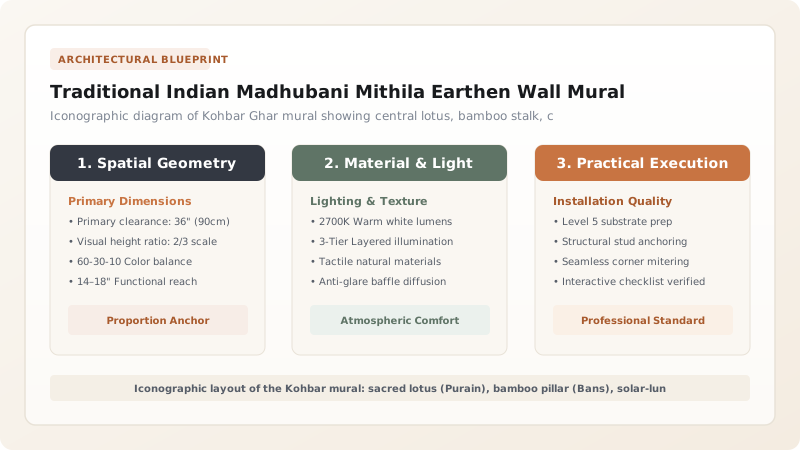
At the epicenter of the master Kohbar mural sits the monumental Purain (the sacred water lotus). Its giant circular leaf and radiating petals represent the divine feminine principle (Shakti), maternal fertility, and the cosmic womb. Piercing the center of the lotus is the Bans (the phallic bamboo stalk), representing the masculine principle (Purusha), structural strength, and the uninterrupted continuity of the family lineage. Surrounding this sacred axis are fertility talismans: swimming fish (representing abundance and water sanctity), paired parrots (erotic love and fidelity), sea turtles (longevity and the foundational support of the cosmos), and the radiant discs of Surya (the Sun) and Chandra (the Moon), who serve as eternal celestial witnesses to the marriage vows.
Earthen Lepana Canvas & Kalam Stylus Dynamics
The physical canvas of a Madhubani mural is an organic continuation of the earth. Before a single stroke of ink is laid, the peasant wall undergoes lepana (or lipai)—the ritual smoothing of the substrate using a slurry of sacred zebu cow dung (gobar) blended with alluvial yellow river clay (pila mitti). This organic render is swept across the wall in overlapping circular arcs with bare hands. As it dries, it forms a velvety, non-reflective, dust-free plane with a warm greenish-ochre hue that provides the ideal tooth for water-based pigments.
Drawing upon this soft earthen ground demands delicate touch. Metal pens or stiff bristle brushes would scratch and gouge the clay. Instead, artists fashion the kalam—a stylus crafted from split green bamboo twigs or tall river reeds. The writing end is whittled into a blunt point and wrapped in a dense wad of unspun, raw cotton fleece secured with fine thread. When dipped into ink made of mustard-oil soot, the cotton acts as a fluid capillary reservoir, feeding pigment smoothly down the bamboo tip. This enables the artist to trace continuous, graceful double-outline contours without tearing the plaster substrate.
Chromatics of the Earth: Pure Botanical & Mineral Formulations
Traditional Mithila art recognizes no synthetic industrial tubes. The artist’s palette is an edible, non-toxic chemistry derived entirely from local botany and minerals. The foundational line color is a velvety, indelible black (kajal), harvested by holding earthen saucers over flickering terracotta lamps fueled by cold-pressed mustard oil. Deep yellow is extracted from fresh raw turmeric rhizomes (haldi), while a pinch of slaked lime putty added to turmeric induces an immediate chemical shift, creating brilliant vermilion-red.
Brilliant blues come from fermented plant cakes of wild indigo (neel), greens are crushed from broad beans (sem ke patte) and creeping nightshade leaves, and brilliant saffron-oranges are brewed from the sun-dried blossoms of the flame-of-the-forest tree (Palash / Butea monosperma). Every pigment is bound with viscous natural gum tapped from the bark of the local babul tree (Acacia nilotica). When applied to the lime-clay plaster, these natural colors fuse chemically with the porous substrate, radiating a warm, biophilic resonance that has preserved the spiritual soul of rural Mithila for millennia.
Stylistic Traditions & Sacred Spatial Taxonomy in Mithila Murals
Use this reference table to calculate exact physical dimensions, ratios, and specifications before purchasing:
| Style / Domain | Chamber Location | Stylus & Line Technique | Color Palette | Symbolic Significance |
|---|---|---|---|---|
| Kohbar Ghar (Bridal Chamber) | Interior bridal room | Dense double outlines + fine kachni hatching | Vibrant crimson, ochre, indigo, and black | Cosmic fertility, conjugal longevity, lotus & bamboo union |
| Gosain Ghar (Deity Shrine) | Family prayer alcove | Geometric yantras & iconographic profiling | Saffron yellow, vermilion, sacred soot black | Divine protection, lineage blessings, kuldevata invocation |
| Kachni Style | Veranda feature walls | Microscopic parallel cross-hatching (no solid fills) | Monochrome lampblack or sepia wash | Intellectual restraint, linear intricacy, spiritual focus |
| Bharni Style | Ceremonial living halls | Bold outlines filled with solid, saturated flat color | High-contrast primary hues (red, yellow, blue) | Celebration of agricultural abundance, sensuality, joy |
| Godna / Gobar Style | Courtyard perimeter walls | Stippled concentric rings and tattoo-inspired glyphs | Raw cow dung wash, kajal, diluted earth ochres | Ancestral empowerment, protective talismans, organic grounding |
Practical Constraints
Every successful decoration project must account for physical and environmental constraints:
Extreme monsoon humidity and damp wall swelling in the Gangetic plains
Unsealed organic murals suffer mold growth and pigment bleeding during July–August monsoons Mitigation: Incorporate neem leaf extract and copperas (kasis) into clay plasters as natural antifungal preservatives
Fugitive nature of natural organic dyes under direct sunlight exposure
Turmeric yellow and palash orange fade significantly when exposed to direct exterior solar rays Mitigation: Confine natural botanical dyes to sheltered indoor chambers and use lightfast mineral ochres for outdoor walls
Execution Blueprint & Craftsmanship Sequence
Execute this professional sequence to achieve flawless results without backtracking:
Substrate Cleaning & Base Repair
Scrape loose dust from the sun-dried mud or brick wall, filling hollows with a mix of sticky river silt and fine sand.
Cow Dung & Clay Lepana Plastering
Mix fresh zebu cow dung with yellow clay (chikni mitti) and water, applying in smooth, overlapping circular hand sweeps (lipai).
Drying & Carbonation Period
Allow the earthen plaster to dry slowly in shaded ambient air for 48 hours until it cures into a velvety, matte greenish-ochre ground.
Bamboo Kalam Stylus Fashioning
Sharpen slender bamboo twigs into chisel points, wrapping the tips with unspun raw cotton wool bound tightly with fine thread.
Lampblack Ink Preparation
Collect pure soot from mustard oil clay lamps (diyas) on earthenware saucers, grinding with gum arabic (babul gond) and water.
Double-Outline Contour Drawing
Dip the cotton-wrapped kalam into black ink, sweeping freehand double-outline contours across the wall to define all figures.
Kachni Linear Texturing
Fill the space between parallel outlines and internal anatomy with hair-thin diagonal hatching and stippling using a sharp reed stylus.
Bharni Polychromatic Color Infusion
Apply saturated natural washes of turmeric yellow, fermented indigo blue, and palash flower orange using soft cotton rag pads.
Common Mistakes & Countermeasures
Avoid these costly errors that compromise aesthetics, ergonomics, and budget:
Applying Madhubani murals directly onto modern alkaline Portland cement plaster
Using commercial metal-ferrule synthetic paintbrushes for traditional line work
Drawing single-line outlines rather than traditional double contours filled with hatching
Project Execution Checklist
Track your physical progress. Checkboxes persist automatically on this device:
Frequently Asked Questions
What is the cultural and mythological origin of Madhubani painting?
According to regional epic lore, Madhubani (Mithila) painting originated during the Treta Yuga when King Janaka of Mithila commissioned village artists to decorate the entire kingdom and the nuptial chamber for the royal wedding of his daughter Sita to Prince Rama. For millennia, this sacred domestic art was passed down matrilineally from mother to daughter.
What is the central motif of the Kohbar Ghar bridal chamber?
The heart of the Kohbar mural is the 'Purain' (blooming lotus leaf) representing the bride, penetrated vertically by a stylized 'Bans' (bamboo stalk) representing the groom and phallic lineage vitality. Surrounding this central union are the sun, moon, fish (fertility), parrots (amorous love), and turtles (cosmic stability).
Why is cow dung essential to the wall preparation?
Indigenous zebu cow dung (gobar) contains rich lignified cellulose micro-fibers that prevent clay from cracking as it shrinks during drying. Furthermore, cow dung possesses natural bactericidal, insect-repellent, and antifungal enzymes that preserve earthen walls in hot, humid tropical climates while providing a warm, non-glare olive-ochre ground.
What are the primary differences between Kachni and Bharni styles?
Kachni translates to 'line work' and relies exclusively on intricate, monochromatic parallel cross-hatching, stippling, and fine geometric textures. Bharni translates to 'filling' and features broad areas of rich, saturated color washes contained within bold, black double outlines.