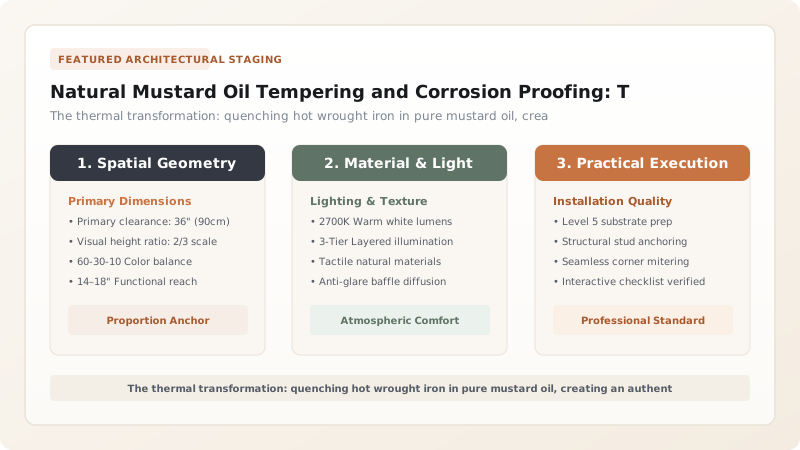
Natural mustard oil tempering and corrosion proofing is the traditional chemical and thermal finishing technique that gives Bastar Loha Shilp its distinctive velvety carbon-black patina and extraordinary rust resistance. By heating the completed wrought iron sculpture to dark red heat (600°C–650°C) and immediately quenching it in or brushing it with pure cold-pressed mustard oil (sarson ka tel), the organic fatty acids thermally polymerize into the microscopic pores of the iron, forming a durable, non-toxic magnetite-carbon protective barrier.
At a Glance: Key Takeaways
- Finish Medium: Pure cold-pressed mustard oil (Brassica juncea seed oil)
- Thermal Tempering Range: Dull dark red heat (600°C to 650°C)
- Chemical Barrier: Thermally polymerized fatty acid cross-linked carbon-black iron oxide layer
- Surface Sheen: Deep satin eggshell black with visible crystalline hammer facets
- Maintenance Protocol: Periodic wiped application of beeswax or mustard oil every 12 months
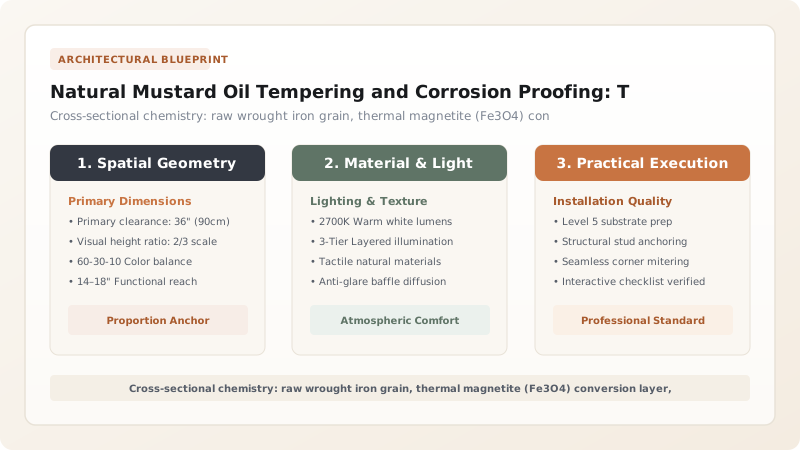
The Chemistry of Oil Quenching: Polymerization at 600°C
In the ancestral metallurgical wisdom of Indian blacksmiths, the final thermal treatment of wrought iron is not merely a method of cooling; it is an act of chemical synthesis. Known colloquially as sarson tel ka pani (quenching in mustard oil), this process transforms raw, silvery-gray hammered iron into an enduring, satin-black talisman. The physics of the process relies on thermal lipid polymerization.
When iron is heated to a dull dark red (approximately 600°C to 650°C), its crystalline lattice expands, opening microscopic pores on the metallic surface. When plunged into unrefined mustard oil, the extreme heat instantly breaks the carbon-carbon double bonds in the oil's unsaturated fatty acids. These reactive molecules cross-link into a dense, insoluble polymer network that penetrates deeply into the open iron pores. Simultaneously, oxygen from the oil reacts with the iron to form a micro-thin layer of black magnetite (Fe3O4)—a stable, non-flaking oxide that halts further corrosive oxidation.
Why Mustard Seed Oil: The Unique Role of Erucic Acid
Blacksmiths around the world have utilized various organic oils for quenching—from olive oil in the Mediterranean to whale oil in early industrial Europe. Yet within the Indian subcontinent, mustard oil (Brassica juncea) was discovered to possess chemical properties uniquely suited for metalsmithing. Cold-pressed mustard oil contains exceptionally high concentrations of erucic acid (a 22-carbon monounsaturated fatty acid) alongside oleic and linoleic acids.
Erucic acid exhibits a remarkably high smoke point and superior thermal stability, allowing it to withstand the violent thermal shock of contact with hot iron without instantly carbonizing into loose, chalky soot. Instead, it forms a cohesive, elastic, and rubbery polymer film that adheres tenaciously to the metal. Furthermore, natural glucosinolates and sulfur compounds inherent to mustard seeds contribute to the formation of a dark, uniform iron-sulfide passivation layer that imparts Bastar art with its iconic velvety depth.
Tactile Finish vs. Synthetic Coatings: The Sensory Dimension
The aesthetic appeal of authentic Bastar Loha Shilp is fundamentally tactile. Modern industrial metal finishes—such as electrostatic powder coating or synthetic black spray paints—deposit an impermeable, plastic film over the metal. This synthetic envelope rounds off crisp hand-hammered arrises, fills in subtle tool marks, and creates an artificial, cold plastic glare that completely obliterates the soul of hand craftsmanship.
In contrast, mustard oil tempering is a microscopic surface conversion. The polymerized black film is only a few microns thick, preserving every minute strike of the blacksmith’s hammer, the crisp edges of chiseled details, and the crystalline texture of the drawn iron. To touch an authentic Bastar sculpture is to feel the cool, solid weight of raw iron softened by an organic, satin-smooth skin that feels remarkably warm and human.
Conservation and Longevity in Modern Living Spaces
Bastar iron sculptures tempered in mustard oil and buffed with natural beeswax possess extraordinary longevity. When displayed in indoor residential or commercial environments with moderate humidity, they remain completely rust-free for generations without requiring chemical intervention. Unlike painted iron, which blisters when moisture penetrates through a scratch, an oil-tempered surface is chemically integrated with the underlying metal.
Heritage conservation requires minimal effort. Homeowners and curators should avoid washing the sculpture with harsh household detergents or water, which can strip the protective organic lipids. An annual dusting followed by a light wipe with a soft cotton cloth dampened with a single drop of virgin mustard oil or paste beeswax is all that is required to nourish the polymer layer, ensuring that the ancient, dark majesty of Bastar’s tribal forges continues to glow with timeless resonance.
Metal Finishing Systems for Wrought Iron Decor: Performance Comparison
Use this reference table to calculate exact physical dimensions, ratios, and specifications before purchasing:
| Finishing System | Application Temperature | Chemical Mechanism | Tactile Surface Quality | Reversibility / Restoration |
|---|---|---|---|---|
| Mustard Oil Hot Tempering | 600°C (Dull dark red) | Thermally baked lipid polymerization + black magnetite layer | Velvety, organic satin-black; showcases hammer facets | Easily refreshed indefinitely by re-wiping with warm oil |
| Modern Synthetic Spray Paint | Ambient room temperature | Solvent evaporation leaving acrylic/alkyd plastic film | Chalky, artificial, plastic skin; obscures metal texture | Difficult; requires toxic chemical strippers or abrasive blasting |
| Chemical Gun Bluing (Selenium) | Cold / ambient application | Chemical conversion to copper-selenium blackening | Cold, gunmetal blue-gray; prone to streakiness on raw iron | Poor; easily scratched and offers low moisture protection |
| Commercial Powder Coating | 200°C baking oven | Electrostatic polyester powder melted into plastic shell | Thick, rounded, glossy plastic casing; destroys craft soul | Irreversible without extreme industrial pyrolysis or burning |
Practical Constraints
Every successful decoration project must account for physical and environmental constraints:
Pungent Fumes and Smoke Generation during Quenching
Vaporizing mustard oil releases intense allyl isothiocyanate fumes that severely irritate eyes and lungs. Mitigation: Perform the quenching operation outdoors or beneath open-sided forge canopies with active cross-ventilation.
Surface Sweat in High-Humidity Coastal Environments
Marine salt-air accelerates electrolytic corrosion, penetrating micro-porosities in the baked oil film. Mitigation: Apply an additional protective sealant layer of microcrystalline wax or paste carnauba wax over the oil temper.
Execution Blueprint & Craftsmanship Sequence
Execute this professional sequence to achieve flawless results without backtracking:
Surface De-Scaling and Cleansing
Buff the forged sculpture with steel wire brushes to remove all loose forging scale, charcoal dust, and silica ash from crevices.
Even Thermal Soaking in the Hearth
Place the sculpture into the gentle peripheral embers of the bhati, turning it continuously to achieve an even thermal saturation of 600°C to 650°C.
Oil Trough Preparation and Safety Setup
Fill a heavy steel trough with pure unrefined mustard oil, keeping a fire blanket and sand bucket nearby in case of localized oil flare-ups.
Thermal Extraction and Immediate Quenching
Lift the dark-red glowing sculpture with tongs and submerge it smoothly into the oil trough, holding it beneath the surface for five to ten seconds.
Swabbing Intricate Detail Zones
For oversized pieces that cannot submerge, place the hot iron over a draining tray and swab boiling mustard oil over every contour using a dense cotton mop.
Thermochemical Polymerization Reaction
Observe the intense smoke as high heat breaks down the mustard oil fatty acids, bonding carbon and iron into a black oxide surface matrix.
Vigorous Burlap Buffing and De-Greasing
While the iron is still hot (approx. 120°C), rub the entire sculpture aggressively with coarse jute burlap sacks to strip excess oil and burnish the black skin.
Beeswax Sealant Infusion
While the metal cools to hand-warmth (50°C), rub a block of pure raw beeswax over the sculpture; the wax melts into microscopic pores, leaving a soft eggshell luster.
Common Mistakes & Countermeasures
Avoid these costly errors that compromise aesthetics, ergonomics, and budget:
Quenching iron when it is too hot (bright orange or yellow heat, 900°C+)
Using modern petroleum-based motor oil or chemical gun bluing
Leaving heavy, unburned pools of mustard oil on the iron surface
Project Execution Checklist
Track your physical progress. Checkboxes persist automatically on this device:
Frequently Asked Questions
Why is mustard oil used instead of linseed, coconut, or mineral oil?
Mustard oil (sarson ka tel) is uniquely high in erucic acid (over 40%) and long-chain unsaturated fatty acids. When exposed to hot iron (600°C), these specific fatty acids polymerize rapidly through thermal cross-linking, transforming into a tough, impermeable carbonaceous enamel that bonds directly to the porous iron surface. Furthermore, mustard oil contains natural sulfur compounds that react with iron to form a dark, rust-inhibiting iron sulfide and black magnetite film.
Will a mustard-oil-tempered sculpture smell like cooking oil in my home?
No. The pungent smell of mustard oil (caused by volatile allyl isothiocyanate) is completely vaporized and driven off during the high-heat quenching process. Once cooled and buffed with beeswax, the finished sculpture is entirely odorless, non-greasy to the touch, and will not soil hands or light-colored furniture.
What should I do if a Bastar iron sculpture develops small spots of orange rust?
Restoring the finish is simple and non-destructive. Do not use sandpaper. Instead, rub the rusty spot gently with fine steel wool (grade 0000) dipped in a drop of mustard oil or mineral oil until the orange rust flakes off. Wipe clean with a cloth and apply a tiny dab of clear beeswax, buffing lightly to restore the uniform satin-black patina.
Is mustard-oil-treated iron safe for outdoor garden display?
While mustard oil provides excellent protection for indoor and covered veranda environments, prolonged exposure to direct driving rain and standing water will eventually breach the oil-wax barrier. For permanent outdoor garden installations, apply a clear exterior architectural paste wax or breathable silane-siloxane impregnator once a year to maintain rust-free longevity.