The búbos kemence (beehive bread oven) is the monumental architectural and spiritual heart of the traditional Kalocsa home. Hand-sculpted from clay, chopped straw, and horse manure over a wicker or brick armature, this domed earthen oven features a broad sitting bench (padka) and an arched baking vault. The massive curved clay surface is finished with dense slaked lime whitewash burnished glassy-smooth with woolen cloths, then lavishly painted by pingálóasszonyok with heat-resistant mineral floral murals celebrating domestic warmth and bounty.
At a Glance: Key Takeaways
- Architectural Typology: Domed earthen masonry bread oven & thermal heater (Búbos kemence)
- Structural Core: Woven willow wicker armature covered in clay, straw, and horse manure
- Whitewash Formula: Aged slaked fat lime putty burnished with woolen rags (szöszölés)
- Thermal Mass Capacity: Retains and radiates heat for 24 to 36 hours from a single wood firing
- Sacred Domestic Role: Baking sourdough bread, room heating, elder sleeping bench, and floral altar
The Cosmic & Thermal Heart of the Hungarian Homestead
In the traditional peasant architecture of the Great Hungarian Plain, a house was not considered a home until its furnace was born. Positioned in the corner of the main living room (tiszta szoba or konyha), the búbos kemence (beehive bread oven) was far more than an appliance for baking crusty sourdough loaves; it was the sacred physical and emotional anchor of domestic life.
Built by local itinerant stove-builders (kemenceépítő mesterek) in cooperation with the family, the oven is a monumental organic sculpture. Its swelling, domed form—evoking both the feminine womb and the maternal breast—was constructed using zero industrial metal. Functioning on pure thermal mass, the kemence absorbed heat from burning dried maize stalks, wheat straw, and locust-tree branches, storing thermal energy within its two-ton earthen core and slowly radiating soothing warmth through freezing winter blizzards.
Wicker Armatures & Composite Clay-Dung Engineering
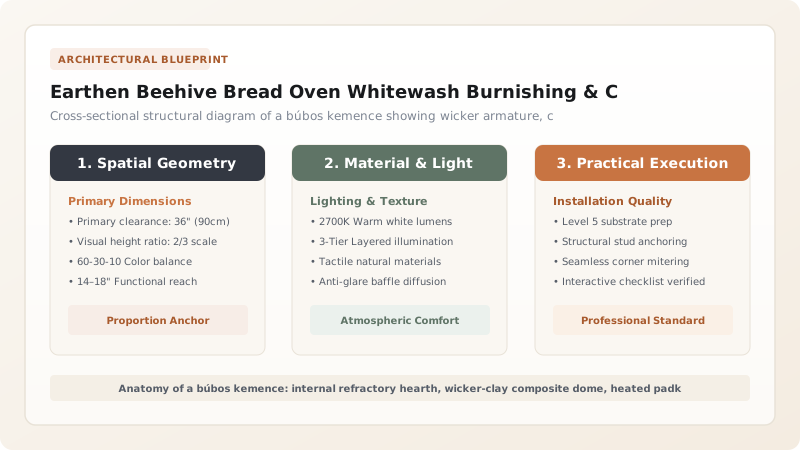
The construction of a búbos kemence is an ancient craft combining basketry and masonry. On a raised foundation of dense, low-fired bricks, the builder weaves an armature from supple, green willow or hazel withies (vesszőváz), forming an inverted dome or beehive shape roughly 1.5 meters in diameter and 1.6 meters tall. The arched doorway of the baking vault (kemenceszáj) is framed with selected fireclay bricks.
Over this flexible woven basket, the builder applies the sározás—a composite mud plaster formulated from sticky yellow river clay, fine sand, chopped straw chaff, and fresh horse manure. Horse manure is essential: its partially digested cellulose fibers form a microscopic tensile mesh that bridges thermal expansion stress, while its organic bile salts increase the clay’s plasticity. Applied in successive 50 mm layers and compacted with wooden paddles, the wall thickness reaches 150 to 200 mm, creating an airtight, refractory envelope capable of enduring centuries of continuous thermal cycling.
The Craft of Lime Burnishing (Szöszölés): Achieving Porcelain Smoothness
Once the massive clay dome has air-cured in shaded conditions for a month and received low-temperature commissioning fires, its exterior surface is transformed from rough brown mud into a gleaming white architectural jewel. The finish is not modern synthetic paint, but high-calcium slaked fat lime putty (oltott mész) applied in multiple creamy coats.
The critical vernacular technique is szöszölés (wool burnishing). While the final, fourth coat of lime whitewash is still slightly damp, the women take coarse, unwashed sheep’s wool rags or dense felt pads and rub the curved dome in vigorous, overlapping circular motions. This friction action crushes the soft calcium hydroxide crystals, forcing them into microscopic surface pores and aligning the calcite platelets. As the lime carbonates under atmospheric contact, the matte plaster cures into an extraordinarily smooth, dense, non-dusting porcelain-like finish that feels cool, silky, and stone-hard to the touch.
The Floral Altar: Iconography on the Heated Dome
With the white dome gleaming like a miniature snow-covered hill inside the room, the pingálóasszonyok were invited to perform their sacred decorative art. Painting on a curved, dome-like surface requires immense spatial skill; lines must bend across three dimensions without appearing distorted from eye level. The artists divided the oven into distinct visual registers.
Around the arched firebox mouth, a bold border of stylized wild tulips and climbing vines framed the glowing fire. Across the broad swelling crown of the dome (a kemence búbja), the painter executed the masterwork: a colossal, symmetrical bouquet of lush peonies, wild roses, forget-me-nots, and ripe red paprika pods tied with a painted festive silk ribbon. Along the base of the heated sitting bench (padka), where family members sat to warm their feet, continuous wavy border friezes ran horizontally, grounding the sculpture. Using heat-stable mineral oxide pigments bound with egg white and milk casein, these radiant murals never scorched or faded, transforming the humble clay bread oven into an eternal, flowering altar celebrating the warmth of hearth and home.
Búbos Kemence Anatomy & Surface Finish Specifications
Use this reference table to calculate exact physical dimensions, ratios, and specifications before purchasing:
| Stove Component | Operating Surface Temp | Material Formulation | Decorative Treatment | Thermal Function |
|---|---|---|---|---|
| Dome Crown (Búb) | 60°C–80°C | Straw-reinforced alluvial clay + horse dung | Grand central floral bouquet (virágcsokor) | Thermal heat accumulation and radiant release |
| Firebox Mouth (Kemenceszáj) | 180°C–250°C | Refractory fireclay + crushed grog | Unpainted or black soot border margin | Combustion chamber & bread baking arch |
| Sitting Bench (Padka) | 35°C–45°C | Rammed earth + brick facing + lime screed | Undulating floral vine borders and dot fringes | Gentle radiant warmth for human sitting/sleeping |
| Smoke Hood (Kéményalja) | 50°C–70°C | Clay-lime plaster over timber lath | Cascading paprika swags and tulip sprays | Channels smoke into attic flues while heating room |
| Ash Pit (Hamuzó) | Ambient to 40°C | Solid low-fired brickwork | Dark charcoal or soot-tinted lime band | Catches cold embers; protects surrounding floor |
Practical Constraints
Every successful decoration project must account for physical and environmental constraints:
Violent thermal expansion and contraction during winter bread-baking cycles
Hairline stress fissures open across the curved whitewashed dome surface Mitigation: Incorporate horse manure and finely cut cattle hair to provide elastic micro-mesh tensile bridging
Soot smudging during the removal of hot sourdough bread loaves from the oven mouth
Airborne soot blackens the lower white plaster around the firebox archway Mitigation: Paint a dark protective charcoal border band around the firebox arch to frame the opening
Execution Blueprint & Craftsmanship Sequence
Execute this professional sequence to achieve flawless results without backtracking:
Foundation Plinth & Hearth Bedding
Build a massive 1.5 x 1.5 m brick foundation plinth elevated 400 mm, bedding an inner floor of smooth refractory firebricks.
Wicker Armature Weaving
Weave a flexible dome-shaped wicker framework from fresh green willow shoots, anchoring the bases into the foundation brickwork.
Clay, Dung & Straw Layering
Pack a dense, stiff mixture of yellow clay, chopped wheat straw, and fresh horse manure 150 mm thick over the wicker dome.
Padka Heated Bench Sculpting
Sculpt a wide, comfortable sitting bench (padka) around the base of the dome using rammed earth and clay mortar.
30-Day Shaded Air Curing
Allow the massive clay dome to dry slowly in shaded interior air for a full month until all shrinkage has ceased.
Multi-Coat Lime Whitewashing
Apply four thick, cross-directional coats of pure aged slaked lime putty wash across the curved dome and bench.
Woolen Cloth Burnishing (Szöszölés)
While the final lime coat is damp, buff the entire curved dome vigorously with coarse woolen rags to polish the surface.
Folk Floral Fresco Painting
Paint grand multi-layered floral bouquets, peonies, and paprika pods across the dome and padka using mineral distemper.
Common Mistakes & Countermeasures
Avoid these costly errors that compromise aesthetics, ergonomics, and budget:
Firing the clay beehive oven immediately with a roaring wood fire after building
Applying synthetic chemical glazes or heat-resistant automotive paints to the oven
Painting over greasy creosote or soot deposits around the firebox opening
Project Execution Checklist
Track your physical progress. Checkboxes persist automatically on this device:
Frequently Asked Questions
Why is horse manure used in building the búbos kemence?
Horse manure contains undigested pasture grasses broken down into fine, resilient, uniform cellulose fibers. When mixed with clay, these fibers act as thousands of tiny reinforcing rebars that absorb thermal expansion stresses, completely preventing large cracks from forming when the oven heats up to baking temperatures.
What does the word 'búbos' mean in Hungarian?
Búbos translates to 'crested', 'tufted', or 'having a hump'. It refers to the gentle, organic, swelling dome shape of the oven, which resembles a rounded hillock or an inverted traditional clay beehive rising organically from the floor.
How long does a búbos kemence stay warm after firing?
Due to its colossal thermal mass—often comprising over two metric tons of dense clay, brick, and sand—a single firing with dried corn stalks or hardwood branches heats the oven core to 250°C for bread baking, and continues to radiate gentle 25°C to 40°C heat into the room for 24 to 36 hours.