Kalocsa floral folk fresco painting (pingálás) is a celebrated Hungarian vernacular decorative craft originating on the Great Hungarian Plain (Alföld) along the Danube River. Historically practiced by gifted village women known as pingálóasszonyok, freehand floral murals adorn whitewashed adobe cottages, covered porches (tornác), clean rooms (tiszta szoba), and monumental beehive bread ovens (búbos kemence). Using slaked lime undercoats, milk-casein binders, and vibrant mineral pigments, artists paint local flora including iconic red paprika pods, lush peonies, tulips, and forget-me-nots.
At a Glance: Key Takeaways
- Geographic Origin: Kalocsa region (Sárköz / Danube Basin), Bács-Kiskun County, Hungary
- Folk Painters: Village women painters known as Pingálóasszonyok (e.g. Master Ilus Király)
- Substrate Architecture: Sun-dried adobe brick cottages (vályog) & domed clay ovens (búbos kemence)
- Iconic Botanical Motifs: Red spice paprika (fűszerpaprika), peonies (bazsarózsa), tulips, forget-me-nots
- Binding Medium: Slaked fat lime putty (oltott mész) and curdled milk-casein (túrós mész)
In-Depth Guides in this Directory
Explore specialized subtopic blueprints, technical dimensions, and execution checklists:
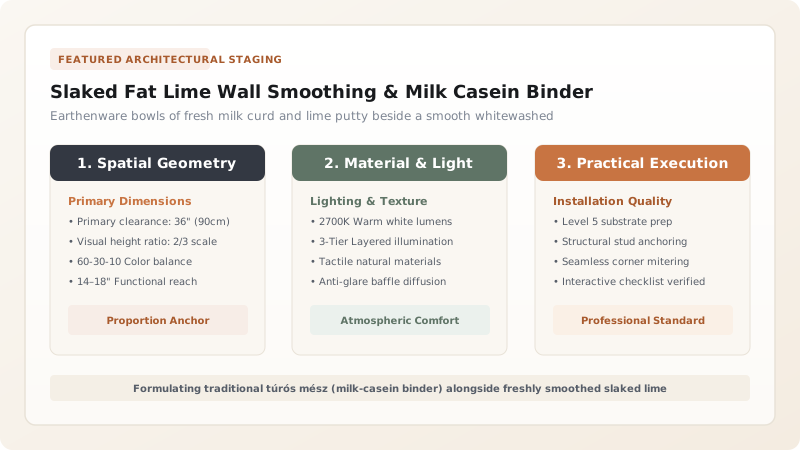
Slaked Fat Lime Wall Smoothing & Milk Casein Binders in Kalocsa Fresco Craft
Learn authentic Hungarian slaked fat lime plastering and milk-casein paint formulation (túrós mész) for traditional Kalocsa murals.
Freehand Paprika & Peony Porch Border Painting & Stenciling in Kalocsa Folk Art
Master freehand porch border painting (pingálás), paprika pod motifs, and peony garlands in traditional Kalocsa Hungarian folk architecture.
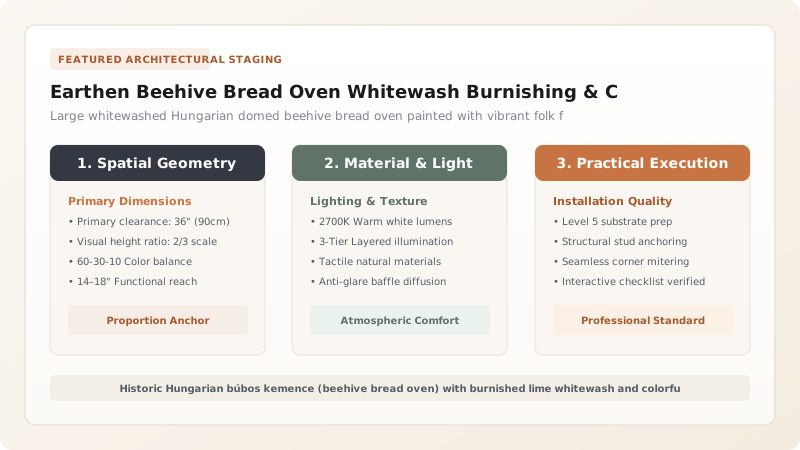
Earthen Beehive Bread Oven Whitewash Burnishing & Ceramic Stove Art
Explore the sculptural construction, lime burnishing, and floral mural art of traditional Hungarian búbos kemence beehive bread ovens.

The Vernacular Adobe Architecture of the Great Hungarian Plain
In the vast, sun-drenched lowlands of the Great Hungarian Plain (Alföld), where the Danube River meanders through rich alluvial silt banks, vernacular architecture was historically shaped by mud, straw, and reeds. In the historic market town of Kalocsa and its surrounding agrarian hamlets, peasant homesteads were constructed using vályog—massive sun-dried mud bricks made from dense river clay, river sand, and chopped straw.
These thick, monolithic adobe walls provided exceptional thermal mass, buffering scorching 38°C summer heatwaves and insulating against freezing Carpathian winter winds. To protect the water-soluble clay bricks from rain erosion, cottages were rendered in slaked lime plaster and enveloped in deep, pillared open porches called tornác. It was across these brilliant white, sunlit porch colonnades and interior vaults that the women of Kalocsa developed one of Europe's most exuberant floral mural traditions: the art of pingálás.
The Pingálóasszonyok: The Master Painter Women of Kalocsa
In traditional rural Hungarian society, architectural mural painting was an exclusively female domain. The practitioners were not academically trained studio painters; they were agrarian village women celebrated as pingálóasszonyok ('painting women'). Passed down through maternal lineages, the craft required astonishing hand-eye coordination, spatial balance, and botanical memory.
A master painter like the legendary Ilus Király (1886–1966) worked entirely freehand, carrying no rulers, compasses, carbon stencils, or preliminary charcoal outlines. Standing upon wooden benches before a freshly whitewashed wall, the painter dipped handmade brushes into saucers of milk-casein paint, sweeping sweeping curves, circular rosettes, and serrated leaves onto the plaster in a continuous kinetic trance. The artist adapted the scale and rhythm of the floral garland spontaneously to the architectural proportions of the room, turning window lintels, door surrounds, and ceiling arches into living botanical frames.
Botanical Iconography: From Paprika Pods to Imperial Peonies
The visual lexicon of Kalocsa painting is an exuberant celebration of local agricultural botany. Surrounding Kalocsa are endless fields of fűszerpaprika—the pungent spice pepper that became the culinary and economic identity of Hungary. In the hands of the pingálóasszonyok, the long, curving, tapering silhouette of the red paprika pod became an iconic architectural motif, painted hanging in lush clusters among twisting green tendrils.
Alongside paprika, the murals feature the bazsarózsa (lush double-petaled garden peony), the tulipán (sacred tulip representing female fertility and beauty), wild roses, cornflowers (búzavirág), and delicate blue forget-me-nots (nefelejcs). Historically, the palette evolved through distinct phases: during the 19th century, painters used subdued indigo, black, and madder violet—a phase known as szomorúpamukos ('sad cotton colors'). In the early 20th century, the introduction of affordable mineral pigments sparked an explosion of joyful polychromy, dominated by brilliant scarlet, marigold yellow, and emerald green.
The Sacred Center: The Búbos Kemence Bread Oven
The ultimate architectural canvas in the Kalocsa peasant interior was the búbos kemence—the monumental, dome-shaped earthen bread stove that dominated the corner of the living room. Hand-sculpted from a mixture of river clay, chopped straw, and horse manure over a wicker armature, this colossal organic sculpture featured a sleeping bench (padka) along its base and an arched firebox for baking sourdough rye loaves.
Whitewashed with dense coats of slaked lime milk burnished smooth with woolen rags, the curved dome of the kemence stood like a gleaming white hillock inside the room. Across its undulating, warm masonry faces, the pingálóasszonyok painted lavish, symmetrical bouquets that seemed to sprout from the hearth itself. Far from a decorative luxury, these floral murals were an act of domestic consecration—a perpetual springtime garden blooming beside the glowing fire that sustained family life through the bleak Hungarian winter.
Architectural Canvas Zones in Kalocsa Folk Dwellings
Use this reference table to calculate exact physical dimensions, ratios, and specifications before purchasing:
| Architectural Zone | Wall Substrate | Paint Vehicle | Iconographic Composition | Durability Profile |
|---|---|---|---|---|
| Covered Porch (Tornác) | Sun-dried adobe (vályog) + lime plaster | Milk-casein distemper (túrós mész) | Continuous horizontal frieze garlands (koszorú) | 2–3 years; refreshed annually for Easter |
| Beehive Bread Oven (Kemence) | Clay, straw, and horse manure dome | Fat lime wash + egg yolk tempera | Cascading bouquets around fire mouth and bench | 3–5 years depending on wood-firing cycles |
| Clean Room (Tiszta Szoba) | Smooth lime plaster on adobe | Skim milk + powdered mineral pigments | Corner bouquets, window frames, and beam borders | 10–20 years in dry sheltered interiors |
| Street Gable Pediment | Exterior rendered brick / adobe | Potassium silicate or hydraulic lime | Monumental heraldic floral wreaths and dates | 5–8 years under deep roof overhangs |
| Timber Ceiling Beam (Mestergerenda) | Solid Scots pine timber | Animal hide glue / casein paint | Geometric rosettes, vine scrolls, family initials | Permanent interior heirloom preservation |
Practical Constraints
Every successful decoration project must account for physical and environmental constraints:
Heavy seasonal driving rain and splashing mud along exterior porch bases
Lower 400 mm of lime whitewash and painted floral borders erode under water impact Mitigation: Apply a durable, dark soot-tinted plinth band (lábazat) along the base to mask dirt spatter
Thermal expansion hairline cracking across the domed clay bread oven
Fissures open through the whitewashed surface, disrupting painted floral motifs Mitigation: Reinforce oven finish plaster with chopped cattle hair and fine flax fibers before painting
Execution Blueprint & Craftsmanship Sequence
Execute this professional sequence to achieve flawless results without backtracking:
Adobe Substrate Leveling
Inspect sun-dried adobe brick walls, repairing hollows with a pliable paste of local yellow clay, fine sand, and chopped straw.
Fat Lime Whitewash Preparation
Dilute well-aged slaked lime putty with rainwater to milk consistency, adding a pinch of ultramarine blue to counteract yellow tones.
Base Whitewash Application
Apply three uniform coats of lime whitewash across the walls and porch colonnades using broad horsehair whitewash brushes.
Milk-Casein Medium Formulation
Blend fresh unpasteurized cottage cheese curds (túró) with slaked lime putty until the protein dissolves into a clear adhesive glaze.
Mineral Powder Pigment Grinding
Mull dry earth oxides, cinnabar red, chrome yellow, ultramarine blue, and vine black on stone slabs, mixing into the casein vehicle.
Freehand Vine & Stalk Layout
Stroke undulating green stem lines and vine branches across the white wall without stencils, establishing rhythmic floral nodes.
Focal Floral Painting (Pingálás)
Paint bold red paprika pods, lush peonies (bazsarózsa), and wild tulips using smooth, calligraphic brush sweeps.
Detailing, Veining & Pollen Dots
Add delicate serrated leaf margins, spiraling tendrils, and bright yellow pollen dots to give visual depth to the garden composition.
Common Mistakes & Countermeasures
Avoid these costly errors that compromise aesthetics, ergonomics, and budget:
Applying synthetic latex or acrylic paints over traditional earthen adobe walls
Using mechanical stencils for authentic Kalocsa architectural murals
Painting floral murals directly over freshly plastered, uncured lime renders
Project Execution Checklist
Track your physical progress. Checkboxes persist automatically on this device:
Frequently Asked Questions
Who were the 'pingálóasszonyok' of Kalocsa?
Pingálóasszonyok (literally 'painting women') were exceptionally gifted village women in the Kalocsa region who specialized in freehand architectural and domestic murals. Highly respected in agrarian communities, they were hired by neighbors ahead of major holidays, weddings, and village festivals to transform drab whitewashed walls into flowering gardens.
What is the historical significance of the paprika motif in Kalocsa art?
Kalocsa is the historic paprika capital of Hungary. Introduced in the 18th century, the bright red spice pepper (fűszerpaprika) became the economic lifeblood of the region. Village artists embraced the curved, vibrant red silhouette of the hanging paprika pod as a proud regional emblem, incorporating it alongside peonies and tulips.
What is a 'búbos kemence' and why was it painted?
A búbos kemence is a colossal, dome-shaped earthen beehive bread oven built in the main living space of a traditional Hungarian peasant house. Functioning as the thermal hearth, bakery, and winter bed, it was the cosmic center of family life. Whitewashing and painting it with lush floral murals honored the hearth and brought springtime cheer through bleak winters.
Why did Kalocsa painting transition from 'sad colors' to bright polychromy?
In the 19th century, painters were limited to natural indigo, soot black, and muted madder purples (a palette known as szomorúpamukos or 'sad colors'). Around the 1910s and 1920s, affordable synthetic mineral pigments became available in regional markets, unleashing an explosion of vibrant scarlet reds, canary yellows, and emerald greens.