The defining brilliance of Lippan Kaam is the integration of reflective glass mirrors (abhla) and luminous slaked lime whitewash (khadi). Before the embossed mud coils harden, artisans press hand-cut geometric and convex glass mirrors directly into the wet clay compartments. The surrounding mud forms a mechanical bezel that locks the glass edges without chemical adhesives. Once dry, the entire relief is coated with multiple layers of refined slaked lime wash, creating a dazzling, chalky-white surface that bounces desert thermal heat and transforms a solitary oil lamp into a glittering constellation of reflected light.
At a Glance: Key Takeaways
- Mirror Varieties: Abhla (convex blown glass bubbles, diamonds, circles, & triangles)
- Mounting Mechanism: Mechanical clay bezel crimping (zero synthetic chemical adhesives)
- Whitewash Coating: Refined slaked fat lime (Khadi / Chuna) + Acacia gum binder
- Optical Function: Specular reflection & convex wide-angle light scattering across dark rooms
- Thermal Reflection: High solar reflectance index (SRI > 85), cooling desert dwellings
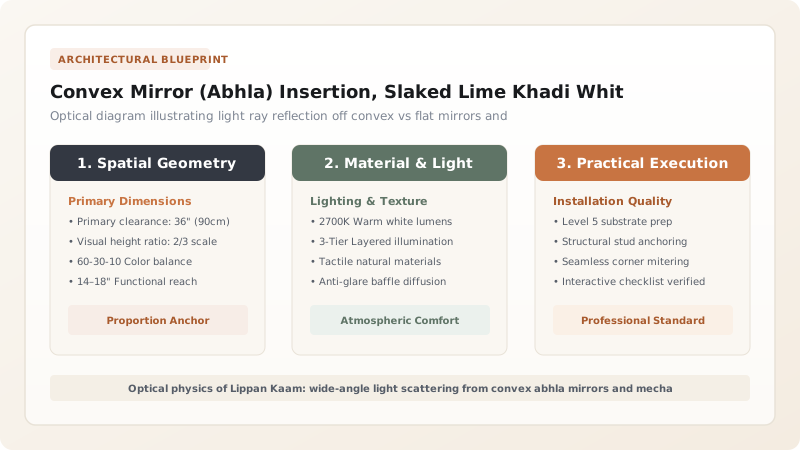
The Optical Miracle of the Desert Mirror: The Abhla
In the austere, sun-scorched expanse of the Rann of Kutch, where water is scarce and the earth is shades of dust and salt, the reflection of light is treated as sacred. In traditional Gujarati domestic architecture, this reverence culminated in the integration of abhla—small, shimmering glass mirrors embedded directly into the structural earthen skin of the home.
Before the advent of modern sheet glass, mirrors were precious luxury commodities. In the historic villages of Kutch, craftsmen utilized fragments of hand-blown, thin-walled glass bubbles silvered on their interior concave surfaces. When fractured, these shards formed small convex mirrors. Unlike flat mirrors that only reflect light in a single, narrow beam, a convex mirror acts as a wide-angle scattering lens, gathering ambient daylight or lantern glow from all angles and dispersing it back into the room as a brilliant, twinkling starburst.
The Mechanical Bezel: Adhesive-Free Glass Setting
One of the most astonishing aspects of authentic Lippan Kaam is that the thousands of glass mirrors adorning a wall are secured with zero synthetic glue, resin, or chemical adhesive. Modern adhesives are unsuited for earthen walls: chemical solvents degrade the silver nitrate backing of mirrors, while thermal expansion causes rigid glues to shear off clay surfaces.
Instead, the mirror is set using classical mechanical bezel capture. While the embossed mud coils are in their 'leather-hard' plastic state—neither fully wet nor dry—the artisan gently presses the mirror into its designated mud compartment. Using a curved wooden stylus, the soft lip of the surrounding clay coil is pushed over the outer perimeter of the glass by less than a millimeter. As the clay dries and shrinks slightly, it grips the beveled glass edge in a permanent, tight mechanical embrace that holds for generations.
Khadi Alchemy: The Slaked Lime Radiance
Once the mud relief and embedded mirrors have completely cured, the entire surface is unified through the application of khadi (also known as chuna or slaked fat lime). Sourced from calcined seashells or high-calcium desert limestone, the lime is slaked in water and sieved through multiple layers of muslin to yield an ultra-fine, silky white cream.
Applied in three to five whisper-thin coats using soft brushes, the lime wash penetrates into the porous clay. As it absorbs atmospheric CO2, it undergoes carbonation, converting into crystalline calcium carbonate (calcite). The resulting surface is not the sterile, artificial white of modern titanium house paint; it has a soft, luminous, crystalline glow resembling fine white chalk or unpolished Carrara marble. This brilliant white skin possesses an exceptionally high Solar Reflectance Index (SRI > 85), bouncing intense desert thermal radiation and keeping the interior of the bhunga delightfully cool.
Nocturnal Architecture: The Lantern Light Symphony
The ultimate magic of Lippan Kaam reveals itself after sunset. In the traditional villages of the Banni, where electricity was historically non-existent, family life unfolded in near-total darkness. Inside the circular, windowless bhunga, the mother of the household would light a single clay oil lamp (diya) filled with mustard or sesame oil.
The solitary flickering flame, positioned near the room’s center, strikes the white walls. Thousands of convex abhla mirrors catch the light, multiplying the single flame into a dazzling, three-dimensional constellation of dancing golden reflections. The circular walls dissolve into a shimmering kaleidoscope of light, turning a humble earthen hut built of mud and dung into a celestial palace that stands as one of the world's most poetic vernacular achievements.
Reflective Mirror Elements in Indian Vernacular Architecture
Use this reference table to calculate exact physical dimensions, ratios, and specifications before purchasing:
| Mirror Typology | Fabrication Method | Optical Behavior | Durability & Patina | Typical Application |
|---|---|---|---|---|
| Historic Convex Abhla | Hand-blown thin glass bubbles silvered on interior curve | Wide-angle hemispherical light scattering; sparkles at any angle | Heirloom antique patina; soft warm reflection | Authentic Kutch bhungas & heritage palace Shish Mahals |
| Modern Flat Cut Mirrors | Commercial sheet glass cut with diamond wheel cutters | Directional planar reflection; requires direct sightline to flash | Silvering prone to edge oxidization if damp | Contemporary craft panels, wall frames, and gifts |
| Faceted Acrylic Mirrors | Die-cut silvered polymethyl methacrylate (PMMA) | Moderate reflection; light weight; will not shatter | Scratches easily; yellows under desert UV exposure | Export craft items and lightweight student practice kits |
| Mica Flakes (Abhrak) | Natural cleaved mineral muscovite silicate sheets | Subtle pearlescent, translucent shimmer; non-mirrored | Impervious to moisture, rot, and UV radiation | Pre-modern tribal mud walls before glass became accessible |
Practical Constraints
Every successful decoration project must account for physical and environmental constraints:
Silvering Corrosion in Humid Coastal or Monsoonal Microclimates
Moisture seeping through porous clay attacks the back silver nitrate coating of flat mirrors, causing black rot. Mitigation: Seal the rear faces of mirrors with clear shellac or marine varnish before seating them into the wet clay.
Extremely High Lime Alkalinity Hazing Glass During Whitewash Application
High-pH calcium hydroxide etches untreated soft glass if left wet for prolonged periods. Mitigation: Clean the mirror faces promptly within 2 hours of whitewashing before carbonation hardens the calcite crust.
Execution Blueprint & Craftsmanship Sequence
Execute this professional sequence to achieve flawless results without backtracking:
Mirror Selection and Geometric Sorting
Sort hand-cut abhla mirrors into separate trays by geometry: 10 mm round centers, 8 mm diamond borders, 6 mm triangles, and focal convex hemispherical lenses.
Checking Clay Leather-Hard Consistency
Verify that embossed clay coils have rested for 6 to 12 hours. The dough must be firm enough to hold its shape but soft enough to yield under mirror insertion without cracking.
Mechanical Mirror Seating and Bezel Forming
Place the mirror into its designated compartment. Press down firmly with the flat pad of the fingertip, then use a boxwood spatula to nudge the surrounding clay coil over the glass edge by 0.5 mm.
Full Shaded De-Watering and Curing
Allow the entire mud-and-mirror panel to dry slowly in the shade for 7 days. Inspect for any hairline gaps around mirrors, burnishing them smooth with a damp finger.
Refining the Slaked Lime Whitewash (Khadi Preparation)
Slake pure fat quicklime in water for 3 days. Sieve the liquid through double-layered cheesecloth to yield a silky, milk-like whitewash (khadi). Add 5% acacia gum solution to increase scrub resistance.
Applying the Multi-Layer Lime Wash
Brush the thin lime wash over the entire panel using a broad, soft ox-hair brush, ensuring the white wash penetrates deep into every embossed coil crevice and coats the mud completely.
Drying and Carbonation Reaction
Allow each coat to dry for 6 hours. As atmospheric carbon dioxide reacts with the calcium hydroxide, the greyish wet wash converts into brilliant, dazzling chalk-white calcium carbonate.
Mirror De-Hazing and Final Polish
Moisten a soft cotton cloth or cotton swab with diluted vinegar. Rub the face of each mirror firmly, dissolving the dry lime haze to reveal sparkling, diamond-bright reflections against the pure white mud.
Common Mistakes & Countermeasures
Avoid these costly errors that compromise aesthetics, ergonomics, and budget:
Using commercial synthetic superglues (cyanoacrylates) to fasten mirrors onto dry clay
Applying thick, single-coat lime plaster that buries the delicate mirror edges and fills crevices
Scraping dried lime whitewash off glass mirrors with sharp steel razor blades
Project Execution Checklist
Track your physical progress. Checkboxes persist automatically on this device:
Frequently Asked Questions
Why were convex mirrors used instead of flat mirrors in historic Lippan Kaam?
Flat mirrors only reflect light in a single direct beam; unless you are standing at the exact angle of reflection, the mirror appears dark. Hand-blown convex mirrors curve outward, capturing ambient light from a full 180-degree field of view. In a dim, circular bhunga lit by a single small flame, convex mirrors glow and sparkle from every corner of the room, maximizing illumination.
What is 'khadi' and how does it differ from modern white paint?
Khadi is the traditional Gujarati term for ultra-refined slaked lime (chuna) prepared from pure limestone. Unlike modern synthetic emulsion paints that contain plastic acrylic polymers and VOCs, khadi is completely natural, mineral, and microporous. It allows the underlying earthen wall to breathe, naturally resists mildew through high alkalinity, and dries to a soft, velvety dead-matte white that reflects heat beautifully.
How did desert artisans get mirrors before modern glass factories?
In pre-industrial Kutch, traveling merchants traded small hand-blown glass globes from northern craft centers like Firozabad. Artisans silvered the hollow glass globes on the inside with molten tin, lead, or mercury alloys, and then broke the spheres into small fragments. The curved shards naturally produced brilliant, weather-resistant convex mirrors (abhla).
Can colored pigments be added to the Lippan whitewash?
While traditional Lippan Kaam in Kutch was almost exclusively kept pure chalk-white to maximize light bounce and heat reflection, modern decorative artists frequently tint sections of the relief with natural earth pigments (yellow ochre, terracotta red, and copper turquoise) to highlight borders while keeping the central field white.