
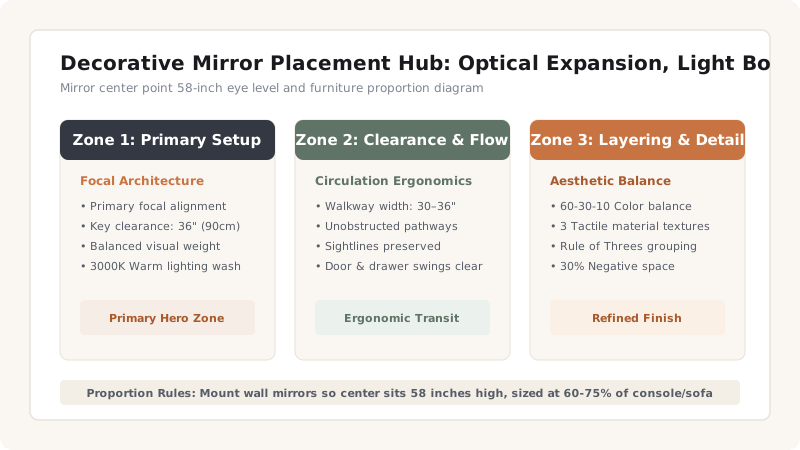
Decorate with mirrors effectively by mounting wall mirrors at a 58-inch center eye level, scaling mirror width to 60-75% of underlying furniture, positioning mirrors perpendicular or opposite light sources to double natural illumination, and using wall-anchor safety brackets.
At a Glance: Key Takeaways
- Mount wall-hung mirrors so the center point rests exactly 58 inches from finished floor.
- Size mirrors to occupy 60-75% of the width of console tables, mantels, or sofas beneath.
- Position mirrors to reflect desirable views (windows, greenery, artwork) rather than clutter.
- Leaning floor mirrors require heavy-duty anti-tip safety wall straps.
In-Depth Guides in this Directory
Explore specialized subtopic blueprints, technical dimensions, and execution checklists:
Mirrors for Small Spaces: Window-Pane Mirrors & Leaning Mirrors
Maximize small rooms with mirrors: window-pane grid mirrors, floor leaning arches, narrow hallway mirror tricks, and light reflection tactics.
Decorative Mirror Placement Rules: Focal Anchors & Collages
Master mirror placement: console table sizing, mantel mounting, gallery wall mirror collages, hardware anchors, and reflection mapping.
1. Mirror Optical Physics, Daylight Bouncing & Spatial Expansion
Architectural mirror placement is one of the most powerful tools in interior design, operating fundamentally as a dynamic manipulation of optical physics, spatial geometry, and ambient illumination. A mirror is far more than a vanity tool for grooming; it functions as a simulated structural window that captures exterior daylight, visually duplicates floor area, and introduces kinetic energy into static interior envelopes.
Understanding light reflection geometry is paramount. Natural sunlight entering through a window strikes opposing wall planes at precise incident angles. When a large mirror is positioned perpendicular or directly opposite to an exterior fenestration, it captures incoming lumens and bounces them deep into dark, windowless room cores, increasing ambient daytime brightness by 30% to 50% without adding a single watt of artificial electricity. However, the cardinal law of mirror placement is reflection curation: never install a mirror without strictly auditing what it will reflect. A mirror positioned across from an open utility closet, a chaotic television wire nest, or a glare-producing bare bulb simply doubles the visual pollution of the space. Position mirrors to capture lush garden views, architectural artwork, or atmospheric chandelier glows.
Dimensional proportioning relative to adjacent furniture dictates whether an installation appears architectural or accidental. When hanging a mirror above a console table, fireplace mantel, or sofa, the mirror width must measure between 60% and 75% of the total width of the furniture piece beneath it. A mirror wider than the supporting furniture creates a top-heavy, precarious optical imbalance, while an undersized mirror appears lost and disconnected from the wall plane.
2. Mirror Glass Quality, Desilvering Prevention & Heavy-Duty Cleats
The manufacturing quality of architectural mirrors varies dramatically. Low-cost mass-market mirrors frequently utilize thin 1/8-inch (3mm) sheet glass backed with sprayed aluminum film. Thin glass flexes imperceptibly under its own weight, causing subtle optical distortion—a funhouse effect that warps vertical lines. Furthermore, aluminum backings react with ambient humidity and chemical cleaners, resulting in 'desilvering' (black, corroded jagged edges that creep across the glass perimeter within two years).
Specify heirloom-grade architectural mirrors constructed with 1/4-inch (6mm) distortion-free float glass backed with pure silver nitrate coats, copper vapor barriers, and multi-layer epoxy protective paint. For high-humidity zones (such as master ensuites and powder rooms), mandate marine-grade sealed edge coatings that resist steam oxidation.
Structural mounting demands absolute mechanical security. Heavy decorative mirrors weighing 40 to 120 pounds should never be suspended from picture wire or single drywall hooks. Modern wire installations stretch over time and pull angled wall anchors out of gypsum board under gravitational shear. Always utilize interlocking extruded aluminum French cleat bars (Z-clips) rated for 150 to 300 lbs. Secure the wall cleat directly into at least two timber wall studs using 2.5-inch structural screws. The interlocking wedge profile pulls the mirror flush against the wall, preventing rotational wobble and providing seismic safety.
3. Eye-Level Height Formulas & Clearances Across Room Typologies
Hanging a mirror at the incorrect height instantly disrupts the vertical harmony of a room. A common amateur mistake is mounting mirrors too high, forcing users to crane their necks and reflecting only ceiling drywall. Adhere strictly to architectural eye-level formulas:
- Standard Centerline Rule: The vertical center point of the mirror glass should hang precisely 58 to 60 inches (147 to 152 cm) above the finished floor. This standard reflects the average human eye level across seated and standing postures.
- Console & Credenza Clearances: When mounting above an entryway console or dining credenza, leave a gap of 6 to 10 inches between the top surface of the furniture and the bottom of the mirror frame to allow room for decorative catchall trays and low florals without colliding.
- Fireplace Mantel Clearances: Position mirrors 4 to 6 inches above fireplace mantels. If the mantel exceeds 54 inches in height, lean the mirror slightly forward (using top cleat shims) to tilt the reflection downward toward the room rather than upward at ceiling joists.
- Full-Length Floor Leaner Clearance: For full-height leaner mirrors (measuring 72 to 84 inches tall), anchor the top frame to wall studs using concealed anti-tip aircraft cables, tilting the base outward exactly 6 to 8 inches from the baseboard for optimal full-body viewing perspective.
4. Frame Material Selection & Architectural Character
The frame material of a mirror bridges the gap between functional glass and room architecture. In contemporary minimalist or Japandi interiors, ultra-slim 1/4-inch brushed aluminum or black iron pill-shaped frames provide crisp graphical discipline without overwhelming subtle textures.
For classical, Parisian, or eclectic interiors, specify hand-carved solid hardwood frames finished in genuine gold leaf, antiqued bronze, or hand-rubbed wax. Antique foxed mirrors (glass treated with gentle acid etching to mimic 19th-century silver aging) provide rich, moody atmospheric charm in formal dining rooms and private cocktail lounges, softening harsh light reflections into warm, vintage patinas.
Architectural Mirror Profiles & Mounting Specifications
Use this reference table to calculate exact physical dimensions, ratios, and specifications before purchasing:
| Mirror Profile | Typical Dimensions | Recommended Glass Thickness | Weight Range | Mounting Hardware Required |
|---|---|---|---|---|
| Oversized Floor Leaner | 36x78" to 48x84" | 1/4" (6mm) Tempered Float Glass | 75-130 lbs | Concealed aircraft anti-tip safety cables + wall studs |
| Round Architectural Focal | 36" to 48" Diameter | 1/4" Float Glass with silver backing | 35-65 lbs | Interlocking 18" aluminum French cleat into 2 studs |
| Arched Windowpane Grid | 32x54" to 40x60" | 1/4" Float Glass with welded steel frame | 50-85 lbs | Dual welded rear keyholes directly into wall studs |
| Slim Capsule / Pill Sconce Mirror | 20x40" to 24x48" | 3/16" or 1/4" Distortion-free glass | 25-45 lbs | Heavy-duty steel Z-bar mounting bracket |
Architectural Mirror Constraints
Every successful decoration project must account for physical and environmental constraints:
Desilvering Corrosion from Glass Cleaners
Ammonia-based glass cleaners sprayed directly onto mirrors seep into bottom edge seams, dissolving the silver backing and creating black rot; spray cleaner onto a microfiber cloth first and wipe edges dry immediately.
Heavy Wall Stud Centerline Misalignment
Wall studs are rarely centered precisely over decorative consoles or fireplaces; specify wide aluminum French cleat bars with continuous pre-drilled slot holes so the cleat catches studs while allowing the mirror to slide horizontally into exact visual center.
Direct Glare from Low Southern Sun
Mirrors placed opposite low-angle south or west facing windows reflect blinding glare into seating areas during late afternoons; install sheer drapery or angle mirrors away from direct solar axes.
How to Hang a Heavy Wall Mirror
Execute this professional sequence to achieve flawless results without backtracking:
Determine 58-Inch Center
Mark wall spot exactly 58 inches above finished floor for mirror center point.
Locate Wall Studs
Use a stud finder to locate two wood wall studs behind mirror mounting area.
Install Heavy D-Ring Anchors
Drive 50lb rated picture hooks into studs corresponding to mirror D-rings.
Hang & Level Mirror
Hang mirror securely and place a bubble level on top frame to verify.
Common Mistakes & Countermeasures
Avoid these costly errors that compromise aesthetics, ergonomics, and budget:
Hanging Mirrors Too High on Wall Planes
Using Cheap Wire Suspension on Heavy Mirrors
Reflecting Unintentional Clutter
Project Execution Checklist
Track your physical progress. Checkboxes persist automatically on this device:
Frequently Asked Questions
How high should a decorative wall mirror be hung?
As an architectural standard, the center point of a wall mirror should be hung 58 to 60 inches (147 to 152 cm) from the finished floor. When mounted above a console table or mantelpiece, maintain a 6 to 8 inch clearance between the top of the furniture and the bottom edge of the mirror frame.
How do you hang an extremely heavy mirror safely without studs?
For mirrors weighing over 30 lbs, mounting into timber wall studs using heavy-duty lag screws is strongly advised. If no studs exist at the exact mounting location, use heavy-duty 1/4-inch steel toggle bolts (such as Toggler Snaptoggles rated for 100+ lbs in 1/2" drywall) distributed along an aluminum French cleat bar.
What causes black spots and peeling on the edges of mirrors?
Black edging (desilvering) occurs when moisture, steam, or ammonia-based chemical cleaners penetrate the rear silver backing of the glass, causing oxidation. To prevent desilvering, never spray glass cleaner directly onto mirrors; spray onto a microfiber cloth, wipe gently, and dry bottom edge seams thoroughly.
What is the rule of proportion for mirrors above console tables?
A mirror mounted above a console table, dresser, or sofa should measure approximately two-thirds to three-quarters (60% to 75%) of the furniture's total width. A mirror wider than the console feels precarious and top-heavy, while a mirror narrower than 50% looks visually insignificant.
Can mirrors be used to make a small room feel bigger?
Yes. When positioned opposite or adjacent to natural daylight windows, mirrors reflect light into dark corners and visually double the perceived room depth. Using tall arched mirrors or floor-to-ceiling framed leaner mirrors creates the optical illusion of an open doorway or architectural passageway into another room.

