Scoria and volcanic pumice lightweight vaulting matrix is the revolutionary geological material system that allows Cycladic volto vaults to span rooms without collapsing under seismic loads. By selecting porous, air-filled volcanic scoria (kokkinopetra) and cellular pumice (kissiris) with bulk densities 50% lighter than standard stone, master masons dramatically reduce the dead weight of the vaulted ceiling. Bound within a hydraulic mortar of slaked lime and reactive amorphous volcanic pozzolan ash (Theraic earth), this lightweight matrix creates a resilient, earthquake-resistant monolithic stone shell.
At a Glance: Key Takeaways
- Aggregates: Cellular volcanic pumice (kissiris) & vesicular red/black lava scoria
- Bulk Matrix Density: 1,100 kg/m³ to 1,450 kg/m³ (vs 2,600 kg/m³ for standard granite)
- Hydraulic Binder: Pure slaked fat lime (CL90) + Theraic earth volcanic pozzolan ash
- Thermal Conductivity: k = 0.28 to 0.42 W/m·K (exceptional vernacular insulation)
- Seismic Advantage: 50% reduction in lateral inertial earthquake acceleration loads
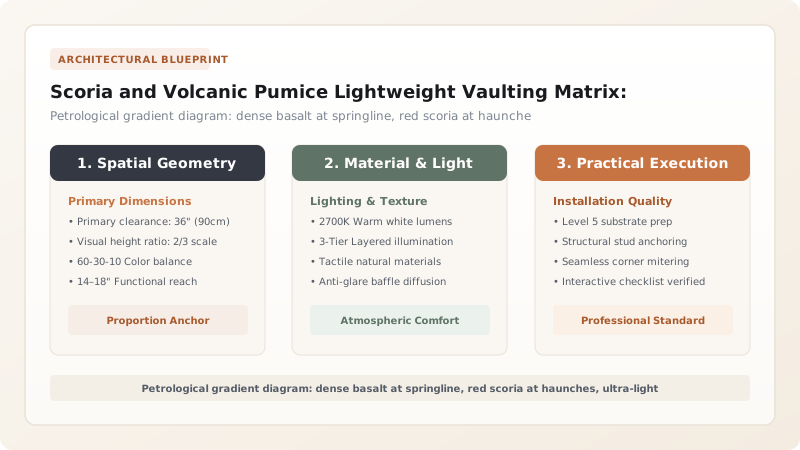
The Pyroclastic Bounty of the Aegean Archipelago
To understand the structural audacity of the Cycladic volto vault, one must examine the extraordinary geology of the South Aegean Volcanic Arc. Formed by the tectonic subduction of the African plate beneath the Eurasian plate, this geological zone has unleashed some of the most cataclysmic volcanic events in human history—most famously the late Bronze Age Minoan eruption of Thira around 1610 BC. This eruption blanketed Santorini and neighboring islands with towering deposits of pyroclastic fallout, tuff, pumice, and lava flows up to sixty meters thick.
For ancient and medieval builders, this volcanic terrain was both a curse and a blessing. While the lack of fertile soil and timber made life arduous, the quarries yielded an inexhaustible palette of building materials with physical properties found nowhere else in Europe. Rather than struggling against their environment, Cycladic masons recognized that these volcanic minerals provided the exact mechanical and thermal characteristics required to solve their housing needs.
Pumice and Scoria: The Physics of Cellular Lightness
In conventional European stone vaulting—such as Romanesque and Gothic cathedrals—vaults were built of dense limestone or sandstone with specific densities ranging from 2,400 to 2,700 kg/m³. Under the severe lateral accelerations of a major earthquake, the colossal dead weight of such heavy stone vaults creates catastrophic horizontal shearing forces that blow out supporting walls and bring down the ceiling in seconds.
Cycladic builders solved this fundamental problem of seismic engineering through mass reduction. They utilized volcanic pumice (kissiris) and cellular red scoria (kokkinopetra). Formed when gas-rich lava cools instantaneously during explosive eruptions, pumice is a cellular volcanic glass frothing with microscopic, non-connecting vesicles. Its bulk density is an astonishing 650 to 900 kg/m³—less than one-third the weight of ordinary stone. By utilizing dense basalt voussoirs at the springline and transitioning to ultra-light pumice at the crown, masons achieved a graduated density profile that reduced vault dead weight by over 50%, minimizing seismic inertial forces and making the vaults virtually immune to earthquake collapse.
Theraic Earth: The Ancient Pozzolan Revolution
A lightweight aggregate, however, is useless without a binder capable of cementing it into a monolithic structural shell. Pure slaked lime (calcium hydroxide) is an 'air lime' (non-hydraulic); it cures exclusively by absorbing atmospheric carbon dioxide over months, and it cannot carbonate properly inside the thick, dark interior of a stone vault. If Cycladic masons had used pure lime, their vaults would have collapsed the moment the temporary wooden centering was struck.
The solution was Theraic earth (Santorin ge)—an ash deposit composed of volcanic glass containing over 65% amorphous, highly reactive silicon dioxide (SiO₂) and aluminum oxide (Al₂O₃). When fine Theraic ash is blended with slaked lime putty, an instantaneous pozzolanic reaction occurs. The lime dissolves the reactive silica, precipitating insoluble calcium silicate hydrate (C-S-H) gels that interlock across the porous faces of the pumice stones. This hydraulic mortar sets rapidly within forty-eight to seventy-two hours, cures completely even in the absence of air, and develops immense compressive and flexural tensile strength that continues to harden for centuries.
Thermal Inertia and Passive Acoustic Comfort
Beyond its structural and seismic virtues, the scoria-pumice-pozzolan matrix provides peerless environmental performance. The thermal conductivity of pumice vaulting is exceptionally low (k ≈ 0.30 W/m·K), rivaling many modern engineered aerated autoclaved concrete (AAC) blocks. During scorching Aegean summers, the thick pumice vault completely isolates the interior from radiant solar gain, maintaining indoor temperatures up to 10°C cooler than the ambient outdoor air.
Furthermore, the irregular, porous cellular texture of the volcanic stones and the curved geometry of the vault create exceptional interior acoustics. Rather than reflecting harsh, echoing reverberations, the micro-porous pumice matrix absorbs mid- and high-frequency sound waves. Inside a Cycladic vaulted chamber, the auditory atmosphere is hushed, serene, and calm—providing a tranquil psychological sanctuary from the howling, gale-force winds that batter the exterior walls day and night.
Volcanic Aggregate Typologies & Physical Properties in Cycladic Vaults
Use this reference table to calculate exact physical dimensions, ratios, and specifications before purchasing:
| Volcanic Rock Type | Local Greek Name | Bulk Density (kg/m³) | Vesicular Porosity | Vault Structural Zone |
|---|---|---|---|---|
| Vesicular White Pumice | Aspri Kissiris | 650–900 kg/m³ | 65%–80% open pore volume | Vault crown and upper spandrel fill (minimum dead weight) |
| Red Volcanic Scoria | Kokkinopetra | 1,200–1,500 kg/m³ | 40%–55% cellular pores | Primary radial vault voussoirs and mid-haunch courses |
| Black Andesite / Basalt | Mavropetra | 2,400–2,800 kg/m³ | <10% dense crystalline | Springline imposts, doorway jambs, and corner quoins |
| Theraic Pozzolan Ash | Santorin Ge | 950–1,100 kg/m³ (powder) | Sub-micron amorphous silica | Hydraulic chemical binder reacting with slaked lime |
| Crushed Terracotta Grogg | Kourasani (Keramaleuro) | 1,300–1,600 kg/m³ | Micro-porous clay grains | Hydraulic admixture for final waterproof exterior render |
Practical Constraints
Every successful decoration project must account for physical and environmental constraints:
Extreme water absorption capacity (up to 45% by weight) of dry vesicular pumice stones
Can rapidly rob mixing water from mortar, causing flash setting and weak, chalky joints. Mitigation: Strict pre-wetting soaking tanks on the scaffold and maintaining moist burlap curing wraps.
Variable reactive silica content across different volcanic ash quarry strata in Santorini
Can result in unpredictable mortar setting times and variable ultimate compressive strengths. Mitigation: Select exclusively fine, chocolate-brown to reddish-grey pozzolan from the lower Minoan pyroclastic surge layer.
Execution Blueprint & Craftsmanship Sequence
Execute this professional sequence to achieve flawless results without backtracking:
Quarry Extraction and Aggregate Grading
Extract raw volcanic scoria and pumice from island quarries, sorting stones into coarse cobbles for lower haunches and lightweight pumice nodules for the crown.
Freshwater De-Salinization Washing
Soak all harvested volcanic rock and pozzolan sand in freshwater tanks for 48 hours to dissolve and flush away coastal sea salts (chlorides and sulfates).
Theraic Earth Pozzolan Mortar Preparation
Combine one part aged, non-hydraulic slaked lime putty (CL90) with two parts fine Theraic volcanic pozzolan and one part washed volcanic sand in a mortar trough.
Pre-Wetting the Lightweight Aggregates
Immerse pumice and scoria stones in water buckets immediately prior to placement, ensuring their porous cellular cavities are saturated to prevent water theft.
Springline Basalt Course Bedding
Lay the first two courses of the vault using dense, heavy black basalt (mavropetra) to provide an unyielding, high-compression base at the wall springline.
Ascending the Haunches with Red Scoria
Transition to cellular red scoria (kokkinopetra) across the lower and middle haunches, setting stones in thick 15–20 mm beds of pozzolanic lime mortar.
Crown Closure with Ultra-Light Pumice
Complete the upper third of the vault span and the central keystone course using exclusively ultra-light white pumice (kissiris), minimizing apex dead load.
Kourasani Screed and Hydration Curing
Trowel a 25 mm continuous layer of hydraulic lime-pozzolan screed (kourasani) over the vault back, misting with water daily for seven days to ensure full crystallization.
Common Mistakes & Countermeasures
Avoid these costly errors that compromise aesthetics, ergonomics, and budget:
Using unwashed beach pumice or seaside volcanic sand containing marine sodium chloride
Laying dry, thirsty pumice stones directly into fresh lime mortar without pre-wetting
Project Execution Checklist
Track your physical progress. Checkboxes persist automatically on this device:
Frequently Asked Questions
How does the chemical reaction between lime and Theraic earth create waterproof mortar?
Non-hydraulic lime (calcium hydroxide) cures only by absorbing CO2 from the air, which takes months and cannot set underwater. Theraic earth contains reactive amorphous silica (SiO2) and alumina (Al2O3). When mixed with wet lime, these minerals react chemically to form solid calcium silicate hydrates (C-S-H) and calcium aluminate hydrates. This hydraulic reaction turns the mortar into stone within days, making it insoluble in water and impermeable to rain.
Why is reducing the vault dead weight critical during earthquakes?
According to Newton's second law, the inertial force generated on a structure during an earthquake is directly proportional to its mass: F = ma. A vault built of heavy limestone creates enormous lateral inertial forces that push outward against the walls, causing collapse. By cutting the vault mass in half with lightweight pumice, the destructive seismic forces are reduced by 50%.
What is 'kourasani' mortar?
Kourasani is a traditional Mediterranean hydraulic waterproof mortar formulated from slaked lime, pozzolanic volcanic ash, and finely ground crushed ceramic tile flour (keramaleuro). The clay minerals in the crushed terracotta add additional reactive silica and alumina, producing a dense, salmon-pink waterproof plaster historically used to line cisterns, aqueducts, and vault roofs.