The finishing and architectural application of Granada taracea represents the final synthesis of artisanal woodworking. After multi-medium wood, bone, and silver mosaic veneers are glued to solid timber carcasses, the surface must be leveled without sandpaper using hand-burnished high-carbon steel cabinet scrapers (cuchillas de ebanista) to prevent soft woods from dishing out around hard bone. The surface is subsequently brought to a glass-like optical luster using classical French polishing (barnizado a muñequilla)—applying hundreds of micro-thin coats of blonde dewaxed shellac using a cotton rubbing pad lubricated with walnut oil. This finish is integrated into luxury coffered jewelry caskets (arquetas), cassone chests, folding tables, and architectural wall friezes.
At a Glance: Key Takeaways
- Surface Leveling: High-carbon steel cabinet scrapers (cuchillas de ebanista) burnished with a polished steel rod
- Finishing Technique: French polishing (barnizado a muñequilla) using a wool-core cotton rubbing pad
- Finishing Resin: Blonde dewaxed button shellac (gomalaca descerada) dissolved in 96% grain alcohol
- Pad Lubricant: Raw walnut oil (aceite de nuez) or light medicinal mineral oil
- Architectural Objects: Coffered jewelry caskets (arquetas mudéjares), bargueño writing desks, and paneled room friezes
The Challenge of Mixed-Media Planar Leveling
When a craftsman completes the assembly and gluing of a taracea mosaic panel onto a solid wood carcass, the raw surface is inherently uneven. Because the micro-mosaic wafers were sliced by hand with a jeweler's saw, adjacent tiles vary in thickness by fractions of a millimeter. Furthermore, the assembly contains three fundamentally different materials: soft porous wood, dense hard bone, and tough metallic German silver wire.
To the novice woodworker, the intuitive response is to attack the surface with an electric orbital sander. In taracea, this is a catastrophic mistake. Sandpaper acts unevenly across materials of differing hardness: the abrasive grains cut rapidly into the soft walnut and sycamore while riding up over the hard bone and metal wire, creating unsightly depressions and dips around every star. Even worse, the sandpaper generates airborne bone dust and metal filings that get driven deep into the open pores of the dark walnut, leaving permanent grey stains that ruin the visual contrast.
The Cabinet Scraper (Cuchilla de Ebanista): Pure Shear Planing
The master of Granada taracea levels the surface exclusively with the cuchilla de ebanista—the traditional cabinet scraper. Fabricated from high-carbon Swedish spring steel, the rectangular scraper blade is hand-filed flat, honed to a mirror edge on water stones, and burnished with a polished carbide rod to turn a microscopic, razor-sharp cutting hook along its edge.
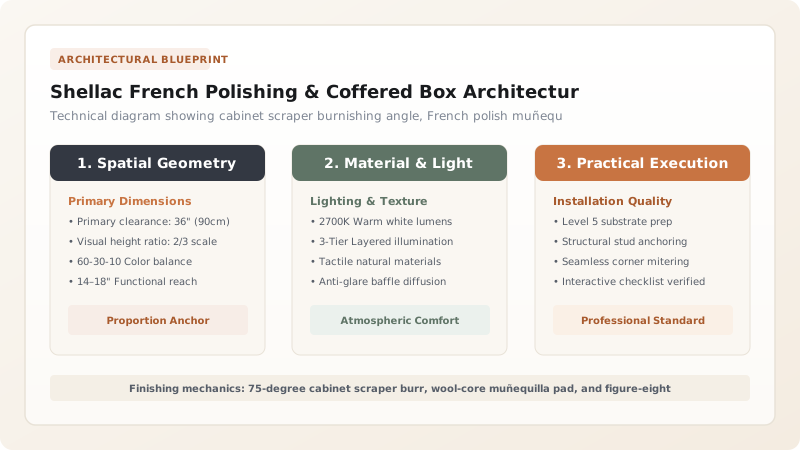
Held in two hands and flexed into a subtle convex curve, the scraper is drawn across the taracea surface at an angle of roughly seventy-five degrees. Rather than abrading or scratching like sandpaper, the burnished hook acts as a micro-plane, shearing across wood, bone, and silver wire simultaneously with uniform surgical precision. Paper-thin, whisper-light shavings curl away from the blade, leaving a continuous, optically flat plane where the transition between a piece of walnut, a segment of bone, and a silver wire cannot be detected even by the most sensitive fingertip.
The Art of the Muñequilla: French Polishing Chemistry
To protect the leveled mosaic and bring its chromatic contrasts to vibrant life, traditional Granada workshops reject modern polyurethane or synthetic lacquers. Instead, they practice barnizado a muñequilla—the revered art of shellac French polishing. Developed in the 18th century, this method utilizes natural shellac—a natural resin secreted by the lac insect (Kerria lacca) on trees in the forests of India and Thailand.
Craftsmen dissolve ultra-pure, dewaxed blonde shellac flakes in 96% denatured grain alcohol. The polishing pad—the muñequilla—is constructed from an unspun wool core wrapped inside a clean, tightly woven linen cloth. When charged with shellac, the artisan glides the pad across the wood in continuous, flowing circular and figure-eight loops. A single drop of raw walnut oil applied to the pad face acts as a lubricant, allowing the cloth to skate smoothly across the drying resin film. Over several days and dozens of successive bodying sessions, the artisan deposits hundreds of microscopic, molecularly thin layers of crystal-clear shellac, filling every pore and building an optical film of breathtaking clarity.
Architectural Integration: Arquetas, Bargueños & Noble Spaces
The ultimate destination for finished taracea marquetry is the classical Spanish furniture repertoire, most notably the arqueta (coffered jewel casket) and the monumental bargueño (fall-front writing desk). The arqueta, with its truncated pyramidal lid inspired by Islamic coffered ceilings (artesonados), represents the quintessential expression of Granada decorative luxury. Every exterior panel is framed in dark walnut moldings, enclosing vibrant fields of eight-pointed stars that reflect light differently as the viewer moves around the piece.
Beyond freestanding furniture, taracea historically played a prominent architectural role in noble Andalusian interiors. Master woodworkers fabricated monumental room friezes, window shutters, choir stalls, and paneled room doors displaying bands of micro-mosaic marquetry that visually tied interior timber woodwork to the geometric tile wainscoting (alicatados) on the walls below. Preserved beneath hand-rubbed shellac and micro-crystalline wax, these intricate wood-and-bone heirlooms stand as timeless ambassadors of Andalusia's rich, multicultural Mudéjar heritage.
Finishing Systems & Architectural Typologies for Granada Taracea Objects
Use this reference table to calculate exact physical dimensions, ratios, and specifications before purchasing:
| Object Typology | Substrate Wood | Surface Finishing System | Luster Profile | Architectural Setting |
|---|---|---|---|---|
| Coffered Casket (Arqueta) | Spanish Cedar / Walnut | Full French Polish (40–50 body coats) | Mirror high-gloss (100% optical depth) | Luxury domestic display, dowry chests, and jewel storage |
| Bargueño Writing Desk | Solid Spanish Walnut | Satin French Polish + Beeswax buff | Warm semi-gloss satin luster | Noble residential libraries, chanceries, and private studies |
| Wall Frieze / Door Panel | Quarter-sawn Pine / Oak | Spirit varnish spray + micro-crystalline wax | Low-luster eggshell sheen | Architectural door pediments, wainscoting, and room friezes |
| Octagonal Folding Table | Walnut with Inlaid Top | Heavy-bodied French Polish + hard carnauba | Scratch-resistant high-sheen gloss | Reception salons and Moorish-revival tea pavilions |
| Chessboard / Game Box | Sycamore & Walnut Carcass | Dewaxed shellac with pumice grain-fill | Durable, glass-smooth flat plane | Domestic leisure furnishings and collector display |
Practical Constraints
Every successful decoration project must account for physical and environmental constraints:
Sensitivity of fresh shellac French polish to ambient atmospheric humidity (blushing)
High humidity (>70%) traps moisture vapor within the evaporating alcohol film, turning the finish milky white. Mitigation: Perform French polishing strictly in climate-controlled workshops with relative humidity below 50%.
Vulnerability of natural shellac finishes to water droplets, alcohol spills, and hot cups
Liquids dissolve or cloud the delicate shellac resin matrix within minutes. Mitigation: Educate clients on proper care; buff finished pieces with hard micro-crystalline Renaissance wax for water resistance.
Execution Blueprint & Craftsmanship Sequence
Execute this professional sequence to achieve flawless results without backtracking:
Surface Scraping & Planar Leveling
Dress the raw inlaid furniture surface with a burnished high-carbon steel cabinet scraper (cuchilla), holding the blade at 75 degrees and taking paper-thin shavings until wood, bone, and silver are flush.
Wet Micro-Lapping (600 Grit)
Lap the scraped surface lightly using 600-grit silicon carbide paper lubricated with mineral spirits, clearing away microscopic metal burrs without generating dry airborne dust.
Shellac Dissolution & Pad (Muñequilla) Assembly
Dissolve dewaxed blonde shellac flakes in pure grain alcohol (2-lb cut), wrapping raw carded wool inside a clean, washed lint-free cotton cloth to form the polishing pad.
Pumice Grain Filling & Pore Sealing
Dust a microscopic sprinkle of fine 4F volcanic pumice powder over walnut areas, working the alcohol-damp pad in small circles to create an abrasive slurry that packs pores flush.
Bodying Sessions & Continuous Figure-Eight Strokes
Charge the pad core with shellac and add a drop of walnut oil to the face, gliding the pad across the surface in continuous, uninterrupted figure-eight and circular loops.
Intermediate Curing & Leveling
Allow the built shellac film to cure for 24 hours between bodying sessions, lightly flatting the surface with 1200-grit micro-mesh to remove any stray dust nibs.
Spiriting Off & Oil Extraction
Wrap the pad with fresh clean linen charged with pure alcohol (zero shellac), stroking parallel to the grain to strip lubricating walnut oil from the surface and reveal crystal-clear gloss.
Hardware Fitting & Micro-Crystalline Wax Buffing
Mount hand-forged brass hinges and locks onto the coffered box, buffing the cured shellac with Renaissance micro-crystalline wax to impart a silky, fingerprint-resistant luster.
Common Mistakes & Countermeasures
Avoid these costly errors that compromise aesthetics, ergonomics, and budget:
Stopping the French polishing pad stationary on the workpiece during polishing strokes
Using wax-containing orange or garnet shellac over bleached bone and silver wire inlays
Using abrasive sandpaper to level mosaic surfaces containing bone and German silver wire
Project Execution Checklist
Track your physical progress. Checkboxes persist automatically on this device:
Frequently Asked Questions
Why is French polishing called 'barnizado a muñequilla' in Spain?
In Spanish cabinetmaking, the polishing pad is called a 'muñequilla' (literally 'little doll'). It consists of a core of unspun sheep's wool or cotton waste gathered inside a square of fine linen or cotton fabric, tied at the top like the head of an old-fashioned rag doll. The artisan squeezes the doll's head to release precise micro-drops of shellac through the cloth as it glides.
What role does walnut oil play during the French polishing process?
Shellac dissolved in alcohol is extremely sticky; if a dry pad touches a wet shellac film, it will grab, tear, and ruin the finish. A single drop of non-drying walnut oil applied to the gliding face of the muñequilla acts as a temporary surface lubricant, allowing the pad to skate effortlessly across the surface without sticking while the alcohol evaporates.
What is an 'arqueta' and why is it the classic format for Granada taracea?
An arqueta is a small, precious coffered chest or jewelry casket featuring a truncated pyramidal or hipped lid. Inherited directly from Islamic pyxides and relic boxes of the Middle Ages, the multi-angled lid facets and compact vertical panels provide the perfect intimate canvas for displaying intricate geometric taracea star medallions and border friezes.