The iconic visual identity of Granada taracea relies on a strict chromatic and textural dialogue between four primary materials: bleached bovine bone, pale sycamore, dark Spanish walnut, and metallic German silver wire. Rather than relying on artificial chemical paints, the contrast is entirely organic. Artisans boil and chemically degrease dense cattle femur bones to produce pure, non-yellowing ivory white tesserae. This is paired with dark, oil-rich Spanish walnut (nogal) heartwood, fine-grained creamy sycamore (often tinted with botanical dyes), and rectangular German silver (alpaca) wire fillets that trace eight-pointed stars and intricate sebka lattice grids with gleaming metallic precision.
At a Glance: Key Takeaways
- White Medium: Degreased, peroxide-bleached bovine bone (hueso de vaca) and iridescent mother-of-pearl
- Dark Medium: Spanish walnut (Juglans regia) heartwood and African ebony (Diospyros crassiflora)
- Light / Tinted Medium: Sycamore / European maple (Acer pseudoplatanus), natural or dyed with vegetable extracts
- Metallic Element: German silver (alpaca: copper-nickel-zinc alloy) and polished brass (latón) wire
- Chromatic Philosophy: High-contrast Mudéjar chiaroscuro: light stars glowing against dark walnut voids
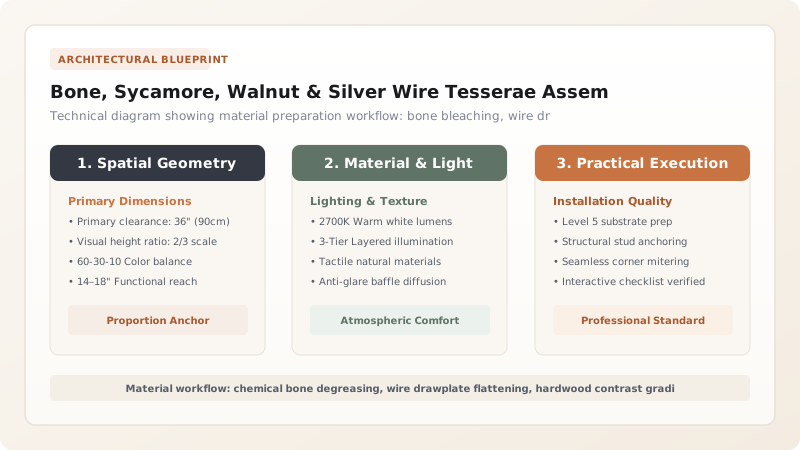
The Mudéjar Palette: Organic Material Chiaroscuro
The aesthetic power of Granada taracea rests upon an uncompromising philosophy of material authenticity. Unlike European marquetry of the 18th century, which frequently relied on painted veneers and tinted varnishes to simulate exotic colors, the masters of the Albaicín achieved their breathtaking visual drama through the unadulterated contrast of natural materials: dark timber heartwood, bleached bone, pale fruitwoods, and metallic alloys.
This aesthetic is rooted in the Mudéjar concept of architectural chiaroscuro—the dramatic interplay of light and shadow, purity and depth. When arranged in the sacred geometry of the lazo de ocho (eight-pointed star), the materials engage in dynamic dialogue: the deep chocolate tones of Spanish walnut absorb ambient light, functioning as the cosmic void, while the ivory white bone and shimmering German silver wires reflect daylight, causing the geometric stars to visually explode outward from the furniture surface.
Bone Preparation: Degreasing, Bleaching & Crystallography
Bovine bone (hueso de vaca) is the undisputed star of traditional taracea. However, raw animal bone is naturally full of yellow fats, blood pigments, and marrow proteins that would rapidly turn rancid, ruin adhesive bonds, and oxidize into an unsightly greasy yellow. Master artisans subject the raw material to a rigorous multi-week chemical purification process.
Artisans select only the dense, thick-walled cortical bones of mature cattle—specifically the femur and tibia. The bones are first sawed into manageable sections and boiled for six to eight hours in an alkaline bath of water and potash lye, which saponifies and extracts all deep cellular lipids. Once degreased, the bones are submerged in a concentrated solution of hydrogen peroxide for several days, followed by slow drying under direct Andalusian mountain sunlight. This chemical oxidation permanently bleaches the calcium hydroxyapatite crystalline matrix into a brilliant, porcelain-like ivory white that will never yellow or degrade over centuries of indoor display.
The Hardwoods: Spanish Walnut & Dyed Sycamore
The organic warmth of taracea is anchored by native Iberian hardwoods. The primary substrate and contrasting dark medium is Spanish walnut (Juglans regia), specifically the slow-growth heartwood harvested from the foothills of the Sierra Nevada. Renowned for its fine, dense pore structure, dimensional stability, and rich dark coffee hues with subtle violet undertones, walnut provides the ideal non-deforming background canvas for micro-inlay work.
For the lighter and colored geometric bands, craftsmen turn to European sycamore (Acer pseudoplatanus). Sycamore is prized for its uniform fine grain, pale ivory coloration, and lack of natural resins, making it the premier timber for taking colored dyes. While much of the sycamore is used in its natural silky white state, traditional workshops also boil thin sycamore veneers in natural dye vats—using madder root for deep crimson, walnut husks for intermediate amber, and copper sulfate solutions for vibrant emerald greens—injecting vivid jewel-like chromatic accents into the geometric field.
Metallic Filigree: Alpaca & Brass Wire Drawing
A defining hallmark that separates Granada taracea from other global marquetry traditions is the integration of fine metallic wire stringing. In Nasrid and Mudéjar aesthetics, metal was not merely an occasional accent; it was an indispensable structural and visual boundary line that framed every geometric polygon.
Craftsmen utilize alpaca (German silver—an alloy of copper, nickel, and zinc) and commercial brass. Crucially, round wire cannot be used directly from the spool; round wire would create microscopic triangular voids on either side that trap dark polishing sludge. The artisan anneals the wire with a torch to soften the metal, then laboriously pulls it through a hardened steel drawplate with rectangular orifices. This transforms the wire into a crisp, ribbon-like strip measuring 0.8 millimeters in thickness and 1.2 millimeters in width. When sandwiched between wood and bone in the laminated bundles, these metallic ribbons act as polished silver and gold fences, catching every stray beam of light and giving the finished marquetry its signature celestial sparkle.
Material Science & Workability Matrix for Taracea Inlay Tesserae
Use this reference table to calculate exact physical dimensions, ratios, and specifications before purchasing:
| Material Component | Specific Gravity | Hardness (Janka / Mohs) | Chemical / Physical Treatment | Aesthetic Character in Inlay |
|---|---|---|---|---|
| Bovine Leg Bone (Hueso) | 1.85 g/cm³ | Mohs 3.0 (High hardness) | Boiled in potash, bleached in H₂O₂ | Pure ivory white; dense non-porous crystalline luster |
| Spanish Walnut (Nogal) | 0.68 g/cm³ | 1,010 lbf (Janka) | Slow air seasoning; natural oil finish | Deep chocolate brown to black; warm chatoyant grain |
| Sycamore (Sicómoro) | 0.61 g/cm³ | 1,050 lbf (Janka) | Natural cream or aniline dyed red/green | Silky ivory-gold sheen; excellent uniform dye absorption |
| German Silver (Alpaca) | 8.50 g/cm³ | Mohs 3.5 (Ductile metal) | Annealed; drawn into 0.8x1.2 mm strip | Cool silvery brilliance; sharp geometric outline dividers |
| Mother-of-Pearl (Nácar) | 2.70 g/cm³ | Mohs 3.5 (Brittle mineral) | Diamond-sliced into 1 mm tablets | Prismatic iridescence shimmering under changing light angles |
Practical Constraints
Every successful decoration project must account for physical and environmental constraints:
Toxicity and skin hazard of concentrated hydrogen peroxide used for bone bleaching
Industrial 30% H₂O₂ causes severe chemical burns and releases aggressive oxygen vapors. Mitigation: Perform bleaching inside ventilated chemical fume hoods using acid-resistant gloves and eye protection.
Differential thermal conductivity of metal wire versus wood during polishing
Friction heat from polishing pads expands metal wire faster than wood, causing wire ends to telegraph proud of the surface. Mitigation: Apply ultra-light hand pressure during French polishing and allow surfaces to cool completely between sessions.
Execution Blueprint & Craftsmanship Sequence
Execute this professional sequence to achieve flawless results without backtracking:
Bovine Bone Sourcing & Primary Cleaning
Obtain fresh bovine femur bones, scraping away muscle tissue and boiling the bones in water with wood ash lye for 6 hours to extract organic greases.
Peroxide Bleaching & Sun-Drying
Submerge the boiled bone segments in a bath of 30-volume hydrogen peroxide for 48 hours, sun-drying on outdoor racks for a week until bone turns brilliant snow white.
Bone Splitting & Tablet Dimensioning
Slit the thick tubular bone walls into flat rectangular plates using water-cooled diamond saws, dressing faces flat on a magnetic surface grinder.
Exotic Hardwood Milling & Grading
Resaw Spanish walnut, sycamore, and ebony into straight-grained veneers, sorting by color density to ensure consistent chromatic contrast across the piece.
Botanical Dyeing of Sycamore Tesserae
Immerse thin sycamore veneer strips in heated dye solutions of madder root (for crimson) and copper acetate (for emerald green), drying under weighted caul boards.
Alpaca Wire Drawing & Flattening
Anneal round German silver wire with a propane torch, pulling the wire through rectangular steel drawplate dies until reduced to a sharp-cornered 0.8x1.2 mm ribbon.
Tesserae Pre-Assembly & Lamination
Assemble the contrasting materials into composite geometric bands using hot hide glue, sandwiching silver wire fillets between white bone and dark walnut elements.
Chromatic Quality Control & Inspection
Inspect the assembled mosaic surfaces under direct raking light, verifying that zero glue seepage or dark wood dust stains have contaminated the porous white bone tesserae.
Common Mistakes & Countermeasures
Avoid these costly errors that compromise aesthetics, ergonomics, and budget:
Failing to thoroughly degrease bovine bone before laminating with hide glue
Using soft commercial pine or poplar as a substitute for sycamore in the mosaic pattern
Inserting round metal wire into mosaic seams without flattening into rectangular ribbons
Project Execution Checklist
Track your physical progress. Checkboxes persist automatically on this device:
Frequently Asked Questions
Why did Granada craftsmen use cattle bone instead of genuine elephant ivory?
While royal commissions in the 14th-century Nasrid court occasionally utilized imported African elephant ivory, local bovine leg bone (hueso de vaca) became the universal material of choice for Granada taracea. Bovine femur bone—when properly degreased and bleached—exhibits exceptional density, fine grain, and an immaculate ivory white color that is virtually indistinguishable from elephant ivory, while being ethically sustainable and locally abundant.
What is 'alpaca' wire and why is it used instead of pure silver?
Alpaca (often called German silver or nickel silver) is an alloy composed of copper, nickel, and zinc. Unlike pure sterling silver, which oxidizes rapidly in ambient air and turns dull black, alpaca maintains a bright, corrosion-free silvery luster for decades without tarnishing. Furthermore, its mechanical hardness matches the surrounding bone, allowing both to be scraped flush without gouging.
How do artisans dye sycamore wood bright green and red without obscuring the grain?
European sycamore (Acer pseudoplatanus) is a diffuse-porous wood with exceptionally low natural resin content and pale uniform color. Artisans submerge sycamore strips in hot water-soluble aniline or natural botanical dye baths under light vacuum. The dye penetrates through the entire cellular thickness of the wood rather than sitting on the surface, preserving the natural chatoyant wood luster.