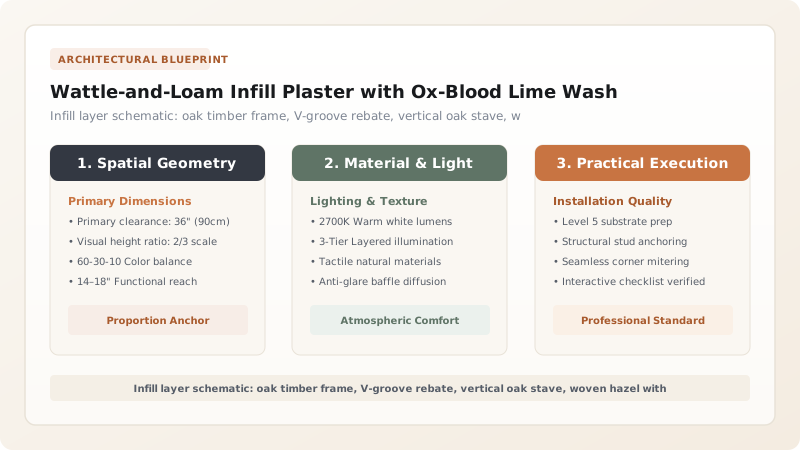
Wattle-and-loam infill plaster sealed with ox-blood lime wash represents the organic, breathable building envelope of the traditional German half-timbered barn. Built inside the open bays (Gefache) of the oak frame, vertical split-oak or pine staves (Staken) are wedged into grooves and interwoven with flexible split hazel or willow withies (Flechtwerk). Artisans press straw-tempered alluvial clay loam (Lehmbewurf) deep through the wattle from both sides, leveling it flush with the timbers. After drying, the loam is rendered with a thin hydraulic lime skim coat and painted with pure slaked lime wash enriched with ox blood (Ochsenblut). The blood proteins react chemically with calcium hydroxide to form an insoluble, water-repellent calcium proteinate film, yielding a brilliant, rot-resistant russet-red finish.
At a Glance: Key Takeaways
- Wattle Framework: Vertical cleft oak staves (Staken) and woven split hazel/willow withies
- Loam Composition: Heavy alluvial clay, sharp sand, chopped rye straw, and cow manure
- Plaster Render: Breathable natural hydraulic lime (NHL 2) with fine quartz sand
- Paint Chemistry: Slaked lime (CL90) + fresh ox blood forming calcium proteinate
- Traditional Color: Ochsenblutrot: deep earthy russet red to warm terracotta-brown
The Living Wall: Ecological Physics of Lehmbau
In the vernacular architecture of Central Europe, the structural timber skeleton of a building was only half of the architectural equation. The open voids between the structural oak posts, beams, and diagonal braces—known in German as the Gefache (bays)—demanded an infill material that was lightweight, fire-resistant, highly insulating, and chemically compatible with green oak timber. For over two millennia, from the Celtic Iron Age through the high medieval period, the universal solution across German-speaking lands was Lehmflechtwerk (wattle-and-daub).
Far from being a primitive peasant substitute for stone, wattle-and-loam represents a pinnacle of vernacular building physics. Clay loam (Lehm) is a natural composite material consisting of clay minerals, silt, and sand. Unlike fired ceramic brick or Portland cement, raw unbaked clay is a reversible, non-hydraulic binder that possesses extraordinary hygroscopic properties. Clay can absorb and release water vapor up to forty times faster than gypsum or cement plaster. In a half-timbered barn, the loam infill acts as a massive environmental sponge, absorbing excess moisture from agricultural operations, damp animals, and humid weather, and releasing it when humidity drops, thereby keeping the ambient moisture content of the adjacent structural oak permanently below the 15% threshold required for wood-rotting fungi (such as Coniophora puteana) to germinate.
The Internal Skeleton: Staken & Hazel Flechtwerk Weaving
Constructing a wattle infill begins with the preparation of the timber boundary. Master carpenters chisel a continuous V-shaped groove (Staknut) along the bottom face of the upper tie-beam and individual blind mortise holes along the top face of the lower sill plate. Vertical staves (Staken)—cleft from straight-grained oak, pine, or larch poles—are shaped with a pointed chisel tip at the top and a beveled spade end at the bottom. The carpenter inserts the pointed top into the upper groove and springs the flexible stave into the lower mortise, spacing them at intervals of 150 to 200 millimeters across the bay.
Once the staves are firmly seated, the weaving phase (Flechten) begins. Artisans harvest young, flexible coppice rods of hazel (Corylus avellana) or willow (Salix) during early spring before the buds break. The rods are split down their center using a specialized splitting brake to expose the flat inner wood grain while retaining the flexible outer bark. The weaver laces these flexible withies horizontally around the vertical staves in an alternating, over-and-under basket-weave pattern. The withies are driven down tightly with wooden mallets to create a dense, rigid timber lattice that acts as an integrated structural diaphragm, stiffening the wall bay against shear distortion while providing millions of mechanical micro-undercuts to lock the subsequent clay daub.
The Loam Recipe: Tempering, Straw & Foot Treading
The preparation of the daub plaster (Lehmbewurf) is an ancient, sensory craft. The raw material is subsoil clay dug from regional marl pits. Pure clay cannot be used alone because it undergoes massive shrinkage and cracking as its water evaporates. To stabilize the matrix, the master plasters temper the clay with sharp quartz river sand and copious amounts of fibrous organic aggregate—traditionally chopped rye straw (Roggenstroh) cut to lengths of 30 to 50 millimeters, cattle hair, and fresh cow manure.
The inclusion of cattle manure is a masterstroke of vernacular biochemical engineering. The digested grass fibers within the manure provide micro-reinforcement that prevents hairline cracking, while the organic bile acids and enzymes act as natural plasticizers, increasing the workability of the sticky clay paste. The ingredients are placed in a shallow pit, soaked with water, and thoroughly blended by foot treading—frequently using draft horses or oxen walked in circles through the pit. The tempered loam is left to ferment for several days, allowing anaerobic bacteria to break down plant starches into natural organic gums that enhance adhesion. Artisans then throw and press the loam fists firmly into the wattle lattice from both sides simultaneously, forcing the clay to mushroom through the weave and weld into a continuous, solid mineral core.
Biochemical Sealing: The Science of Ochsenblut Lime Wash
Because raw clay loam is water-soluble, an exterior wall exposed to driving rain must be shielded by an impervious, weather-resistant coating. In traditional German barn architecture, this protective shield was achieved through the celebrated Ochsenblut-Kalkmilch (ox-blood lime wash). Once the loam core dried and cured, it was rendered with a thin, 3-to-5-millimeter skim coat of natural hydraulic lime (NHL 2) mortar. When this render had set, the building was painted with an authentic bio-protein lime wash.
The recipe required fresh, strained bovine blood collected during seasonal livestock slaughter, which was stirred immediately with slaked lime putty (calcium hydroxide, Ca(OH)₂) and diluted with water. A profound biochemical reaction occurs between the two substances: the albumin and hemoglobin proteins in the blood denature in the highly alkaline (pH 12.5) lime environment, binding to the calcium ions to form insoluble calcium proteinate. As the wash dries and absorbs atmospheric carbon dioxide, the calcium proteinate cross-links with calcium carbonate crystals, creating an exceptionally tough, flexible, water-repellent film. Simultaneously, the iron within the hemoglobin oxidizes, producing an unforgettable, deep russet-red color (Ochsenblutrot). This coating shed driving rains like an oilcloth, resisted fungal growth due to the high alkalinity of the lime, and allowed internal moisture vapor to transpire freely, preserving both the wattle-loam core and the surrounding oak timbers for centuries.
Wall Infill Systems (Gefachausfachungen) in German Half-Timber Architecture
Use this reference table to calculate exact physical dimensions, ratios, and specifications before purchasing:
| Infill Typology | Structural Framework | Thermal Mass & Insulation | Vapor Permeability | Historical Era |
|---|---|---|---|---|
| Wattle and Daub (Lehmflechtwerk) | Woven hazel withies on oak staves | Excellent insulation; high hygroscopic buffering | Maximum breathability; ideal timber protection | Medieval to early 19th century |
| Handmade Clay Brick (Backstein) | Soft clay bricks in lime mortar | High thermal mass; moderate insulation | High breathability (if soft lime mortar used) | Late Renaissance through 19th century |
| Adobe Mudbrick (Lehmgrünlinge) | Sun-dried unburned clay bricks | High thermal mass; exceptional humidity regulation | Maximum breathability | Hesse, Thuringia, & Lower Saxony barns |
| Rubble Stone & Lime (Bruchstein) | Regional limestone/schist in lime mortar | Very high thermal mass; poor insulation | Moderate breathability; heavy dead load | South German plinth walls and stables |
| Engineered Concrete Blocks | Modern cement block infill | Cold; zero hygroscopic regulation | Impermeable; destroys adjacent oak timber | Prohibited in historic preservation |
Practical Constraints
Every successful decoration project must account for physical and environmental constraints:
Substantial drying shrinkage of raw clay loam infill (typically 5% to 8% volumetric contraction)
Creates peripheral gaps between the dried loam block and the surrounding oak timber frame. Mitigation: Stuff peripheral gaps with hemp fibers soaked in lime slurry and install Dreikantleisten timber edge cleats.
Modern slaughterhouse regulations restricting access to fresh, uncoagulated animal blood
Sourcing authentic bovine blood for historic restoration paint formulations is difficult. Mitigation: Utilize certified historical mineral substitutes: slaked lime enriched with casein protein and natural red iron oxide.
Execution Blueprint & Craftsmanship Sequence
Execute this professional sequence to achieve flawless results without backtracking:
Gefach Timber Rebating & Cleat Fitting
Cut continuous triangular timber cleats (Dreikantleisten) or chisel a 15 mm continuous groove along the inner faces of the oak framing members.
Oak Stave (Staken) Fabrication & Wedging
Rive straight-grained oak into 30x30 mm staves, pointing the top end to fit into upper drilled holes and springing the beveled bottom into lower grooves.
Hazel Withy (Flechtwerk) Interweaving
Weave green split-hazel or willow rods horizontally around the vertical staves in alternating basket-weave patterns, packing rows tightly.
Clay Loam Tempering & Fermentation
Blend alluvial clay subsoil with washed sharp sand, chopped rye straw (30–50 mm), and water, treading with feet in a pit and resting for 48 hours.
Loam Daub (Lehmbewurf) Hand Application
Two artisans standing on opposite sides of the wall throw and press loam fists firmly into the wattle simultaneously, keying it through the weave.
Drying Period & Gap Packing
Allow the loam to dry for 30 days, then pack any peripheral shrinkage gaps between the loam and oak timbers with lime-soaked hemp tow.
Hydraulic Lime Skim-Coat Rendering
Mist the dry loam with water and apply a 4 mm skim coat of Natural Hydraulic Lime (NHL 2) mortar, floating the surface smooth with a wooden float.
Ox-Blood Lime Wash Formulation & Application
Mix 1 part strained fresh blood with 4 parts aged slaked lime putty (CL90) and water, brushing two thin coats across the plaster to cure into russet red.
Common Mistakes & Countermeasures
Avoid these costly errors that compromise aesthetics, ergonomics, and budget:
Applying impermeable synthetic acrylic or latex paints over traditional loam-lime infill
Applying the lime render before the thick loam daub has fully dried and shrunk
Project Execution Checklist
Track your physical progress. Checkboxes persist automatically on this device:
Frequently Asked Questions
Why is wattle-and-loam (Lehm) structurally better for timber frames than modern brick?
Raw clay loam is flexible and possesses elastic properties that match the seasonal movement of timber. Furthermore, clay is a superior natural humidity buffer: it absorbs excess interior moisture during damp periods and releases it when dry. Crucially, clay maintains an equilibrium moisture content below 5%, keeping adjacent oak timbers permanently dry and completely preventing fungal wood rot and insect attack.
How does ox-blood make lime wash waterproof?
Fresh blood contains high concentrations of albumin and hemoglobin proteins. When mixed with alkaline slaked lime (calcium hydroxide), the calcium ions bind to the protein chains, precipitating an insoluble calcium-protein polymer complex (calcium proteinate). As the wash carbonates, this protein matrix forms a water-repellent, weather-resistant outer skin that sheds driving rain while remaining fully permeable to water vapor.
Why are horizontal willow or hazel withies woven rather than using sawn wooden laths?
Split round hazel or willow withies (coppiced wood) retain their natural bark and curved, irregular cross-sections. This irregular surface provides thousands of mechanical undercuts that lock the wet clay daub securely onto the framework. Sawn, flat laths provide poor mechanical keying, causing heavy clay daub to slip and shear off under gravity.