Curved oak St. Andrew's Cross (Andreaskreuz) bracing represents the structural and decorative masterpiece of German half-timbered (Fachwerk) carpentry. Originating as a functional X-shaped diagonal shear brace spanning structural wall bays beneath window sills (Brüstungsfelder) and in corner bays, the Andreaskreuz prevents lateral racking under severe wind loads. Master carpenters transformed utilitarian straight braces into dynamic, S-curved and nose-shaped (geschweift) artistic expressions crafted from naturally curved oak branches. Joined at their center crossing by halved lap joints and tenoned into vertical studs and horizontal sills with draw-bored wooden pegs, the Andreaskreuz provided both unmatched earthquake and wind shear resistance and powerful apotropaic symbolic protection against lightning and evil.
At a Glance: Key Takeaways
- Structural Mechanism: Triangulated diagonal compression and tension shear bracing
- Timber Provenance: Naturally curved oak compass timber (Krummholz) from branch crotches
- Center Intersection: Halved lap joint (Überblattung) secured with central wooden trunnel
- Terminal Joinery: Mortise-and-tenon (Zapfenverbindung) draw-bored with octagonal oak pegs
- Symbolic Meaning: Apotropaic protection against lightning, fire, and structural collapse
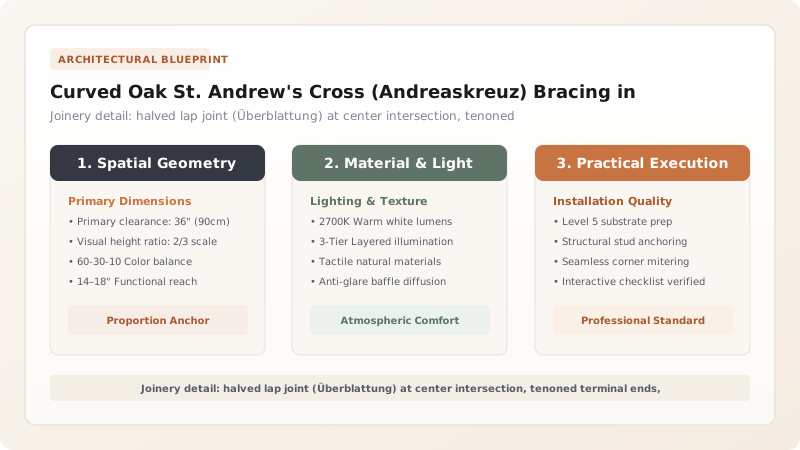
Structural Mechanics: Triangulation & Lateral Shear Rigidity
A fundamental structural vulnerability of post-and-beam construction is that a rectangular frame composed solely of vertical posts and horizontal beams possesses zero inherent resistance to lateral racking. Subjected to hurricane-force Atlantic winter gales or heavy snowdrifts accumulating on expansive barn roofs, an unbraced post-and-beam frame will parallelogram and collapse. To achieve structural equilibrium, the rectangular bays must be subdivided into rigid triangles—the only geometric polygon incapable of deforming without changing the physical length of its sides.
While simple diagonal struts (Streben) provide triangulation in one direction, the master carpenters of Central Germany developed the ultimate bilateral shear solution: the Andreaskreuz (St. Andrew’s Cross). Positioned symmetrically in the parapet bays beneath windows (Brüstungsgefache) and within the heavy corner bays of the barn, the Andreaskreuz consists of two diagonal oak timbers intersecting in an 'X'. When wind pressure strikes the building from the left, one diagonal is placed into pure compressive load, transferring the lateral thrust directly into the heavy foundation sill; when the wind reverses from the right, the opposing diagonal immediately takes the compressive load, conferring complete dynamic equilibrium upon the multi-storey timber skeleton.
From Function to Art: The Weser & Franconian Renaissance
During the Late Gothic era of the 14th and 15th centuries, the Andreaskreuz was an austere, functional component composed of straight, unadorned oak timbers. However, with the arrival of the Renaissance in the mid-16th century—particularly across the prosperous merchant and agricultural regions along the Weser River (the Weserrenaissance) and throughout Franconia—carpenters transformed this utilitarian brace into the premier artistic signature of German vernacular architecture.
Straight timbers were abandoned in favor of dramatic, curvilinear forms. Master carpenters sculpted the braces into flowing S-curves (geschweifte Streben), incorporating decorative carved cusps and pointed lobes known as 'noses' (Nasen). In the most elaborate examples, such as the Mannheimer Kreuz or the Franconian feathered cross, the braces were embellished with chip-carved rosettes, fluted scrolls, and spiraling foliage that mirrored the stone scrollwork of aristocratic castles. This artistic flowering turned agricultural barn facades into three-dimensional rhythmic canvases of light and shadow, proclaiming the prosperity and civic sophistication of the peasant burgher.
Compass Timber: Sourcing & Hewing Krummholz
A critical engineering secret of the curved Andreaskreuz lies in the procurement of the raw timber. A master carpenter would never cut a curved brace from a straight-grained oak log. If a curved profile is sawn across straight grain, the wood fibers are severed diagonally across the member (a defect known as 'short grain'). Under heavy wind loading, tensile shear stresses would cause the brace to split instantaneously along the severed grain lines.
Instead, the Zimmermann ventured into the forest to hunt for Krummholz (compass timber)—trees that had naturally grown with curved trunks or massive branch crotches due to wind exposure, hillside slope, or canopy competition. Because the tree grew in an arc, its continuous cellulose fibers run uninterrupted around the curve. When hewn with a broadaxe, the natural curve of the wood grain follows the exact contour of the brace. This natural fiber continuity endows the curved Andreaskreuz with phenomenal structural strength, allowing it to act as a natural spring that flexes elastically under shock loads without brittle fracture.
The Master Joint: Halved Lap & Draw-Bored Trunnels
Executing the joinery for an Andreaskreuz is considered the true test of a journeyman carpenter's skill. At the center where the two curved diagonals intersect, the timbers cannot simply bypass each other; they must form a coplanar, flush junction. The carpenter cuts a halved lap joint (Überblattung), removing exactly half the thickness of each beam using precision cross-cut handsaws and wide paring chisels. The joint must be cut with tolerances under half a millimeter: too loose, and the braces will rattle and allow racking; too tight, and the wood will split when seasonal humidity causes swelling.
At the four terminal ends, the braces are fashioned with tenons that penetrate mortises cut into the vertical posts and horizontal sills. Crucially, every connection is secured using draw-boring (in German, den Zapfen anziehen). The peg hole drilled through the tenon tongue is deliberately offset by 2 to 3 millimeters closer to the tenon shoulder than the matching hole through the mortise cheeks. When an octagonal, hand-riven seasoned oak pin (Holznagel) is driven through, its tapered point forces the misaligned holes into alignment, pulling the tenon shoulder with tremendous mechanical leverage deep into the mortise socket. This mechanical tension locks the Andreaskreuz permanently into the structural matrix, ensuring that the barn remains plumb and rigid through centuries of seasonal storms.
German Diagonal Bracing Typologies & Shear Load Capacities
Use this reference table to calculate exact physical dimensions, ratios, and specifications before purchasing:
| Bracing Typology | German Name | Geometry / Form | Shear Resistance | Aesthetic Era |
|---|---|---|---|---|
| Straight St. Andrew's Cross | Einfaches Andreaskreuz | Simple straight X-brace intersecting at 90° | Very high compressive & tensile shear | Late Gothic (14th–15th c.) |
| Curved Andreaskreuz | Geschweiftes Andreaskreuz | Sinuous S-curved oak timbers with center lap | High shear; provides elastic flexibility | High Renaissance & Mannerist (1550–1650) |
| Nosed Cross (Mit Nasen) | Andreaskreuz mit Nasen | Curved cross with ornamental carved nose lobes | High shear; excellent decorative prominence | Weser Renaissance & Franconian Baroque |
| Knee Brace | Kopfband / Fußband | Short diagonal brace at post-beam corners | Moderate; stiffens localized right angles | Universal throughout all Fachwerk eras |
| Wild Man (Wilder Mann) | Der Wilde Mann | Anthropomorphic brace combining post, legs, & arms | Maximum shear rigidity for corner bays | Middle and South German Renaissance |
Practical Constraints
Every successful decoration project must account for physical and environmental constraints:
Scarcity of naturally curved compass oak timber (Krummholz) in modern commercial forestry
Locating branches with the precise radius of curvature for historic restoration is time-consuming. Mitigation: Establish direct partnerships with traditional sustainable forestry estates managing oak coppice woodlands.
Extreme precision required to execute compound-angled half-lap joints on curved members
Any gap exceeding 1 mm allows joint rotation and water infiltration. Mitigation: Utilize full-scale 1:1 timber drafting beds (Reißboden) and physical wooden templates.
Execution Blueprint & Craftsmanship Sequence
Execute this professional sequence to achieve flawless results without backtracking:
Timber Sourcing & Compass Grain Inspection
Select natural curved oak limbs from tree branch crotches where the continuous grain follows the required curvature without cross-grain weaknesses.
Full-Scale Reißboden Lofting
Snap chalk lines on the workshop floor to lay out the full-scale rectangular bay, determining the exact intersection angle of the X-brace.
Continuous Diagonal Hewing & Profiling
Hew the primary diagonal member with a broadaxe, shaping the decorative carved nose lobes (Nasen) along the curved outer edges.
Center Half-Lap Joint (Überblattung) Cutting
Chisel a half-lap joint at the center intersection of both members, removing exactly 50% of the timber depth from each piece for a flush fit.
Terminal Tenon Angling & Shoulder Scribing
Cut tenons on the four brace terminals, cutting angled shoulders that mate flush with the vertical studs and horizontal sill plates.
Draw-Bore Hole Layout & Offset Drilling
Bore 20 mm peg holes through the mortise cheeks, marking the tenon tongue and drilling with a 2 mm offset toward the shoulder.
Trial Assembly & Framing Square Trueing
Assemble the entire bay flat on the ground, driving temporary steel drift pins (Aufsteckdorne) to check diagonal squareness.
Final Erection & Oak Trunnel Driving
Raise the frame into position, driving hand-carved octagonal seasoned oak trunnels through all joints and trimming the projecting heads.
Common Mistakes & Countermeasures
Avoid these costly errors that compromise aesthetics, ergonomics, and budget:
Cutting curved braces from straight-grained timber across the grain (short grain)
Omitting the center lap joint and simply butting two halves against a continuous diagonal
Project Execution Checklist
Track your physical progress. Checkboxes persist automatically on this device:
Frequently Asked Questions
Why is the X-brace called a St. Andrew's Cross (Andreaskreuz)?
The X-shaped diagonal brace is named after Saint Andrew the Apostle, who according to Christian tradition was martyred on a diagonal cross (crux decussata). In medieval and early modern German society, the symbol carried profound religious and apotropaic significance: villagers believed that mounting an Andreaskreuz in the walls of a barn protected the harvest and livestock from lightning strikes, demonic infiltration, and structural collapse.
What structural advantage does an Andreaskreuz provide over a single diagonal brace?
A single diagonal brace can only act primarily in compression; when wind forces reverse and pull the brace in tension, the joint risks pulling apart. An Andreaskreuz provides symmetrical, opposing diagonals: regardless of which direction lateral wind shear or earthquake forces strike the barn, one diagonal member is in pure compression while the opposing member resists in tension, preventing racking in both directions.
Why are the decorative lobes on the edges of the cross called 'noses' (Nasen)?
In German carpentry terminology, 'Nasen' refers to the sharp, curved protrusions or cusp lobes carved along the inner concave profiles of the braces. Emerging during the Gothic period and perfected in the Renaissance, these lobes mimicked stone Gothic tracery, casting deep architectural shadows that visually softened the massive timber members and demonstrated the artistic virtuosity of the master carpenter.