Lehmwickel (clay-straw wrapped ceiling batons) is a historic Central European flooring and ceiling system. Triangular cleft oak or pine struts (Wickellatten) are wrapped spirally in long winter rye straw soaked in liquid clay slip (Lehmschlicker). The wet batons are slid side-by-side into continuous rebates along the flanks of heavy ceiling joists, tamped flush, and plastered from below with calcified pit-slaked lime wash, providing superior fire insulation, acoustic mass, and natural humidity buffering.
At a Glance: Key Takeaways
- Ceiling Baton (Wickellatte): Triangular Cleft Oak, Pine or Spruce (30 mm × 40 mm)
- Wrapping Straw: Long Unbroken Winter Rye Straw (1.0 m to 1.2 m length)
- Clay Slurry (Schlicker): High-plasticity subsoil clay slurry (creamy viscosity)
- Fire Resistance Rating: F60 to F90 (60–90 min structural burn resistance)
- Ceiling Finish: Fine animal-hair lime plaster and 5-coat pure lime wash
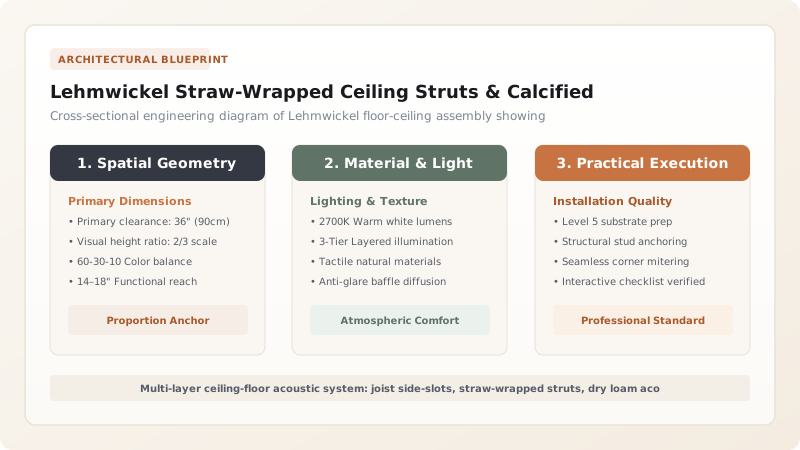
The Forgotten Acoustic and Thermal Genius of Lehmwickel
In modern wood-frame construction, multi-story buildings struggle with impact footstep noise, sound transmission between floors, and fire spread. In medieval and early modern German Fachwerk houses, master carpenters solved all three issues simultaneously with an ingenious composite ceiling system known as Lehmwickel (or Windelboden).
By installing heavy earthen rolls wrapped in long straw between floor joists, the builders added substantial dead mass (typically 120 to 180 kg per square meter). This massive density acts as an exceptional acoustic damper, stopping airborne conversation and footfall vibrations dead in their tracks. Simultaneously, the inorganic clay matrix encapsulates the straw, creating an airtight, non-flammable thermal barrier that resisted fire spread through ceilings for up to two hours.
Fabricating the Wickellatte: Wrapping Straw in Liquid Clay Slurry
Fabricating Lehmwickel is a rhythmic, sensory manual craft. The core strut (Wickellatte) is split from straight-grained oak, spruce, or pine into a rough triangular cross-section (approximately 30 mm × 40 mm). Its ends are trimmed to a bevel to match the slot angle in the joists.
Beside a shallow wooden trough filled with creamy liquid clay slurry (Lehmschlicker), the artisan lays out long, unthreshed winter rye straw. Bundles of straw are dipped into the clay bath until every fiber is saturated with liquid mineral paste. The artisan grasps the wooden strut, anchors the head of the straw bundle at one end, and rolls the stick in a rotating motion along a wooden work bench, spiraling the sticky clay-soaked straw tightly around the wood core until it forms a uniform roll roughly 80 mm to 100 mm in diameter.
Installation Mechanics: The Joist Rebate and Beetle Compaction
Along the lower sides of the heavy ceiling joists (Balken), carpenters chisel continuous longitudinal grooves (Nut) measuring 30 mm wide and 25 mm deep, located 40 mm above the joist's bottom face.
While still wet and malleable, each wrapped Lehmwickel roll is lifted into the ceiling bay. One end of the wooden core is pushed deep into the groove on one joist, and the opposite end is swung into the matching groove on the opposing joist. The worker then uses a broad wooden beetle (mallet) to ram the newly placed roll sideways against the preceding one. The wet clay-straw rolls deform under compaction, squishing together into a seamless, solid earthen slab spanning the entire ceiling bay.
The Ceiling Underside: Animal-Hair Plaster and Pit-Slaked Lime Wash
As the clay-straw rolls dry over several weeks, the underside of the ceiling forms an undulating, ribbed earthen topography. To finish the ceiling, artisans apply a breathable mineral plaster system:
- Base Scratch Coat: A rich mix of fat lime putty and coarse sharp pit sand, reinforced with sterilized ox hair or goat hair (4 kg/m³). Pressed firmly into the straw fissures to create a strong mechanical bond.
- Fine Setting Coat: A 1:1 mix of aged lime putty and fine silver quartz sand floated with a felt pad to produce a velvety smooth plane.
- Calcified Limewash: Five to seven coats of pure slaked lime wash (Kalkmilch). As it absorbs atmospheric carbon dioxide, the lime carbonates into pure calcium carbonate (calcite), producing a luminous, light-reflecting white ceiling that naturally disinfects the air and resists indoor mold growth.
Ceiling-Floor Systems: Lehmwickel vs Modern Drywall / Mineral Wool vs Concrete Slab
Use this reference table to calculate exact physical dimensions, ratios, and specifications before purchasing:
| Technical Metric | Historic Lehmwickel Ceiling | Modern Timber Joist + Drywall | Solid Reinforced Concrete Slab |
|---|---|---|---|
| Acoustic Mass (Low Frequency) | Outstanding (150 kg/m² mass damping) | Poor; transmits footstep thumps easily | Exceptional; massive rigid acoustic mass |
| Moisture Regulation | Active hygroscopic buffer; adsorbs humidity | Zero; requires mechanical dehumidification | Zero; prone to condensation surface mold |
| Embodied Carbon | Negative / Zero; local clay, straw, and timber | High; gypsum calcination and fiberglass | Extreme; Portland cement and steel rebar |
| Reversibility & Repair | 100% recyclable; re-soak in water to re-use | Landfill waste; torn down during remodel | Permanent; requires heavy demolition hammer |
| Historical Authenticity | Mandatory for Grade I Fachwerk preservation | Unacceptable; introduces synthetic moisture barriers | Structurally incompatible with timber frames |
Practical Constraints
Every successful decoration project must account for physical and environmental constraints:
Massive Initial Water Load Added to Building Interior
A standard house ceiling introduces over 1,500 liters of water into the building structure Mitigation: Install Lehmwickel in late spring with continuous open-window cross-drafts, utilizing industrial dehumidifiers if building in autumn
Sourcing Unbroken Long-Stem Grain Straw
Modern combine harvesters shred and chop straw into short pieces unusable for wrapping Mitigation: Source straw from heritage farms utilizing vintage sickle-bar mowers or traditional threshing machines that preserve full stalk length
Execution Blueprint & Craftsmanship Sequence
Execute this professional sequence to achieve flawless results without backtracking:
Joist Side Groove Channelling
Plow a continuous 30 mm × 25 mm rebate along both lower sides of structural floor joists using a router plane or grooving saw.
Core Strut Clefting and Length Trimming
Rive triangular wooden struts (Wickellatten) from spruce or oak. Cut ends to 45° bevels, sizing length exactly 30 mm wider than clear joist span.
Liquid Clay Slurry (Schlicker) Preparation
Dissolve plastic subsoil clay in water in a wooden trough, stirring with a paddle until it reaches the consistency of heavy pancake batter.
Rye Straw Immersion and Baton Rolling
Dip long unbroken winter rye straw in clay slurry. Spiral straw tightly around the wooden strut on a rolling table to an 80 mm diameter.
Ceiling Slotting and Lateral Mallet Compaction
Slide the ends of the wet wrapped strut into opposing joist grooves. Ram firmly against adjacent struts using heavy wooden beetles.
Upper Acoustic Dry Loam Fill (Schüttung)
Once Lehmwickel is dry, spread a 60-mm layer of dry expanded clay pellets, sharp sand, and wood shavings across top surface to level floor.
Base Hair-Lime Plaster Application
Mist ceiling underside with water. Trowel on an 8-mm scratch coat of non-hydraulic lime putty and coarse sand reinforced with goat hair.
Multi-Coat Calcified Limewashing
Apply five thin coats of pure pit-slaked limewash with a wide whitewash brush, allowing 24 hours between coats for full calcite carbonation.
Common Mistakes & Countermeasures
Avoid these costly errors that compromise aesthetics, ergonomics, and budget:
Laying flooring boards directly onto wet, uncured Lehmwickel batons
Using machine-chopped short straw to wrap the wooden struts
Plastering the ceiling underside with gypsum plaster instead of lime
Project Execution Checklist
Track your physical progress. Checkboxes persist automatically on this device:
Frequently Asked Questions
How heavy is a completed Lehmwickel ceiling assembly?
A standard Lehmwickel ceiling—including the wrapped struts, upper dry loam leveling fill, and lower lime plaster—weighs between 140 and 180 kg per square meter. This substantial mass is precisely what gives historic timber houses their quiet acoustic comfort.
Can modern recessed ceiling lights be installed in a Lehmwickel ceiling?
Historically, no. Cutting large holes through Lehmwickel severs the wooden struts and creates pathways for fire spread. Modern lighting in restored Fachwerk buildings is typically wall-mounted or integrated into surface-mounted conduits along the joists.
What is the upper dry fill (Schüttung) made of?
Historically, the fill above the Lehmwickel consisted of dry subsoil loam, wood shavings, sheep's wool, or calcined gypsum spalls. Modern restorations often use expanded clay pellets (Leca) or perlite mixed with lime dust to provide lightweight leveling and acoustic absorption.
How does lime wash turn into hard stone on the ceiling?
Slaked lime (calcium hydroxide, Ca(OH)2) reacts with ambient carbon dioxide (CO2) in the air through a process called carbonation. As water evaporates, the lime chemically transforms back into solid calcium carbonate (CaCO3)—the exact mineral composition of natural limestone and marble.