Flechtwerk and Lehmbewurf represent the traditional German wattle-and-daub infill method for timber-framed Fachwerk bays. Pointed cleft oak staves (Staken) are wedged into triangular grooves in upper and lower frame beams at 150-mm intervals. Flexible hazel or willow withes are woven horizontally through the staves to form a springy lattice hurdle. A dense bio-composite of clay subsoil, sharp sand, chopped rye straw, and cow dung is then pressed into both faces to form a 60-mm thick breathable earthen wall panel.
At a Glance: Key Takeaways
- Wattle Staves (Staken): Cleft Green Oak or Sweet Chestnut (25 mm × 35 mm)
- Weaving Withes (Gerten): Coppiced 2-year Hazel (Corylus) or Willow (Salix)
- Stave Spacing: 120 mm to 160 mm on center along bay groove
- Daub Composite: Clay Loam (30%), Sand (50%), Rye Straw & Cow Dung (20%)
- Finished Thickness: 50 mm to 70 mm (recessed 15 mm from timber beam face)
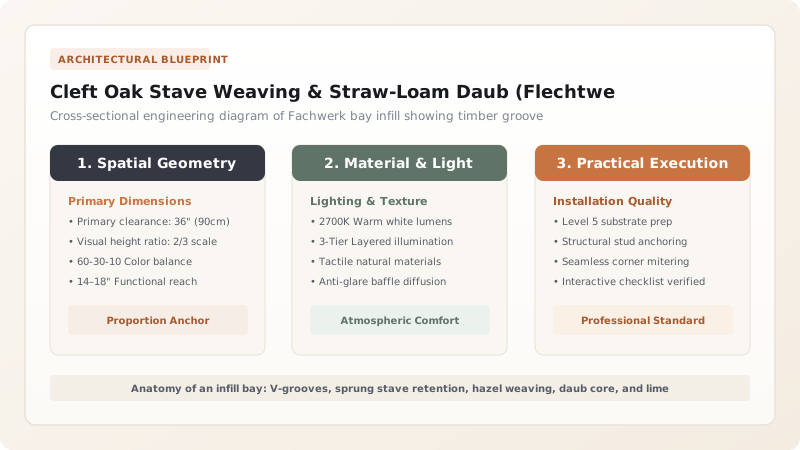
The Anatomy of the German Infill Bay (Gefach)
In a historic Fachwerk structure, the skeletal oak posts and diagonal braces carry all structural loads: the roof weight, upper story deadweight, and wind forces. The spaces between timbers—the Gefache—function purely as protective infill curtains.
Because the heavy oak frame naturally expands, contracts, and flexes under seasonal humidity and high winds, rigid infill materials like fired brick or cement mortar invariably crack along the timber interfaces. Wattle-and-daub (Flechtwerk und Lehmbewurf) is inherently flexible and elastic. It forms an organic bond with the wood, flexing alongside the timbers without debonding and providing unmatched vapor permeability that protects the oak frame from rot.
Cleft Oak Staves and the Sprung-Wedge Groove System
Securing the wattle lattice inside the timber bay without nails or metal clips is an ingenious feat of joinery:
- The Upper Groove (Staknut): The carpenter cuts a continuous triangular or rectangular V-groove (25 mm wide and 30 mm deep) along the underside of the upper horizontal tie beam.
- The Lower Sockets (Bohrungen oder Kerben): Along the top face of the lower sill beam, the carpenter cuts matching individual notches or an angled chamfer groove (15 mm deep).
- The Sprung Stave (Stake): Vertical staves are cleft (split along the natural grain) from young green oak heartwood. The upper end is whittled to a blunt wedge; the lower end is carved into a sharp chisel point. Cut 15 mm longer than the clear bay height, the stave is inserted deep into the top groove, bent outward in an arc like an archer's bow, and snapped into the bottom notch. When straightened, it wedges itself immovably under internal spring tension.
Weaving the Flechtwerk: Coppiced Hazel and Willow Withes
Once the vertical staves are wedged at 150-mm intervals, the wattle hurdle is woven. Craftsmen use flexible two-year-old rods (Gerten or Ruten) harvested from coppiced hazel or willow stands during winter dormancy.
The withes are woven horizontally in an alternating basket-weave pattern (in front of one stave, behind the next). The ends are twisted and tucked back around the perimeter staves. Periodically, the weaver places a wooden block on the woven rods and strikes it with a mallet, consolidating the weave into a dense, tight lattice. This springy basketry skeleton acts as a continuous three-dimensional reinforcement grid that holds the wet clay daub securely suspended inside the timber frame.
The Master Daub Recipe: Clay, Rye Straw, and Cow Dung Chemistry
Formulating the daub (Lehmbewurf) is an exact empirical science. Pure clay shrinks excessively as water evaporates, causing catastrophic cracks; pure sand lacks cohesion and crumbles to dust. The optimal mix contains roughly 30% reactive subsoil clay, 50% sharp graded sand and gravel grit (up to 6 mm), 15% chopped winter rye straw (50–80 mm long), and 5% fresh cow dung.
The cow dung plays a critical biochemical role: it introduces natural ammonium and casein proteins that act as organic surfactants, lowering water tension and accelerating clay plasticization. Furthermore, the micro-fibers of digested plant cellulose intertwine with the larger straw stems, creating a multi-scale fiber network that arrests shrinkage micro-cracking during the drying phase.
Flechtwerk Constituents and Quality Parameters
Use this reference table to calculate exact physical dimensions, ratios, and specifications before purchasing:
| Constituent Element | Optimal Material Spec | Dimensional Standard | Structural Function |
|---|---|---|---|
| Vertical Staves (Staken) | Cleft straight-grained European oak heartwood | 25 mm × 35 mm rectangular profile | Rigid vertical load-transfer columns spanning bay height |
| Weaving Withes (Gerten) | Coppiced green hazel or osier willow rods | 10 mm to 18 mm diameter; unpeeled | Horizontal tensile basket lattice holding daub core |
| Subsoil Clay Loam | Iron-rich illite/kaolinite mineral subsoil | Passes 2 mm sieve; zero organic loam | Mineral glue binder locking aggregates together |
| Chopped Rye Straw | Clean, dry winter rye or barley straw | Stalk lengths 50 mm to 80 mm | Primary structural tensile reinforcement fiber |
| Aged Cow Dung | Fresh manure from grass-fed cattle | Filtered through coarse mesh screen | Casein binder, plasticizer, anti-shrinkage agent |
Practical Constraints
Every successful decoration project must account for physical and environmental constraints:
Seasonal Availability of Coppiced Green Hazel and Willow
Coppice harvesting is restricted to winter months (November–February) before sap rises Mitigation: Harvest and store winter withes in shaded damp sand pits or submerge in cold water troughs to keep pliable for spring builds
High Shrinkage of Rich Pure Clays
Heavy pottery clays can shrink up to 12% by volume during air drying Mitigation: Blend 2 to 3 parts sharp sand to 1 part pure clay, conducting shrinkage bar tests before full wall application
Execution Blueprint & Craftsmanship Sequence
Execute this professional sequence to achieve flawless results without backtracking:
Timber Groove and Socket Channelling
Chisel a 25-mm deep continuous V-groove in the upper bay beam and matching 15-mm deep notches along the lower sill beam.
Oak Stave Clefting and End Shaping
Rive oak staves with a froe to 25 mm × 35 mm gauge. Carve upper blunt wedge and lower chisel point, cutting length 15 mm oversized.
Spring-Loading Staves into Bay
Insert top of stave into upper groove, flex stave outward into an arc, and snap bottom point into lower notch, repeating at 140 mm centers.
Hazel Withe Weaving (Flechtwerk)
Weave flexible 15-mm hazel rods horizontally across staves in alternating basket pattern, tamping rows tight with wooden drift blocks.
Daub Pugging and Kneading
Mix clay subsoil, sharp sand, chopped rye straw, and cow dung on a tarp with water. Tread by foot until mixture reaches stiff dough consistency.
Two-Sided Simultaneous Daub Throwing
Two workers standing inside and outside the wall simultaneously throw and press fist-sized daub lumps into the weave, interlocking through voids.
Surface Scraping and Recess Profiling
Level the daub with a wooden float, recessing the panel face 15 mm behind the oak beam face to accommodate the final lime plaster.
Key Scratching and Natural Curing
Comb diamond scratch keys into wet daub face. Allow panel to dry naturally in shaded cross-breezes for 4 to 6 weeks before lime plastering.
Common Mistakes & Countermeasures
Avoid these costly errors that compromise aesthetics, ergonomics, and budget:
Applying daub flush with the outer face of the oak timbers
Treading daub with excessive water to make it flow easily
Using dried, brittle hazel withes that break during weaving
Project Execution Checklist
Track your physical progress. Checkboxes persist automatically on this device:
Frequently Asked Questions
Can willow branches be used instead of hazel for Flechtwerk?
Yes. Coppiced willow (osier) is exceptionally flexible and slightly softer than hazel, making it easier to weave around tight corner staves. Hazel is slightly stiffer and offers higher lateral rigidity, making a combination of both ideal.
How do you seal the gap that forms between the dried daub and the oak beams?
As daub dries, it naturally shrinks slightly away from the wood. This perimeter gap (typically 2–4 mm wide) is packed tightly with a fine clay-sand-hair slip paste, followed by the flexible lime render coat that bridges the junction with a feathered waterproof lap.
Why is rye straw preferred over wheat or oat straw for daub?
Rye straw has long, tough, highly fibrous stems with high silica content, making it remarkably rot-resistant and mechanically tough. Wheat straw is acceptable; oat straw is too soft and decomposes quickly in damp conditions.
Does cow dung cause the wall to smell once it dries?
No. When mixed into wet clay and allowed to cure, the organic odor vanishes completely within 48 to 72 hours. Once dry, the wall smells purely of fresh earth, clean straw, and mineral lime, emitting zero unpleasant odors.