
The spaces between Fachwerk timbers (*Gefache*) are filled with traditional wattle-and-daub (*Flechtwerk*). Flexible split hazel or oak stakes (*Staken*) are sprung into continuous grooves in the framing timbers and woven with horizontal hazel rods, then plastered on both sides with a wet mixture of subsoil clay, chopped barley straw, sand, and animal dung, finished with pure breathable slaked lime wash.
At a Glance: Key Takeaways
- Panel Designation: Gefach (Timber infill panel) with Flechtwerk (Wattle-and-Daub)
- Upright Stakes: Split oak or hazel stakes (*Windstaken*) sprung into pre-cut beam grooves
- Horizontal Weft: Coppiced hazel (Corylus avellana) or willow rods (8–15mm diameter)
- Daub (Lehmbewurf): Local subsoil clay (30%), sharp sand (40%), chopped straw (20%), cow dung (10%)
- Finish Render: Non-hydraulic slaked lime render (CL90) finished with pure lime milk
- Thermal & Moisture: High hygroscopic humidity buffering and breathability (prevents timber rot)
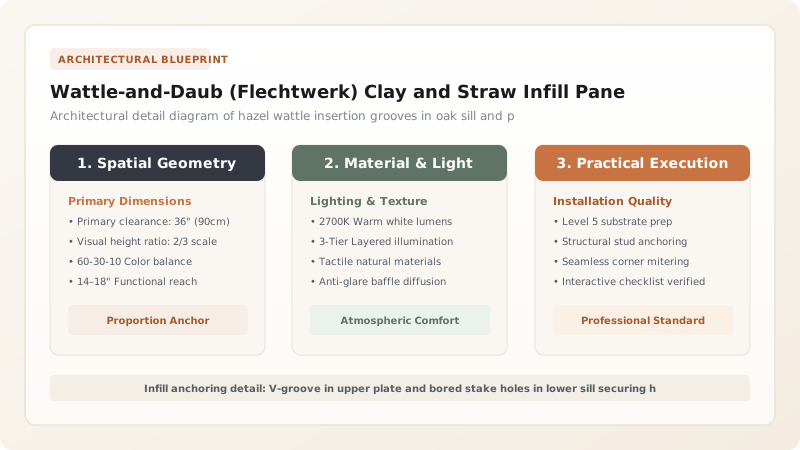
Wattle Armature Mechanics and Coppicing Ecology
The wattle armature provides the mechanical skeleton that holds the heavy earthen daub securely inside the framing bay without falling out during windstorms or timber movements:
- Beam Grooving: Before raising the wall, carpenters cut a continuous triangular V-groove (15–20mm deep) along the underside of the upper timber plate and augered round holes (25mm diameter) every 20cm along the top face of the lower sill.
- Springing the Stakes (Staken): Riven oak or hazel stakes (Windstaken) were sharpened at both ends. The upper tip was seated into the V-groove, and the stake was bowed outward by hand until the bottom tip snapped securely into the lower hole.
- Hazel Weaving (Flechtwerk): Flexible, green hazel or willow shoots harvested from sustainably coppiced woodlands were woven basket-style horizontally around the vertical stakes, creating a rigid three-dimensional mesh.
Clay Daub Formulation and Hygroscopic Timber Protection
Earthen daub (Lehm) is the ultimate partner to oak timber. While modern cement renders trap moisture against wood, causing rapid fungal decay, clay is intensely hygroscopic:
Subsoil clay absorbs ambient moisture from the air faster than oak wood. When humidity rises, the clay infill pulls moisture out of the surrounding timbers; when the air dries, the clay releases the moisture safely into the atmosphere. This continuous natural dehumidification keeps the oak heartwood below the 18% moisture threshold required for fungal rot, preserving the timbers indefinitely.
The traditional mix balances subsoil clay (binder), coarse sharp sand (aggregate skeleton), chopped barley or rye straw (tensile fiber reinforcement), and fresh cow dung (which provides casein enzymes and natural fibers that enhance plasticity and reduce shrinkage cracking).
Wattle-and-Daub (Flechtwerk) Clay and Straw Infill Panels in Fachwerk Architectural Decision Matrix
Use this reference table to calculate exact physical dimensions, ratios, and specifications before purchasing:
| Infill Material | Vapor Permeability (μ) | Flexibility under Timber Movement | Thermal Mass | Compatibility with Oak |
|---|---|---|---|---|
| Wattle & Daub (Flechtwerk) | 5–10 (Extremely breathable) | High (Absorbs racking without cracking) | High (Thermal lag) | Perfect (Maintains dry timber) |
| Fired Clay Brick in Lime | 10–15 (Breathable) | Moderate (Separates at perimeter joint) | Very High | Excellent if lime-pointed |
| Porous AAC Block | 6–10 | Low (Brittle) | Medium | Requires flexible lime perimeter |
| Portland Cement Concrete | 80–120 (Vapor barrier) | Zero (Causes shearing & cracking) | High | Destructive (Induces oak rot) |
Practical Constraints
Every successful decoration project must account for physical and environmental constraints:
Seasonal Clay Harvesting and Freezing
Coppice Wood Availability
Weaving and Daubing a Fachwerk Bay (Gefach)
Execute this professional sequence to achieve flawless results without backtracking:
Stake Fitting
Measure bay height; cut riven hazel stakes 20mm oversize; seat upper chisel point in beam groove and snap lower point into sill socket.
Hazel Weaving
Weave green, pliable hazel rods around the stakes in alternating basket weave, packing rods tightly downward with a wooden block.
Daub Mixing & Treading
Combine subsoil clay, sand, chopped straw, and water in a shallow pit; tread with bare feet until thoroughly mixed into a stiff, clayey paste.
Double-Sided Application
Two workers stand on opposite sides of the wattle mesh, throwing clay balls against each other simultaneously to force daub into all basket voids.
Scratch Keying & Drying
Level the daub 10mm recessed from the oak timber faces; score wavy key lines with a fork; allow to dry under shade for 3–4 weeks.
Lime Plaster & Limewash
Apply a 10mm top coat of aged slaked lime mortar flush with the timber bevels; finish with three coats of pure calcium lime milk.
Common Mistakes & Countermeasures
Avoid these costly errors that compromise aesthetics, ergonomics, and budget:
Rendering lime plaster flat over the oak timber faces
Applying daub in direct summer sunlight
Using straw fibers longer than 10cm
Project Execution Checklist
Track your physical progress. Checkboxes persist automatically on this device:
Frequently Asked Questions
Why does cow dung improve wattle-and-daub mortar?
Cow dung contains micro-cellulose plant fibers digested by bovine enzymes, as well as natural casein proteins. When mixed with clay and sand, the casein acts as a natural water-resistant binder, while the ultra-fine digestive fibers prevent micro-cracking during drying.
How do builders prevent rain from seeping between the infill panel and the oak beams?
Carpenters cut a 45-degree chamfer or bevel on the inner edges of the oak beams. The lime plaster finishes into this triangular recess, creating a weather-shedding lap joint that naturally sheds wind-driven rain away from the timber-infill seam.


