
Traditional German Fachwerk joinery eliminates all metallic fasteners in favor of wood-to-wood mechanical interlocking. Master carpenters utilized housed mortise-and-tenons, dovetail laps, and halving joints secured by draw-boring (*Verdübelung*). In draw-boring, an offset hole through the tenon forces the joint tight as a tapered octagonal oak pin is driven, creating permanent mechanical clamping.
At a Glance: Key Takeaways
- Joinery Typologies: Verzapfung (Mortise-and-Tenon), Überblattung (Halving Lap), Schwalbenschwanz (Dovetail)
- Fastener: Hand-riven octagonal oak pegs (*Holznägel*) 20–25mm diameter
- Draw-Bore Offset: 2.0 to 3.5 mm offset toward the tenon shoulder
- Clamping Force: Generates 15–25 kN of permanent compressive shoulder clamping
- Carpentry Tooling: T-auger (Stangenbohrer), framing chisel (Stechbeitel), wooden mallet
- Moisture Matching: Pegs must be bone-dry (<10% MC) driven into green/semi-dry frame timbers
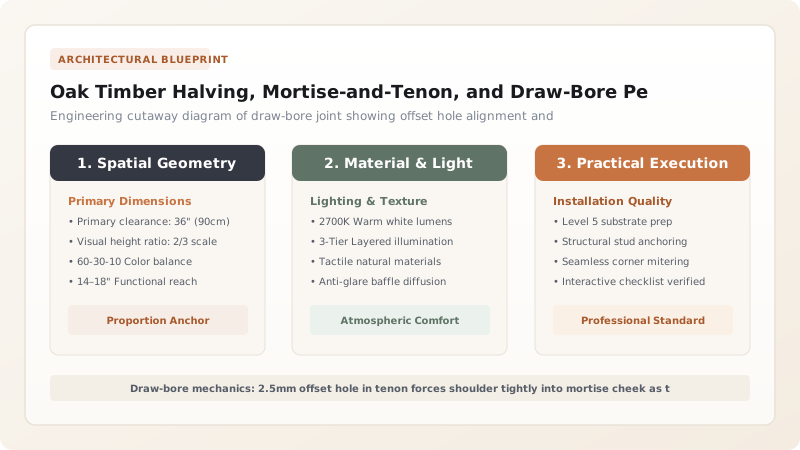
Kinematics and Mechanics of the Draw-Bored Joint
Draw-boring (known in German as Ziehnagelung or Verdübelung) is one of the most ingenious feats of pre-industrial mechanical engineering. In standard pinned joinery, holes are drilled through the assembled joint, leaving the connection susceptible to loosening as timber shrinks. Draw-boring actively pre-stresses the timber connection:
- The mortise is cut, and a hole (typically 22 mm) is bored cleanly through both mortise cheeks using a T-handled auger.
- The tenon is inserted and its shoulder seated tightly; the center of the mortise hole is pricked onto the tenon tongue using the point of the auger or a center punch.
- The tenon is withdrawn. The hole through the tenon is bored 2 to 3 millimeters closer to the tenon shoulder than the mark.
- When reassembled, the holes are intentionally misaligned. As a tapered, hard-seasoned octagonal oak peg is hammered through, the peg flexes elastically, pulling the tenon shoulder violently against the mortise face with tons of clamping force.
Halving Laps and Scarf Joints in Long Structural Beams
Because medieval forests rarely yielded straight oak logs exceeding 12–15 meters, carpenters used sophisticated scarf joints (Holzverbindungen) to join sill plates and wall girts longitudinally:
- Halving Lap (Überblattung): Timbers are half-checked and overlapped, pinned with four vertical oak pegs. Ideal for sill beams resting on continuous masonry foundations.
- Stop-Splayed Scarf with Under-Squinted Tenons: Used in self-supporting ceiling beams. The diagonal cut distributes flexural shear stresses, while a central hardwood wedge (Schlüssel) drives the scarf halves into permanent mechanical lock.
- T-Bridle Joints: Used where horizontal girts meet vertical mid-posts, preventing outward thrust from racking the wall frame.
Oak Timber Halving, Mortise-and-Tenon, and Draw-Bore Pegging in Fachwerk Architectural Decision Matrix
Use this reference table to calculate exact physical dimensions, ratios, and specifications before purchasing:
| Joint Type | German Designation | Primary Stress Resisted | Peg Quantity | Typical Assembly Zone |
|---|---|---|---|---|
| Draw-Bored Mortise & Tenon | Eingezapfte Verbindung | Tension & vertical shear | 1–2 octagonal pegs | Post to sill, brace to post |
| Halving Lap | Gerades Blatt | Direct downward compression | 2–4 through pegs | Sill beam extensions & corner laps |
| Dovetail Lap | Schwalbenschwanzblatt | Lateral pullout & tension | 1 central peg | Tie beams to wall plates (Rähm) |
| Fork / Bridle Joint | Scherzapfen | Bending moment & rotation | 1 heavy pin | Rafter apexes & ridge trusses |
Practical Constraints
Every successful decoration project must account for physical and environmental constraints:
Grain Alignment Tolerances
Tallow Lubrication
Executing a Draw-Bored Fachwerk Joint
Execute this professional sequence to achieve flawless results without backtracking:
Mortise Scribing & Chopping
Scribe mortise boundary using a mortise gauge; drill waste with an auger; pare cheeks square and plumb with a heavy framing chisel.
Tenon Shoulder Cutting
Saw tenon cheeks and undercut shoulders by 0.5 degrees (back-bevel) so the exterior shoulder edges seal tightly against the mortise.
Cheek Boring
Bore a 22mm hole through both mortise cheeks at a distance of 40mm from the joint shoulder.
Tenon Pricking & Offset Boring
Insert tenon; prick hole center; withdraw tenon and bore hole 2.5mm closer to shoulder using a drill guide.
Peg Fabrication
Split straight-grained, kiln-dried oak with a froe into square blanks; shave into octagonal profile with a drawknife; taper the tip.
Driving the Peg
Coat peg in tallow; drive through the joint with a wooden beetle until it rings with a high pitch; trim protruding ends leaving 25mm proud.
Common Mistakes & Countermeasures
Avoid these costly errors that compromise aesthetics, ergonomics, and budget:
Drilling the offset greater than 4mm
Using green (wet) oak pegs in a green timber frame
Driving pegs with a steel sledgehammer
Project Execution Checklist
Track your physical progress. Checkboxes persist automatically on this device:
Frequently Asked Questions
Why are Fachwerk pegs shaped as octagons rather than smooth cylinders?
When an octagonal peg is driven into a round hole, its eight sharp longitudinal corners bite into the round hole walls, crushing slightly to create an airtight, high-friction mechanical key that prevents the peg from ever backing out.
Can historic Fachwerk joints be disassembled once pegged?
Yes. To disassemble a joint during restoration, carpenters center-drill out the oak peg with a bit slightly smaller than the hole diameter and tap out the peg shell, allowing the tenon to slide free without damaging the historic mortise.


