Hand-tooled ciselé border margins and boucharde bush-hammering represent the pinnacle of traditional Flemish stonecutting craft. Masons chisel a crisp, 15 to 30 mm wide drafted border (ciselure) around the perimeter of each Tournai blue limestone flagstone using a flat steel chisel and mallet, creating fine parallel ruled lines. Within this dark, elegant frame, the central field is hammered with a multi-pointed steel bush hammer (boucharde), crushing surface crystals into a light blue-grey stippled texture that provides superior wet slip resistance.
At a Glance: Key Takeaways
- Border Technique: Hand-chiselled ciselure (taille ciselée / drafted margin lines)
- Field Technique: Bush-hammered bouchardage (mechanical/hand multi-point stippling)
- Border Width: 15 mm to 30 mm uniform width with 1.0 mm spaced chisel ridges
- Hammer Tooth Count: Hand boucharde with 16, 25, 36, or 64 pyramidal steel points
- Visual Contrast: Dark, honed charcoal-blue border framing a light stippled blue-grey field
The Renaissance Stonemason Guilds of Flanders & Wallonia
In the medieval and Renaissance guild cities of Ghent, Bruges, Tournai, and Antwerp, the Master Stonemasons Guild (Les Compagnons Tailleurs de Pierre) exercised strict control over the techniques used to dress building stones. A raw, un-tooled block of Tournai blue limestone fresh from the quarry was viewed as merely rough quarry product. The prestige, value, and architectural authority of a stone was created entirely through the discipline of the hammer and chisel.
Over centuries of civic and ecclesiastical construction—from the soaring Romanesque Cathedral of Notre-Dame in Tournai to the grandiose Flemish Renaissance guildhalls of the Grand Place in Brussels—masons developed an elaborate vocabulary of surface texturing. Chief among these was the sophisticated juxtaposition of the taille ciselée (ciselure) border margin and the bouchardage (bush-hammered) field, creating an architectural relief that manipulated light and shadow with extraordinary graphic power.
The Art of Ciselure: Geometry & Chisel Kinematics
The creation of a ciselé border (or ciselure) is the supreme test of an apprentice stonemason’s hand. The purpose of the border is to establish a dead-straight, perfectly level frame around the perimeter of the flagstone, typically 15 to 30 mm in width. First, the mason uses a wide squaring chisel to dress the outer arrises (edges) into crisp, un-chipped 90-degree lines.
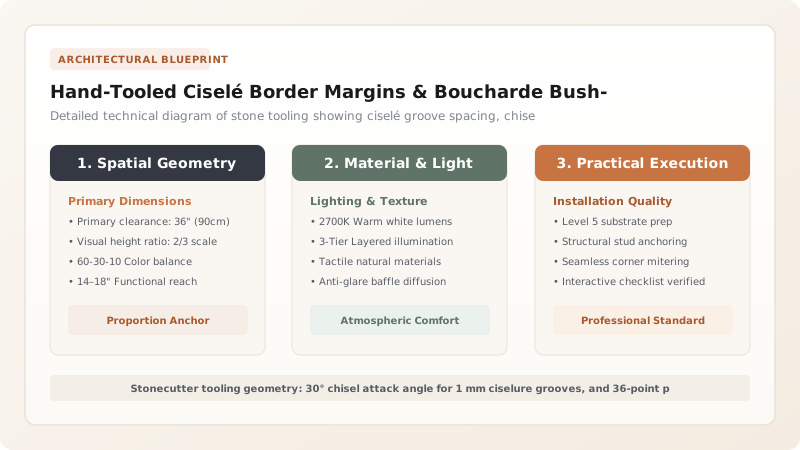
Next, using a razor-sharp flat steel cold chisel (ciseau à border) struck with a turned wooden or iron mallet, the mason drafts fine, parallel grooves across the width of the border. The chisel is held at a consistent 30-degree angle relative to the stone face, moving systematically along the margin at 1.0 mm intervals. Each mallet strike creates a crisp, microscopic ridge. The result is a regular, corduroy-like striped texture that catches the light in dark, velvety lines, providing a dead-flat boundary that allows adjacent flagstones to butt together in razor-thin 2 to 3 mm mortar joints.
Bouchardage Mechanics: The Physics of Crystal Crushing
With the perimeter framed by the dark, pristine ciselé margins, the mason turns to the central field. Leaving the center smooth would create a slippery surface dangerous to walk on when wet, and would fail to accentuate the dark borders. To solve this, the mason employs the boucharde (bush hammer)—a heavy hammer forged from hardened tool steel whose face is milled into a grid of 16, 25, 36, or 64 sharp pyramidal teeth.
Holding the bush hammer with both hands, the mason strikes the stone with vertical, perpendicular blows. As the steel teeth strike the dense Petit Granit, they exert crushing point loads that shatter the outer calcite crystals and fossil bioclasts into microscopic powder. Because light reflects diffusely from these shattered crystal facets, the optical value of the stone shifts dramatically: the dark, inky blue-black stone transforms into a luminous, delicate light blue-grey stipple (teinte adoucie claire). Crucially, the mason never allows the teeth to strike the ciselé border, stopping exactly at the drafted guideline to preserve the crisp architectural frame.
Visual Contrast & High-Traction Slip Performance
The resulting flagstone is a masterpiece of architectural dualism. The outer ciselure margin remains dark, sleek, and finely ruled, emphasizing the geometric discipline of the floor layout and directing the eye along the joints. Enclosed within is the light, sparkling, stippled bouchardé field, which provides a soft, tactile, slip-resistant surface underfoot.
Under modern pendulum slip testing (BS 7976-2), a bush-hammered Tournai blue limestone surface delivers a Pendulum Test Value (PTV) exceeding 65 in wet conditions, easily surpassing international safety standards for public civic plazas, grand palace stairways, and rain-swept exterior porticos. Furthermore, as decades of pedestrian shoes walk across the stone, the highest micro-peaks of the stippled field are gently polished down, creating an authentic, antique patina that deepens in character while maintaining safe, high-traction footing for centuries.
Boucharde Tooth Density & Surface Finish Parameters
Use this reference table to calculate exact physical dimensions, ratios, and specifications before purchasing:
| Bush Hammer Configuration | Point Spacing / Count | Surface Roughness (Ra) | Color Value | Recommended Architectural Zone |
|---|---|---|---|---|
| Bouchardé Gros (Coarse) | 16 pyramidal teeth (4x4) | Ra 4.5–6.0 mm | Very light chalky blue-grey | Exterior monumental public steps, carriage ramps, quays |
| Bouchardé Moyen (Medium) | 36 pyramidal teeth (6x6) | Ra 2.5–3.5 mm | Balanced light blue-grey stipple | Exterior colonnades, entrance vestibules, courtyards |
| Bouchardé Fin (Fine) | 64 pyramidal teeth (8x8) | Ra 1.2–1.8 mm | Soft, velvety light grey texture | Interior entrance halls, museum galleries, kitchens |
| Ciselure Border (Taille Ciselée) | Single flat blade (ciseau) | Ra 0.8–1.0 mm ruled | Deep blue-black ruled lines | Perimeter framing for all high-end flagstones |
| Gradine / Scutch Margin | Toothed chisel (4 to 6 teeth) | Ribbed parallel grooves | Medium dark blue-grey | Rustic barn thresholds and exterior window sills |
Practical Constraints
Every successful decoration project must account for physical and environmental constraints:
Extreme physical artisan fatigue and vibration strain from manual bush-hammering
Manual hammering of large-format slabs limits daily production to 2 to 3 square meters per mason Mitigation: Utilize pneumatic handheld bush hammers with vibration-damped handles for large field areas
Brittle edge spalling along fragile 90-degree stone corners during chiseling
Careless chisel strikes can knock large chips (arrêtes) off the finished edge of the flag Mitigation: Always chisel inward from the outer edge toward the center, never driving the chisel toward an open corner
Execution Blueprint & Craftsmanship Sequence
Execute this professional sequence to achieve flawless results without backtracking:
Slab Face Flattening & Squaring
Saw and plane the Tournai limestone slab to dead-flat tolerance, squaring all four corners to exact 90-degree angles.
Border Guideline Scribing
Scribe a crisp pencil or metal guideline 20 mm inward from all edges using a precision brass marking gauge.
Corner Stop Chiseling
Chisel square corner stops at all four intersections to define the boundary points of the drafted ciselure margins.
Drafting the Ciselure Lines (Taille Ciselée)
Place a 25 mm flat steel chisel perpendicular to the border, striking rhythmically to carve fine parallel grooves spaced 1 mm apart.
Bush Hammer Selection & Calibration
Select a 36-point hand bush hammer, checking that all pyramidal carbide teeth are sharp and free of chips.
Methodical Field Bouchardage
Strike the central field systematically with perpendicular blows, working in overlapping parallel tracks across the stone.
Margin Boundary Paring
Use a small 10 mm chisel to neatly dress the transition zone between the stippled central field and the ruled border margin.
Dust Evacuation & Acid-Free Washing
Vacuum away crushed white calcite powder, scrub the textured surface with clean rainwater, and inspect contrast.
Common Mistakes & Countermeasures
Avoid these costly errors that compromise aesthetics, ergonomics, and budget:
Over-striking the bush hammer into the delicate drafted ciselure border margin
Holding the flat chisel at too steep an angle during ciselure drafting
Using dull or damaged bush-hammer teeth during field texturing
Project Execution Checklist
Track your physical progress. Checkboxes persist automatically on this device:
Frequently Asked Questions
What is the purpose of the ciselé border around a bush-hammered stone?
The ciselé border (ciselure) serves both structural and aesthetic purposes. Structurally, it creates a dead-flat, level perimeter band that allows adjacent flagstones to butt together in perfectly uniform, narrow joints without chipping. Aesthetically, the dark, ruled chisel lines create an architectural frame that accentuates the light, stippled central field.
Why does bush-hammering turn dark blue stone into a light grey color?
When the hardened steel teeth of the bush hammer crush the surface of Tournai blue limestone, they fracture the calcite crystals into millions of microscopic powder facets. These crushed micro-facets scatter light diffusely in all directions, creating an optical shift from dark inky blue to crisp, light blue-grey.
Does bush-hammered limestone become smooth under foot traffic over time?
In high-traffic civic environments, decades of pedestrian shoe friction will gradually polish down the highest peaks of the stippled texture. However, the deep indentations remain intact, preserving excellent slip resistance (PTV > 50) and a mature, antique patina for generations.