Traditional Flemish Tournai blue limestone (Pierre Bleue Belge / Petit Granit) is a legendary Carboniferous flagstone quarried in Wallonia and historic Flanders along the Scheldt river basin. Celebrated for its deep blue-grey to blue-black tone studded with petrified crinoid sea-lily fossils, this ultra-dense limestone possesses granite-like compressive strength (>150 MPa) and near-zero water absorption (<0.25%). Finished with hand-tooled ciselé border margins and bush-hammered fields, bedded in hydraulic lime, and maintained with traditional linseed black soap, it forms the aristocratic flooring of Flemish guildhalls and townhouses.
At a Glance: Key Takeaways
- Geological Classification: Crinoidal fossiliferous limestone (Carboniferous / Tournaisian epoch, ~350 Ma)
- Quarry Region: Tournai, Soignies, and Hainaut basin, Southern Belgium / Flanders
- Compressive Density: Bulk density 2,690 kg/m³, compressive strength >150 MPa, water absorption <0.25%
- Historic Tooling: Hand-chiselled ciselé border margins with stippled bush-hammered fields (bouchardé)
- Traditional Maintenance: Weekly washing with Belgian linseed-oil black soap (savon noir) for satin patina
In-Depth Guides in this Directory
Explore specialized subtopic blueprints, technical dimensions, and execution checklists:
Petit Granit Crinoidal Fossiliferous Limestone Density & Petrology in Tournai Stone
Explore the Carboniferous geology, crinoid fossil petrology, and granitic density of Belgian Petit Granit Tournai blue limestone.
Hand-Tooled Ciselé Border Margins & Boucharde Bush-Hammering in Belgian Blue Stone
Master traditional Flemish stonecutting: hand-chiselled ciselé border margins and boucharde bush-hammering for Belgian blue limestone.
Natural Hydraulic Lime Bedding & Traditional Black Soap Patination for Blue Stone
Master natural hydraulic lime bedding (NHL) and authentic Belgian black soap (savon noir) maintenance for Tournai blue limestone.
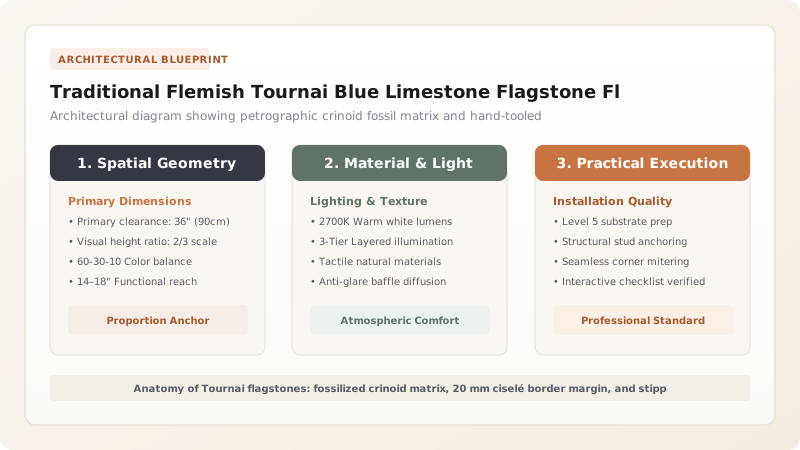
Geological Genesis & Petrography of Belgian Blue Stone
In the architectural history of the Low Countries, no material commands greater prestige than the legendary Pierre Bleue Belge (Belgian Blue Stone), historically quarried along the Scheldt (Escaut) valley around Tournai and the Hainaut basin around Soignies. Formed 350 million years ago during the Tournaisian age of the Carboniferous Period, this stone is a pure sedimentary masterpiece forged beneath a warm, equatorial sea that covered prehistoric Europe.
Known in French stonemasonry as Petit Granit, the stone is not an igneous granite, but an exceptionally dense bioclastic crinoidal limestone. The sea floor teemed with dense underwater forests of crinoids (sea lilies)—marine echinoderms anchored by long, segmented calcified stems. When these organisms died, their calcium carbonate skeletons accumulated in thick beds on the anoxic sea bottom, enveloped in fine calcitic mud enriched with microscopic organic hydrocarbons (bitumen). Under millions of years of pressure, this sediment crystallized into an ultra-dense rock where brilliant white fossil stems remain suspended in a dark, bituminous matrix.
Mechanical Superiority: Granitic Density & Imperviousness
Tournai blue limestone possesses physical performance metrics that rival or exceed true granites. It exhibits an extraordinary bulk density of 2,690 kg/m³, a compressive crushing strength exceeding 150 MPa, and a volumetric water absorption rate of less than 0.25%. Under microscope examination, the calcite crystals and fossil fragments are so tightly compacted that capillary pores are virtually non-existent.
This imperviousness renders Tournai flagstone completely immune to frost weathering (gélifraction). In the freeze-thaw cycles of northern European winters, moisture cannot penetrate the stone core to expand into ice fissures. Furthermore, the high organic bitumen content gives the stone its characteristic deep blue-grey to charcoal-black coloration, which can be honed to a silky velvet sheen or polished to a reflective, obsidian-like gloss that showcases the calcified white fossil sea lilies with breathtaking clarity.
The Stonecutting Heritage: Ciselure Margins & Bouchardage
The aesthetic hallmarks of authentic Flemish flagstones are the hand-tooled surface treatments perfected by guild stonemasons during the Renaissance. The most celebrated technique is the taille ciselée (ciselure). Around the perimeter of each flagstone, the mason cuts a pristine 15 to 30 mm wide drafted margin using a flat steel chisel struck with a mallet, producing fine, parallel hairline ridges spaced exactly 1.0 mm apart.
Within this dark, precise border frame, the central field is textured using a boucharde (bush hammer)—a heavy hammer whose face is studded with 16 to 64 pyramid-shaped steel teeth. Struck repeatedly across the stone, the teeth crush the surface calcite crystals into microscopic facets, transforming the dark stone into a light blue-grey, finely stippled non-slip field. This dramatic graphic contrast between the light textured center and the dark, elegant chisel-ruled margins has defined the civic halls, cathedral aisles, and merchant townhouses of Bruges, Ghent, Antwerp, and Brussels for over five hundred years.
Hydraulic Lime Installation & Traditional Savon Noir Patination
Installing massive Tournai flagstones requires strict adherence to historic building physics. Modern contractors who bed blue limestone in grey Portland cement inevitably cause disaster: the soluble salts in cement wick into the stone, producing permanent, disfiguring white alkaline efflorescence rings across the dark surface. Master masons install Tournai flags exclusively in beds of Natural Hydraulic Lime (NHL 2 or NHL 3.5) mixed with washed quartz sand, providing an elastic, breathable cushion that permits subfloor moisture to evaporate harmlessly through narrow 3 mm lime-grouted joints.
Ongoing maintenance is equally rooted in tradition. Authentic Flemish floors are never sealed with modern acrylic polymers or polyurethane glazes. Instead, they are washed weekly with pure Belgian savon noir (black soap), formulated from cold-pressed linseed oil saponified with potassium hydroxide. The natural fatty acids in the soap react with the calcium ions on the limestone surface, forming an insoluble, water-repellent calcium-soap patina. Over decades of foot traffic and soap washing, the floor develops an exquisite, low-sheen satin luster that repels culinary spills while deepening the stone's mysterious, fossil-studded inky-blue depths.
Architectural Finishes & Applications of Tournai Blue Limestone
Use this reference table to calculate exact physical dimensions, ratios, and specifications before purchasing:
| Surface Finish | Artisanal Tooling Technique | Optical Appearance | Slip Resistance (PTV) | Recommended Architectural Use |
|---|---|---|---|---|
| Ciséle Margin & Bouchardé Field | Hand-chisel border + bush hammer | Light blue-grey stippled center with dark border | High (PTV 65+ wet/dry) | Exterior entrance porticos, grand steps, public plazas |
| Adouci (Fine Honed / Satin) | Progressive wet diamond abrasives | Smooth matte deep blue-grey; visible white fossils | Medium (PTV 45 wet / 60 dry) | Interior residential halls, kitchens, living rooms |
| Bleu Foncé / Polished | High-grit mechanical buffing | Mirror-sheen inky blue-black; glowing fossils | Low (PTV 30 wet / 55 dry) | Feature fireplace surrounds, wall baseboards, vanity tops |
| Clivé (Natural Cleft Split) | Hydraulic wedge-splitting along bed | Rugged undulating geological relief | Very High (PTV 75+ wet/dry) | Courtyard paving, garden terraces, historical quays |
| Vieilli (Tumbled / Antique Patina) | Vibratory drum tumbling with river gravel | Softened rounded edges with velvet satin face | High (PTV 55 wet / 65 dry) | Historical restoration of Flemish medieval interiors |
Practical Constraints
Every successful decoration project must account for physical and environmental constraints:
Colossal structural weight of 2,690 kg/m³ density flagstone flooring
30 mm thick flagstones exert significant dead loads on suspended timber joist floors Mitigation: Engineer reinforced floor joists or specify calibrated 20 mm thin-bed flagstones for upper stories
Sensitivity of dark polished bituminous limestone to scratching from quartz street grit
High-traffic entryways develop dull traffic lanes from abrasive footwear sand Mitigation: Install recessed entrance coir mat wells and maintain a honed (adouci) finish in traffic zones
Execution Blueprint & Craftsmanship Sequence
Execute this professional sequence to achieve flawless results without backtracking:
Quarry Sourcing & Block Petrographic Inspection
Select monolithic Petit Granit blocks from the Tournai or Soignies strata, verifying dense crinoid fossil density.
Gang-Sawing into Calibrated Slabs
Saw blocks into 30 mm thick slabs using steel gang saws with chilled iron grit, maintaining strict planar tolerances.
Hand Ciselure Border Pitching
Chisel a precise 20 mm wide drafted margin (ciselure) around all four face edges using a flat steel chisel and mallet.
Bouchardage Bush-Hammering
Pound the central field within the drafted borders with a 36-point bush hammer, crushing surface crystals into a light grey stipple.
Hydraulic Lime Subgrade Preparation
Lay a 50 mm compacted aggregate sub-base, applying a 30 mm leveling screed of Natural Hydraulic Lime (NHL 3.5) and sand.
Flagstone Setting & Mallet Leveling
Back-butter each limestone slab with lime slurry, bedding into the mortar and beating level with heavy white rubber mallets.
Breathable Sand-Lime Joint Grouting
Grout tight 3 mm joints with fine washed silica sand and lime putty, cleaning residue immediately with damp cellulose sponges.
Traditional Savon Noir Patination
Mop the clean, cured floor with a solution of warm water and Belgian linseed-oil black soap, buffing into a deep satin sheen.
Common Mistakes & Countermeasures
Avoid these costly errors that compromise aesthetics, ergonomics, and budget:
Bedding Tournai blue limestone in standard grey Portland cement mortar
Cleaning blue limestone floors with acidic household cleaners, vinegar, or citrus descalers
Substituting cheap Asian limestone imports sold fraudulently as 'Belgian Blue Stone'
Project Execution Checklist
Track your physical progress. Checkboxes persist automatically on this device:
Frequently Asked Questions
Why is Belgian Blue Stone called 'Petit Granit' if it is actually limestone?
The historic trade name 'Petit Granit' was coined in Wallonia because freshly broken fractures display a sparkling, crystalline texture resembling igneous granite, and the stone exhibits comparable density, crushing strength, and durability. However, petrographically it is 100% sedimentary limestone composed of fossilized marine calcium carbonate.
What are the white markings visible inside Tournai blue limestone?
The distinctive white flecks and circles are the calcified fossil remains of crinoids (sea lilies)—marine invertebrates that flourished in the shallow tropical sea covering Belgium during the Carboniferous period. When sliced and polished, their disc-shaped stem segments shine like brilliant white stars against the dark bituminous matrix.
How does Belgian black soap (savon noir) protect the stone floor?
Savon noir is formulated from cold-pressed flaxseed (linseed) oil saponified with potassium hydroxide. When washed across blue limestone, the free fatty acids react with calcium carbonate on the surface, creating an insoluble microscopic calcium stearate layer. This breathable, non-slippery patina repels water, wine, and culinary grease.
Can Tournai blue limestone be installed outdoors in freezing climates?
Yes. With water absorption under 0.25%, Tournai limestone is virtually non-porous and completely frost-resistant (gelifraction-proof). It has been used for centuries in the freezing, rainy climates of Belgium and the Netherlands for outdoor civic pavements, cathedral steps, and canal lock walls.