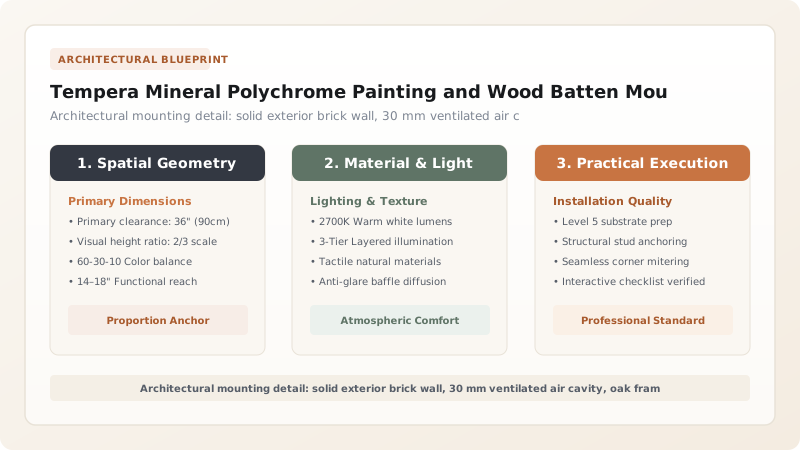
Tempera mineral polychrome painting and perimeter wood batten mounting complete the artistic and architectural integration of Flemish Renaissance goudleer. After relief press embossing, artisans painted background fields and floral scrollwork with egg tempera and slow-curing oil paints pigmented with lapis lazuli, vermilion, malachite, and lead-tin yellow. Multiple panels were then seamed together with waxed linen thread and mounted onto ventilated wooden wall battens leaving a 25–40 mm perimeter air gap, preventing masonry moisture condensation and preserving the leather hangings across centuries.
At a Glance: Key Takeaways
- Pigment Media: Egg tempera & stand linseed oil mineral paints
- Key Mineral Pigments: Natural ultramarine (lapis lazuli), vermilion, malachite, azurite
- Assembly Seaming: Double saddle-stitch with waxed 3-ply linen thread
- Batten Architecture: Seasoned oak perimeter battens with 30 mm ventilation gap
- Fastener Typology: Domed head brass or copper clout nails with leather washers
Polychromy: The Harmony of Mineral Pigments and Gilt Relief
While the shimmering golden relief created by the iron screw press was breathtaking on its own, Flemish taste during the high Renaissance and Baroque eras demanded rich chromatic counterpoints. Monochromatic gold leather was deemed incomplete for grand public interiors. Workshops engaged specialized guild painters—many of whom were trained within the same painting academies that produced master still lifes and altarpieces—to paint intricate polychrome embellishments directly upon the embossed surfaces.
The color palette was strictly mineral-based, utilizing precious ground stones and oxides that provided vibrant opacity and lightfastness across centuries. To create dramatic depth, artists painted the recessed, unembossed background fields with natural ultramarine (pulverized lapis lazuli imported from distant mines in Badakhshan, Afghanistan) or intense azurite blue. This matte or semi-gloss blue background caused the embossed acanthus scrolls and figures to pop forward in striking, three-dimensional relief. Raised ribbons, floral petals, and heraldic crests were accented with vibrant vermilion red (natural mercuric sulfide), malachite green, and lead-tin yellow, turning each wall panel into a monumental painting on leather.
Media Chemistry: Tempera versus Oil over Resin Varnish
Applying paint over a smooth, cured oil-resin varnish presented complex chemical challenges. If a painter applied standard slow-drying oil paint across the entire surface, the oil solvent could partially soften or bleed into the underlying yellow varnish, muddying the colors and softening the crisp embossed ridges. Conversely, pure water-based paints would bead up and fail to adhere to the glossy, hydrophobic varnish film.
Flemish artisans mastered a hybrid technical approach. For broad background fields, they favored egg yolk tempera enriched with a dash of white wine vinegar or ox gall. The natural lecithin in the egg yolk acted as a powerful emulsifier, enabling the water-thinned paint to wet and grip the glossy varnish without dissolving it. Once cured, egg tempera formed an insoluble, velvety-matte protein film that provided an exquisite aesthetic contrast to the gleaming, specular highlights of the varnished gold. For delicate fine-line botanical details and translucent glazes, masters employed stand oil or heat-bodied walnut oil, applied with pinpoint precision using miniature marten-hair brushes.
Assembly Carpentry: Panel Seaming and Batten Engineering
Flemish goudleer was rarely installed as isolated individual framed pictures; it was engineered to clothe entire architectural salons from chair rail to ceiling cornice. Because an individual calfskin panel could measure at most 60 to 75 centimeters by 50 to 60 centimeters, craftsmen had to seamlessly unite dozens of individual skins into colossal continuous wall screens. This process required the skill of expert leather seamstresses and saddle makers.
Using heavy waxed linen thread, artisans aligned adjacent panels and executed tight, recessed double saddle stitches through pre-punched awl holes along the overlap margins. The seams were laid so precisely that pattern repeats—such as running acanthus vines or interlocking strapwork—matched perfectly across panel boundaries. The assembled multi-panel hangings were then fastened to an engineered framework of seasoned oak battens anchored to the masonry wall. By maintaining a continuous 25 to 40 millimeter perimeter air space between the cold exterior brick and the leather tapestry, craftsmen prevented moisture condensation from accumulating behind the skins, ensuring that natural convection kept the leather dry and free of rot.
Modern Conservation Science and Environmental Buffering
Preserving surviving Renaissance and Baroque Flemish leather hangings in museums and historic castles presents modern conservators with intricate challenges. Aged goudleer is a multi-layered composite object composed of protein hide, proteinaceous glue grounds, metallic silver foil, oxidized resin-oil varnishes, and mineral pigments—each possessing distinct coefficients of thermal expansion and hygroscopic sensitivity.
When relative humidity swings wildly, the leather substrate expands or contracts while the brittle metallic and resin layers cannot, resulting in micro-crazing, cupping, and flaking of the gilded surface. Conservators maintain strict museum microclimates: 50% relative humidity with variations limited to ±5%, temperatures maintained between 18°C and 21°C, and total illuminance restricted to under 50 lux with zero ultraviolet radiation. Structural stabilization avoids aggressive re-tanning or modern synthetic glues; instead, tears are mended on the reverse with Japanese mulberry paper and purified sturgeon glue (isinglass), preserving the authentic integrity of these miraculous Flemish masterpieces for future centuries.
Flemish Polychrome Mineral Pigments & Chemical Stability Matrix
Use this reference table to calculate exact physical dimensions, ratios, and specifications before purchasing:
| Pigment Name | Chemical Mineral Origin | Binder System | Color Field Role | Atmospheric Sensitivity |
|---|---|---|---|---|
| Natural Ultramarine | Lapis lazuli (sodium silicate with sulfur) | Egg yolk tempera | Deep celestial blue background recesses | Stable to light; bleached by industrial acidic airborne vapors |
| Azurite | Basic copper carbonate (Cu3(CO3)2(OH)2) | Egg yolk or walnut oil | Vibrant cerulean architectural scrollwork | May darken or convert to green malachite in damp environments |
| Vermilion | Natural mercuric sulfide (HgS) | Purified linseed oil | Crimson heraldic ribbons, fruits, and robes | Stable under low light; can undergo photo-reduction to black metacinnabar |
| Malachite | Basic copper carbonate (Cu2CO3(OH)2) | Egg tempera / stand oil | Foliage garlands and acanthus leaf highlights | Generally stable; sensitive to sulfur pollution and strong alkalis |
| Lead-Tin Yellow | Lead stannate (Pb2SnO4) | Walnut oil | High-relief golden highlights and cartouche accents | Extremely lightfast and stable; reacts with atmospheric sulfides |
Practical Constraints
Every successful decoration project must account for physical and environmental constraints:
Pronounced seasonal thermal and hygric expansion/contraction of large stitched wall hangings
Over-tight stretching causes seam tearing or tack pull-out in winter; loose hanging creates unsightly sagging and ripples in summer. Mitigation: Install hangings with calibrated moderate tension at 50% relative humidity, allowing edge battens slight floating movement.
Accumulation of airborne grime, greasy nicotine, and fireplace soot across high-relief contours
Soot bonds to natural oil-resin varnish, obscuring polychrome colors and corroding delicate foil layers. Mitigation: Clean surfaces with non-polar aliphatic solvent gels and micro-swabs under microscopic conservation surveillance.
Execution Blueprint & Craftsmanship Sequence
Execute this professional sequence to achieve flawless results without backtracking:
Surface Degreasing and Inspection
Carefully inspect the embossed, gilded panel. Wipe the surface with dilute ethanol swabs to remove lingering press grease or release tallow without dissolving the underlying golden varnish.
Grinding and Mulling Mineral Pigments
Grind natural mineral pigments—including genuine Afghan lapis lazuli, Spanish vermilion, and malachite—on a porphyry slab with a glass muller, mixing with clarified egg yolk or heat-bodied walnut oil to produce rich, creamy tempera paints.
Executing Polychrome Backgrounds and Accents
Using fine marten-hair brushes, paint the recessed background areas surrounding the embossed motifs in deep ultramarine blue or jet black. Highlight raised floral scrolls, cherubs, and fruit swags with vibrant opaque reds, greens, and whites.
Squaring and Modular Edge Trimming
Allow painted details to dry thoroughly over seven days. Lay each panel on a cutting bench and trim margins to exact rectangular dimensions using a tempered steel straightedge and sharp shoemaker knife, ensuring pattern alignment across repeats.
Sewing Panels into Continuous Tapestries
Align adjacent panels face-to-face along matching margins. Using an awl and two curved harness needles threaded with 3-ply waxed linen thread, sew the skins together using a double saddle stitch spaced 5 mm apart, flattening seams on a wooden anvil.
Carpentry Framework and Batten Installation
Anchor seasoned, kiln-dried oak battens (30 x 50 mm) vertically and horizontally against the perimeter of the masonry wall. Ensure battens create an unbroken 30 mm airspace between the back of the leather and the cold wall surface.
Tacking and Tensioning the Wall Hangings
Lift the sewn leather hanging into place starting from the top ceiling batten. Fasten the upper border with domed brass clout nails driven through buffer leather washers. Stretch the hanging downward with hands and tack perimeter sides and bottom.
Ventilation Integration and Conservation Monitoring
Install slotted timber baseboards and crown cornices to conceal batten perimeters while permitting free convection of room air behind the leather. Set environmental dataloggers behind the hanging to monitor relative humidity and temperature.
Common Mistakes & Countermeasures
Avoid these costly errors that compromise aesthetics, ergonomics, and budget:
Using water-based acrylic paints or modern industrial latex for color touch-ups
Fastening leather hangings with raw steel or iron nails directly through the leather face
Project Execution Checklist
Track your physical progress. Checkboxes persist automatically on this device:
Frequently Asked Questions
What type of paint medium was used on Flemish goudleer: oil or egg tempera?
Flemish workshops used a combination of both media. Egg tempera was favored for broad background fields (such as dark blues and blacks) because it dried rapidly, did not dissolve the underlying oil-resin varnish, and produced a soft matte contrast against shining embossed gold. For intricate floral highlights and glazes, artists employed slow-drying linseed or walnut oil paints.
Why must leather wall hangings never be mounted with modern contact adhesives or paste?
Adhering leather directly to masonry or drywall with modern glues restricts natural hygroscopic movement, leading to severe puckering, tearing, and permanent fiber damage. Furthermore, masonry condensation cannot escape, causing rapid mold colonization, while modern adhesives cannot be reversed during future conservation interventions.
How do conservators treat historic goudleer panels that have stiffened and distorted from dryness?
Conservators humidify dry, distorted leather slowly inside a controlled chamber using Gore-Tex vapor membranes and ultrasonic humidifiers at 75–80% RH over several weeks. Once the collagen fibers regain flexibility, panels are gently weighted flat between wool felts and conditioned with specialized micro-emulsions of synthetic lubricants.