The brilliant golden appearance of Flemish Renaissance goudleer is an optical illusion achieved by applying pure beaten silver leaf (bladnaptha) over sized calfskin and coating it with an amber-yellow resin varnish (goudvernis). Because genuine gold leaf was prohibitively costly and lacked the ductile elasticity required for deep plate embossing, guild masters used silver leaf burnished to a mirror sheen with agate stone. They then brewed a cooked glaze from linseed oil, Venetian turpentine, saffron, aloe resin, and dragon’s blood that transformed specular silver reflection into a warm, shimmering golden luster.
At a Glance: Key Takeaways
- Metallic Foil: Beaten pure silver leaf (0.2–0.5 microns thick)
- Foil Mordant: Beaten egg-white glair mixed with vinegar and honey trace
- Burnishing Tool: Natural agate stone or wolf’s tooth set in brass ferrule
- Varnish Vehicle: Sun-bleached linseed oil thickened with Venetian turpentine
- Coloring Resins: Aloe socotrina, dragon’s blood, saffron, and sandarac
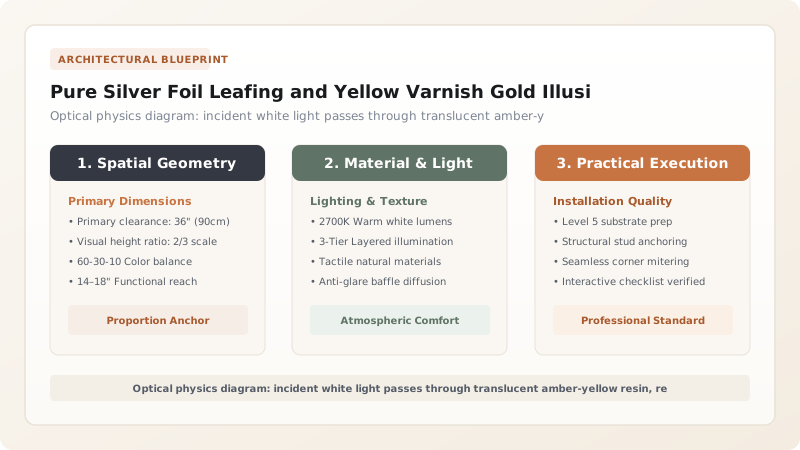
The Economics and Mechanics of the Gilt Illusion
To the aristocratic guest entering a grand Flemish banquet hall or princely bedchamber in 1630, the walls appeared clad from floor to ceiling in solid plates of shimmering, repoussé gold. Yet behind this dazzling spectacle lay one of the most brilliant technological and economic deceptions in the history of European decorative arts. The walls were not gilded with gold at all; they were faced with pure silver foil transformed by a luminous, warm-yellow resin glaze known throughout the Low Countries as goudvernis.
The choice to use silver rather than genuine gold leaf was driven by two compelling factors: economics and metallurgy. Solid gold leaf of the thickness required to cover hundreds of square meters of wall surface would have bankrupt even wealthy merchant oligarchs. More critically, gold leaf beaten to standard paper-thin consistency lacked the molecular ductility needed for high-relief embossing. Pure silver foil, by contrast, could be beaten into slightly thicker, extraordinarily elastic sheets that stretched smoothly into the deep crevices of engraved iron dies without tearing. When married to an optically pure yellow resin filter, the specular reflectivity of burnished silver outperformed genuine gold under candlelight, casting a warmer and more vibrant architectural glow.
The Guild Ground: Size, Mordants, and Leaf Laying
Achieving a mirror-smooth metallic foil ground across flexible vegetable-tanned calfskin demanded exceptional surface preparation. The grain of the sumac-tanned leather, though fine, possessed microscopic dermal pores that would quickly suck adhesives deep into the hide, causing the foil to dull and blister. Guild masters first applied two successive barrier coats of parchment size—a refined gelatin glue produced by simmering clean calf vellum scraps in water until reduced to a pale, rubbery jelly.
Once the size had dried, the gilder prepared the mordant. Oil-based gold size was shunned because it took days to dry and absorbed into the leather, stiffening the skin. Instead, Flemish artisans relied on glair: fresh egg whites whipped into a mountainous white froth, left overnight to settle, and decanted to yield pure, transparent albumin liquid. Applied with a broad flat brush across the sized leather, the glair dried into an ultra-thin, glass-like adhesive film. Working with a badger-hair gilders tip touched lightly to the craftsman’s cheek or hair to pick up a trace of natural oil, individual square leaves of silver (roughly 80 by 80 millimeters) were lifted from the gilding cushion and floated onto the tacky glair in overlapping rows.
Burnishing with Agate: Creating the Optical Mirror
Silver leaf laid upon leather initially displays a dull, milky metallic sheen resembling aluminum foil. To convert this diffuse scatter into an intense, specular mirror, the layer had to undergo rigorous stone burnishing. Guild masters waited until the egg-white glair had dried to the precise stage of firm, resilient tackiness—known among craftsmen as "leather-hard."
Using a burnishing tool consisting of an oval piece of natural banded agate stone or a polished wolf’s canine tooth mounted in a copper ferrule, the gilder stroked the silver surface with firm, overlapping circular motions. The immense localized pressure compressed the microscopic crystalline platelets of the silver leaf, flattening imperfections and closing microscopic seams between adjacent sheets. When completed, the calfskin transformed into an unbroken sheet of flexible, liquid silver mirror reflecting crisp images of the workshop ceiling. This flawless metallic mirror was crucial: any dullness or surface roughness in the silver ground would diminish the luminosity of the golden varnish applied in the subsequent phase.
The Alchemical Formulation of Flemish Goudvernis
The pinnacle of guild technical mastery was the formulation and brewing of the goudvernis. Every prominent workshop in Mechelen, Antwerp, and Amsterdam guarded its specific recipe in handwritten guild ledger books. The core vehicle consisted of high-grade cold-pressed linseed oil, sun-bleached and purified by washing with salt and water to remove mucilage, then gently cooked with natural soft resins such as Venetian larch turpentine, mastic, and sandarac to impart body, gloss, and elasticity.
To this oil-resin matrix, artisans added precise combinations of natural organic colorants. The primary yellow dye was Aloe socotrina (the dried, bitter juice of succulent aloe plants imported from the Indian Ocean), which dissolved into hot oil to yield a clear, intense golden-yellow glaze. To balance the greenish bias of aloe, masters introduced precious stigmas of saffron and minute pinpoints of pulverized dragon’s blood (Daemonorops draco) resin. The cooked varnish was filtered through linen while warm and brushed across the silvered leather in a continuous, flowing film. As sunlight filtered through the amber resin, it struck the burnished silver below, reflected back through the colored filter, and emerged as the magnificent, fiery golden luster that defined Renaissance luxury.
Flemish Goudvernis Historic Recipe Variations & Optical Outcomes
Use this reference table to calculate exact physical dimensions, ratios, and specifications before purchasing:
| Recipe Variant | Primary Resins & Dyestuffs | Oil/Solvent Ratio | Optical Tone | Guild Specialty City |
|---|---|---|---|---|
| Mechelen Classic | Linseed oil, aloe socotrina, sandarac, saffron | 2 parts oil : 1 part resin | Warm, fiery honey-gold with high transparency | Mechelen (Guild of St. Luke standard) |
| Antwerp Royal | Venetian turpentine, mastic, dragon’s blood, aloe | 1.5 parts oil : 1 part resin | Rich reddish-gold with deep copper undertones | Antwerp luxury export workshops |
| Ghent Pale Gold | Cold-pressed walnut oil, gamboge, sandarac | 3 parts oil : 1 part resin | Pale lemon-gold, highly resilient to outdoor air | Ghent civic and palace commissions |
| Brussels Court | Linseed oil, aloe, saffron, ground asphaltum | 2 parts oil : 1.2 parts resin | Antique aged bronze-gold, high dark contrast | Brussels ducal and aristocratic halls |
Practical Constraints
Every successful decoration project must account for physical and environmental constraints:
Atmospheric silver tarnishing triggered by airborne sulfur compounds from coal and peat heating
Sulfur gas diffusing through micro-cracks in the varnish reacts with silver to form disfiguring black silver sulfide. Mitigation: Formulate dense, cross-linking linseed-sandarac varnish layers and seal historic hangings with archival microcrystalline wax.
Rapid brittleness and embrittlement of thick dried natural resin glazes over flexible leather
When leather flexes during seasonal movement, thick brittle resin layers fracture into microscopic crazing networks. Mitigation: Incorporate plasticizing Venetian larch turpentine into the oil-resin matrix to maintain permanent film elasticity.
Execution Blueprint & Craftsmanship Sequence
Execute this professional sequence to achieve flawless results without backtracking:
Parchment Size Sealing
Brush the strained calfskin with two coats of warm parchment size prepared from boiled rabbit skin or vellum trimmings. This prevents subsequent liquid glairs from absorbing into the porous leather substrate.
Preparing the Egg-White Glair Mordant
Whip fresh egg whites into a stiff, white froth. Allow the container to rest covered for twelve hours; decant the clear protein liquid that collects at the bottom. Mix with a few drops of white wine vinegar to reduce surface tension.
Laying the Pure Silver Leaf
Working in a draft-free room, brush a thin layer of glair over a 30 x 30 cm quadrant. Using a flat badger-hair gilders tip, lift individual square sheets of pure beaten silver leaf and lay them edge-to-edge with slight overlaps across the wet mordant.
Agate Stone Burnishing
Once the glair has set to firm elasticity, lay a sheet of glazed tracing paper over the foil and rub lightly to seat the silver. Remove paper and burnish directly with a curved, highly polished agate burnisher until the surface achieves mirror specular reflection.
Brewing the Goudvernis Vehicle
Heat cold-pressed, sun-bleached linseed oil in a glazed ceramic or copper cauldron over low embers. Stir in purified Venetian turpentine and crushed sandarac tears until fully dissolved and homogeneous.
Infusing Natural Yellow Dyestuffs and Resins
Gradually introduce powdered Aloe socotrina and saffron strands for golden yellow hues, adding a pinpoint quantity of powdered dragon’s blood resin (Daemonorops draco) to impart a rich, warm reddish fire to the glaze.
Applying the Golden Varnish Glaze
While the varnish is warm and fluid, apply it across the burnished silver using broad, uniform strokes of a fine hog-bristle brush. Maintain an even wet edge to prevent overlapping brush marks or localized pooling.
Dust-Free Curing and Inspection
Transfer the gilded panel into a warm, dark, dust-free drying cabinet. Allow the oil-resin film to oxidize and cure over 48 hours into a tough, transparent, flexible golden glaze ready for press embossing.
Common Mistakes & Countermeasures
Avoid these costly errors that compromise aesthetics, ergonomics, and budget:
Burnishing silver leaf too early while the egg-white glair mordant is still wet
Overheating the resin varnish kettle, causing aloe and dragon’s blood to burn
Project Execution Checklist
Track your physical progress. Checkboxes persist automatically on this device:
Frequently Asked Questions
How did guild inspectors test if an artisan used genuine silver rather than tin or pewter foil?
Flemish Guild of Saint Luke bylaws strictly forbade the use of tin foil (klatergoud) on first-grade leather hangings. Guild deacons visited workshops unannounced and rubbed test chemicals—typically diluted nitric acid or vinegar solutions—on unvarnished foil edges; tin turned dull and blistered instantly, while pure silver reacted characteristically or resisted mild acids.
What is dragon’s blood and why was it essential in the varnish formulation?
Dragon’s blood is a bright crimson natural resin secreted by the fruits of rattan palms (Daemonorops draco) or Dracaena trees. In goudleer recipes, minute quantities were dissolved into yellow aloe varnishes to neutralize overly greenish-yellow undertones, producing the rich, glowing red-gold luster coveted in royal interiors.
Why does historic goudleer sometimes appear dark brown or black today?
Darkening results from two main aging processes: the oxidation and ambering of thick linseed oil-resin varnishes exposed to centuries of airborne fireplace smoke and candle soot, and sulfur pollution reacting with the silver substrate through micro-fissures in the aged varnish, creating black silver sulfide (tarnish).