
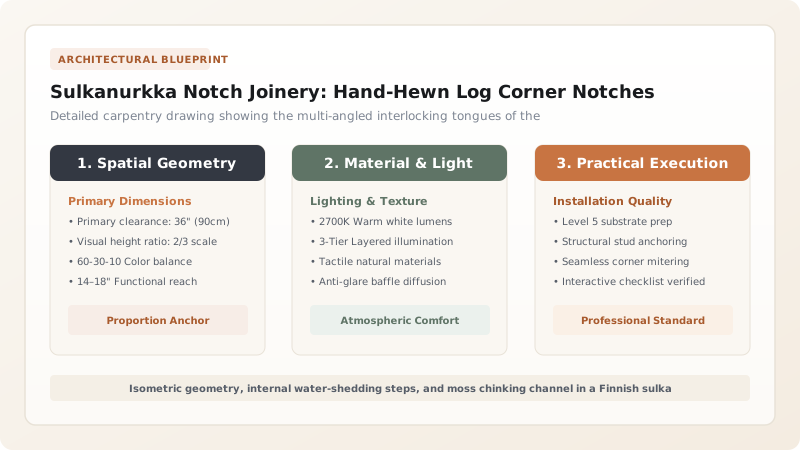
Sulkanurkka (feather corner notch) is the supreme traditional corner joinery system developed by Finnish log craftsmen (hirsiveistäjät) for high-performance log saunas. Hewn entirely by hand using specialized broadaxes (piilukirves) and scribed with a dual-legged compass (vara), the sulkanurkka features beveled, interlocking tongue surfaces with internal water-shedding steps. Combined with continuous concave longitudinal grooves (varaus) packed with antiseptic sphagnum bog moss (rahkasammal), it creates an airtight thermal envelope.
At a Glance: Key Takeaways
- Carpentry Tradition: Hirsirakentaminen (traditional Finnish hand-hewn log architecture)
- Signature Tool: Piilukirves (wide-beveled Finnish carving broadaxe with curved birch handle)
- Corner Joinery: Sulkanurkka (feather notch with self-draining interlocking tongues)
- Natural Insulation: Rahkasammal (Sphagnum fuscum red bog moss gathered from peat wetlands)
The Art of the Piilukirves: Hand-Hewn Texture and Capillary Sealing
In traditional Finnish log construction, chainsaws and circular mills are strictly avoided for finish joinery. The master builder works with the piilukirves—a massive, razor-sharp broadaxe featuring a wide, curved cutting edge and an asymmetrical offset handle that allows the carpenter to swing flush against the log face.
As the broadaxe cuts, it does not tear wood grain; it compresses and polishes the cellular fibers, creating a hand-hewn texture of overlapping, rippling facets known as piilutus. This compressed surface acts as a natural water-repellent armor, preventing moisture from penetrating into the grain during heavy rains.
Sulkanurkka: The Kinematics of the Feather Notch
Standard round notches (such as the simple saddle notch) are prone to water pooling if rain drives into the joint. The Finnish sulkanurkka (feather notch) was engineered specifically to prevent this vulnerability.
The notch features compound angled cuts resembling the layered barbs of an eagle's feather. As the logs interlock, the mating surfaces meet along inclined slopes that direct any penetrating moisture outward and downward away from the building. Furthermore, an internal raised tongue and socket (kynsi) creates an impenetrable labyrinth that completely blocks gale-force subarctic winds from piercing the corner.
The Varaus Groove: Precision Scribing with the Vara Compass
Along the entire underside of each horizontal log runs a continuous longitudinal trough called the varaus. To scribe this groove to the unique contours of the underlying log, the craftsman uses the vara—a heavy forged iron compass equipped with dual scriber points and integrated spirit levels.
By drawing the vara along the logs, the exact undulating profile of the lower timber is scored into the upper log. The joiner then hollows out the concave channel using a curved gouge-adze (kourukirves). The edges of the groove feather to razor-sharp margins, ensuring that when the logs mate, the outer lips press tightly together while opening a generous internal cavity to hold insulation.
Rahkasammal: Nature's Antibacterial Thermal Chinking
To seal the varaus groove, traditional Finns never used synthetic fiberglass, polyurethane foam, or modern caulk. Instead, they gathered rahkasammal—sphagnum red peat moss (Sphagnum fuscum) harvested from pristine Arctic wetlands.
Sphagnum moss is a miraculous biological material. It contains natural phenolic acids that make it naturally antiseptic, preventing decay in the surrounding wood. It can absorb up to twenty times its weight in water without feeling wet to the touch, and when compressed between logs, it forms an elastic, airtight thermal cushion that breathes with the sauna's humidity cycles for hundreds of years.
Finnish Corner Notching Typologies: Sulkanurkka vs Koirankaula vs Satulanurkka
Use this reference table to calculate exact physical dimensions, ratios, and specifications before purchasing:
| Notch Typology | Geometric Profile | Weather-Tightness Rating | Craft Complexity |
|---|---|---|---|
| Sulkanurkka (Feather Notch) | Compound angled slopes with internal tongue-and-groove lip | Supreme; 100% wind- and water-tight even in arctic blizzards | Very high; requires master broadaxe stereotomy skills |
| Koirankaula (Dog-Neck Notch) | Curved round saddle with circular upper socket | Excellent; traditional round-log standard across Finland | Moderate; carved with curved gouges and round adzes |
| Satulanurkka (Saddle Notch) | Standard beveled saddle with projecting log horns | Good; susceptible to weathering if corner horns rot | Standard; common in utilitarian barns and storage sheds |
| Lohkonurkka (Dovetail Notch) | Flush-cut trapezoidal dovetail with no projecting ends | Moderate; corner faces exposed to direct rain and ice | High; requires precision sawing of compound angles |
Practical Constraints
Every successful decoration project must account for physical and environmental constraints:
Physical strength and razor-sharp maintenance required for broadaxe hewing
Hewing dense kelo timbers with a 3-kilogram piilukirves broadaxe requires exceptional endurance and frequent water-stone honing to avoid tearing wood fibers. Mitigation: Rough-hog waste timber using specialized low-vibration electric chain-mortisers, preserving manual broadaxe work exclusively for final 2 mm aesthetic facet cuts.
Seasonal availability and collection ethics of wild wetland sphagnum moss
Sphagnum moss must be gathered in dry summer months from permitted peat bogs without damaging local wetland hydrology. Mitigation: Harvest moss sustainably in rotational patches, taking only the top green and red fibrous layers while leaving subterranean roots intact to regenerate.
Execution Blueprint & Craftsmanship Sequence
Execute this professional sequence to achieve flawless results without backtracking:
Gathering and Sun-Drying Rahkasammal Peat Moss
Harvest long-fibered red sphagnum bog moss from wetland bogs during late summer. Spread moss on wooden racks to air-dry until pliable, elastic, and free of moisture.
Leveling and Scribing the Log Overhangs
Rest the upper raw log over the wall course on temporary wooden spacers. Use the iron vara compass to scribe the contour of the lower log onto both sides of the upper timber.
Hewing the Longitudinal Varaus Groove
Roll the log over. Using a curved kourukirves adze, hollow out the concave varaus channel 100 to 140 mm wide following the scribed lines, keeping outer lips razor-sharp.
Laying Out the Compound Sulkanurkka Feather Angles
Draft the feather notch geometry on the log ends using brass miter squares, marking the sloping drainage cheeks, internal tongue (kynsi), and lock sockets.
Hand-Hewing the Notch with the Piilukirves Broadaxe
Hew the sloping notch facets with the wide-bladed piilukirves broadaxe. Clean internal corners with razor-sharp framing chisels, ensuring clean 45-degree shedding angles.
Spreading Rahkasammal Moss Insulation
Lay a continuous 50 mm thick mattress of dried sphagnum moss across the crown of the lower log, letting fibers drape slightly over both exterior and interior margins.
Boring for Internal Wooden Salatapit Dowels
Bore vertical 32 mm holes through the newly seated log and halfway into the course below. Drive in square kiln-dried birch dowels (salatapit) to prevent lateral bulging.
Tamping the Seams with the Tilkerauta Chisel
Once the log is seated under its dead weight, use a wooden caulking paddle (tilkerauta) to tamp all protruding moss fibers deep into the seam, creating an airtight seal.
Common Mistakes & Countermeasures
Avoid these costly errors that compromise aesthetics, ergonomics, and budget:
Filling the log seams with modern expandable polyurethane spray foam
Hollowing the varaus groove too flat without deep feather margins
Project Execution Checklist
Track your physical progress. Checkboxes persist automatically on this device:
Frequently Asked Questions
What is 'piilutus' and why is it prized on sauna walls?
Piilutus is the hand-hewn surface texture created by the curved blade of the piilukirves broadaxe. Rather than leaving wood flat like a factory machine, piilutus leaves a rhythmic pattern of subtle overlapping scalloped facets. In a dim sauna, candlelight and stove flames dance across these facets, creating a warm, organic, tactile visual warmth that machine-milled logs cannot match.
Why is sphagnum moss superior to fiberglass insulation in a sauna?
Fiberglass insulation contains synthetic binders and microscopic glass fibers that can become airborne under high-heat steam convection, irritating bathers' lungs. Furthermore, fiberglass loses all insulation value when damp. Sphagnum moss is completely natural, non-toxic, naturally antibacterial, and retains its insulation value even when saturated with steam.
What tools are needed to craft an authentic sulkanurkka corner?
A traditional Finnish master uses five essential hand tools: the vara (scribing compass), the piilukirves (broadaxe), the kourukirves (curved adze), a timber framing chisel (taltta), and a wooden mallet (puunuija). No electrical power tools are required.
How long does a moss-chinked kelo log sauna survive in the Finnish climate?
When built on proper granite padstones with adequate roof overhangs, authentic kelo saunas with sulkanurkka joinery and sphagnum moss insulation regularly endure for 200 to 300 years with virtually zero maintenance, surviving dozens of subarctic winter freezes every year.


