
The kiuas is the heart and engine of the Finnish sauna. A heavy wood-burning stove engineered to house 60 to 150 kilograms of dense, volcanic or igneous stones (olivine, peridotite, or granite), the kiuas transforms thermal energy from slow-burning birch logs into deep radiant heat. When fresh water is cast onto the 300°C stones, it vaporizes instantaneously into löyly—a rich, enveloping convective steam wave that circulates through the timber chamber without scorching the skin.
At a Glance: Key Takeaways
- Stove Typology: Continuous-fire wood stove or massive smoke sauna (savusauna) masonry heater
- Stone Mass: 60 to 150 kg of dense, non-exploding volcanic peridotite or olivine rocks
- Combustion Fuel: Seasoned white birch (koivu) producing clean, high-temperature 900°C embers
- Thermodynamic Principle: Instantaneous phase change of water into non-scalding 100°C vapor
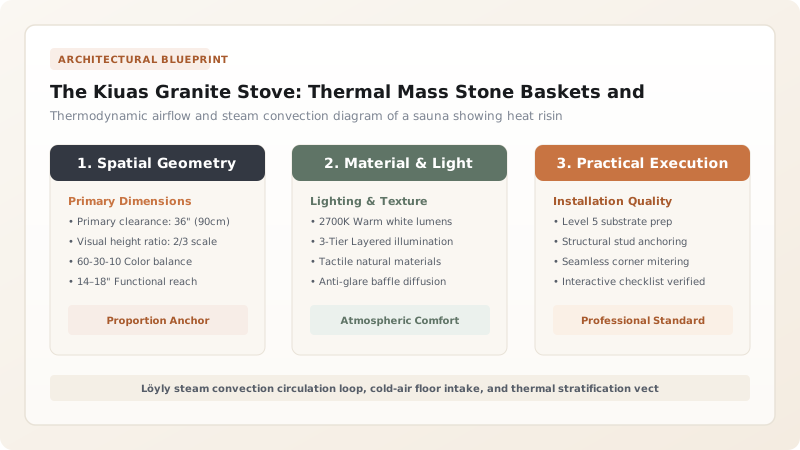
The Physics of the Kiuas: Direct Conduction to Stone Mass
In standard room heating, stoves heat air directly via convective metal fins. In a traditional Finnish sauna, however, heating the air directly is considered a severe technical failure; dry, overheated metal scorches atmospheric dust, producing dry, irritating air that burns the respiratory tract.
The kiuas works on the opposite principle: conductive heat storage. The intense heat of burning birch logs is channeled directly through heavy steel firebox walls into a massive basket of natural igneous stones. The stones act as a thermal sponge, absorbing hundreds of thousands of BTUs while keeping the surrounding air temperature at a moderate, comfortable 75°C to 85°C.
Selecting the Stones: Peridotite, Olivine, and Granite
Using the wrong rocks in a kiuas can be fatal. Porous rocks or river stones with internal air pockets or water inclusions explode violently under extreme thermal shock when doused with cold water. Sedimentary stones (like sandstone or limestone) crumble rapidly into powdery dust that clogs the stove.
Finnish sauna masters choose heavy, dense igneous and metamorphic rocks with high specific heat capacity and low thermal expansion coefficients. The undisputed gold standard is peridotite and olivine quarried in central Finland, alongside dense, unweathered black granite (musta graniitti). These rocks endure repeated thermal cycling from 300°C down to 100°C without cracking, spalling, or releasing toxic mineral dust.
Löyly Hydraulics: The Parabolic Convective Steam Loop
When a ladle (kiulu) of water is dashed onto the glowing rocks, a dramatic thermodynamic phase change occurs. Water does not boil into wet droplets; it flashes instantaneously into micro-fine vapor at over 200°C.
This boiling steam rises rapidly to the ceiling, forming an expanding thermal cloud (löylypilvi). Because the ceiling is sloped or flat over the elevated lauteet benches, the rising steam travels horizontally across the ceiling, cools slightly as it interacts with the cold log walls, and gently descends over the bathers in a comforting, enveloping loop. The sensation is not of searing heat, but of a warm, invisible velvet blanket wrapping around the shoulders.
Combustion and Ventilation: The Law of Fresh Oxygen
The common misconception that a sauna should be an airtight hotbox leads to headache-inducing, oxygen-deprived environments. Authentic Finnish sauna engineering requires a continuous, dynamic gravity-driven air exchange system.
A fresh air intake vent is located low on the wall directly behind or beneath the kiuas stove. As the fire burns and air rises above the hot stones, it sucks fresh oxygen-rich outdoor air into the room, pre-heating it as it passes through the stone basket. An exhaust vent located on the opposite wall beneath the highest bench expels stale, heavy carbon dioxide, ensuring bathers breathe clean, refreshing mountain air even at 90°C.
Sauna Heating Systems: Wood-Burning Kiuas vs Electric Rock Heater
Use this reference table to calculate exact physical dimensions, ratios, and specifications before purchasing:
| Heating Metric | Traditional Wood-Burning Kiuas Stove | Contemporary Electric Element Sauna Heater |
|---|---|---|
| Thermal Quality & Löyly | Soft, humid, deeply penetrating steam; high stone mass (80–120 kg) | Drier, sharper steam; smaller stone capacity (20–40 kg) |
| Sensory Atmosphere | Cracking birch flames, glowing embers, and gentle wood smoke aroma | Completely silent; zero flame or crackle; purely utilitarian |
| Ventilation Compatibility | Naturally draws massive fresh air through intake to feed combustion | Requires carefully engineered mechanical fan ventilation |
| Electrical & Grid Independence | 100% off-grid; operates anywhere with dry firewood | Demands high-amperage 240V / 3-phase heavy electrical service |
| Warm-Up Timeline | 60 to 90 minutes of relaxing fire-tending ritual | 30 to 45 minutes with modern push-button thermostat control |
Practical Constraints
Every successful decoration project must account for physical and environmental constraints:
Creosote accumulation in chimneys from slow, oxygen-starved wood fires
Damping down the stove too much to save wood produces cool flue gases that condense flammable creosote tar inside the chimney, creating chimney fire hazards. Mitigation: Burn only seasoned white birch with moisture content below 15%, maintain bright, roaring flames with open air dampers, and sweep chimney flues every 6 months.
Degradation and crumbling of stones under years of thermal shock
Repeatedly pouring cold water onto 300°C stones causes thermal fatigue that slowly cracks rocks into small gravel over two to three years. Mitigation: Unpack the stove annually, discard cracked and crumbled rocks, wash surviving stones, and replenish with fresh volcanic stones to maintain open airflow.
Execution Blueprint & Craftsmanship Sequence
Execute this professional sequence to achieve flawless results without backtracking:
Fireproof Subfloor Hearth Casting
Pour a 100 mm reinforced concrete hearth pad faced with natural soapstone (vuolukivi) or non-combustible ceramic tiles to support the combined stove and stone weight (approx. 200 kg).
Installing Heat-Shield Clearance Barriers
Mount non-combustible fiber-cement or natural stone heat shields around the stove footprint, maintaining a minimum 50 mm ventilated air gap from combustible kelo log walls.
Positioning the Kiuas and Insulated Chimney Flue
Seat the wood-burning kiuas stove level on the hearth pad. Connect to a double-walled insulated stainless steel chimney pipe equipped with a manual rotary flue damper.
Washing and Inspecting Volcanic Sauna Stones
Scrub quarried olivine or peridotite stones thoroughly in clean water to eliminate quarry dust. Inspect each rock for fissures; reject any stone that rings dull or flakes.
Packing the Stone Basket by Size Hierarchy
Pack the largest stones (100–150 mm) loosely at the bottom directly against the steel firebox walls. Layer medium stones (80–100 mm) in the center, and place smaller rounded stones on top, ensuring loose packing that allows hot air to circulate freely between rocks.
Installing Floor and Ceiling Ventilation Ducts
Cut an adjustable 150 mm fresh-air floor intake vent directly beneath the stove firebox, and cut a matching exhaust vent on the opposite wall 300 mm beneath the ceiling.
Initial Curing and Paint Burn-Off Firing
Light an initial full birch fire with the sauna door and windows wide open, burning off factory protective oils and curing the stove paint for 2 hours before the first bathing session.
Seasoned Birch Stoking and Löyly Calibration
Stoke the firebox with dry split white birch. Bring stones to 300°C over 75 minutes. Ladle warm water over the stones in slow 200 ml bursts to test convective steam circulation.
Common Mistakes & Countermeasures
Avoid these costly errors that compromise aesthetics, ergonomics, and budget:
Packing sauna stones too tightly into the stove basket
Using smooth river pebbles or stones collected from lakeshores
Project Execution Checklist
Track your physical progress. Checkboxes persist automatically on this device:
Frequently Asked Questions
Why is birch (koivu) the preferred firewood for Finnish saunas?
White birch (Betula pendula) has a high natural bark resin content, ignites easily, burns with a bright, hot flame reaching over 900°C, and produces long-lasting glowing embers. Furthermore, birch wood burns with a pleasant, sweet forest fragrance that defines the quintessential Finnish sauna sensory experience.
Why should you use warm water instead of cold water for throwing löyly?
Throwing ice-cold water onto 300°C stones creates extreme thermal shock that accelerates rock cracking and cools down the stove surface too quickly. Using warm or hot water from the sauna bucket creates an instant, smoother vapor cloud without dropping the temperature of the stone bed.
What is a smoke sauna (savusauna) and how does its stove differ?
The savusauna is the archaic ancestor of all saunas. It has no chimney. A colossal stove containing up to 500 kilograms of rocks is fired for six to eight hours with birch wood, filling the entire room with fragrant smoke. Once the fire dies, the room is aired out to expel smoke, leaving the room pristine, sterile, and heated purely by the radiant mass of the rocks.
How often should you replace the stones in a sauna stove?
As a rule of thumb in Finland: re-stack the stones once a year, and replace them entirely every two to three years for residential saunas. In commercial saunas operating daily, stones should be inspected every three months, replacing any rocks that show hairline fractures or crumbling.


