Building an airtight Kelo log sauna requires precision vernacular joinery. Corner stability is achieved using the satulanurkka (saddle notch)—a self-tightening double-beveled notch cut with traditional axes. Along the length of each log, carpenters scribe and hollow out a concave parabolic groove (varaus) packed with 100% natural carded flax ribbon (pellavanauha). The outer knife-edges of the groove bed tightly against the lower log, while internal square birch dowels (vaarnat) prevent wall buckling under structural roof loads.
At a Glance: Key Takeaways
- Corner Joinery Typology: Satulanurkka (double-beveled self-tightening saddle notch)
- Longitudinal Seam: Varaus (concave parabolic under-groove scribed to lower log)
- Scribing Compass: Varausrauta (hardened steel double-leg scriber with spirit level)
- Thermal Sealant: Carded 100% natural flax fiber ribbon (pellavanauha, 15 mm thick)
- Vertical Alignment Pins: Square birch dowels (koivu vaarnat, 30x30 mm)
- Airtightness Standard: q50 < 0.8 m³/(h·m²) without synthetic membranes or tapes
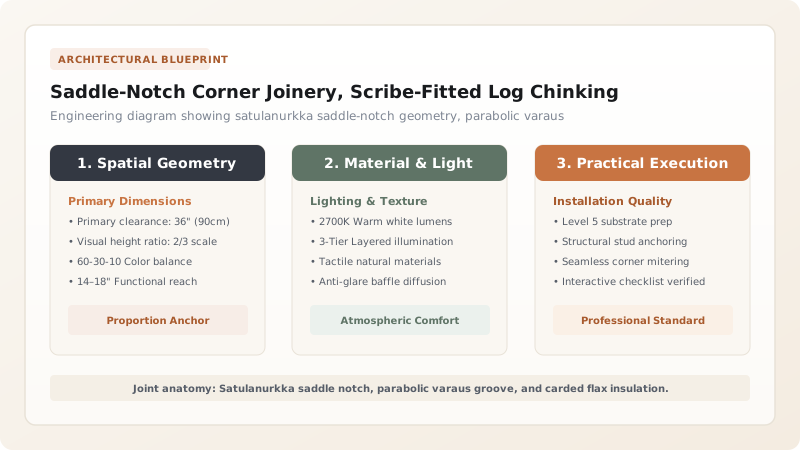
Satulanurkka Saddle-Notch Mechanics & 3D Interlock Geometry
In sub-Arctic log construction, corner notches must withstand extreme forces: hurricane-velocity snow gales, severe thermal shocks between interior steam (+100°C) and exterior winter frost (-35°C), and heavy roof dead loads. The premier Finnish joint for round logs is the satulanurkka (saddle notch).
Unlike simple round saddle notches (which can open up or rotate under lateral wind shear), the satulanurkka features dual opposing 45-degree sloping bevels cut into the sides of the log, creating an inverted triangular 'saddle'. The intersecting log is carved with a matching female pocket that drops snugly over this saddle. As the building rests under the immense dead weight of timber rafters and roof insulation, gravity forces the sloping bevels to wedge tighter together. The joint is self-tightening and locks the intersecting walls in both horizontal axes, creating a rigid structural corner that never rattles or develops air leaks.
Varaus Scribing & Parabolic Groove Carving
Because Kelo logs are wild trees with natural surface undulations, knots, and gentle sweeps, every horizontal log seam must be custom-contoured to fit its mate. The master carpenter places the new Kelo log above the wall on temporary timber spacer dogs. Using a specialized iron scriber (varausrauta) equipped with two sharp hardened steel points and a precision bubble level, the artisan traces the contour of the lower log onto the underside of the upper log.
The log is rolled over, and the craftsman carves the varaus (longitudinal groove) using a curved gouge axe (kourukirves) or specialized curved adze. The cross-section of the varaus must be parabolic rather than flat or V-shaped: the center of the groove is scooped out to a depth of 25 mm, while the outer lips are left knife-sharp. When the log is lowered into position, these sharp outer lips compress tightly against the lower log face under dead load, while the internal hollow provides a protective pocket for natural insulation.
Carded Flax Ribbon Sealing & Birch Vaarna Doweling
Traditional sauna wisdom strictly prohibits synthetic expanding polyurethane foams, silicone caulk, or mineral wool between logs. Toxic chemicals off-gas volatile organic compounds (VOCs) at high sauna temperatures, and mineral wool absorbs condensation, causing hidden rot. Instead, Finnish builders specify pellavanauha—continuous ribbons of 100% natural, unbleached, carded flax fiber (or wild dried Sphagnum moss).
The 15 mm thick flax ribbon is laid along the center of the carved varaus groove before the upper log is dropped into place. When the log is seated, the flax compresses down to 3 mm. Flax fibers are hollow, flexible, and naturally coated with plant lignins and waxes that resist mold. The flax creates an airtight, vapor-permeable gasket that expands and contracts dynamically as the sauna cycles between dry and steam states. To lock the wall against lateral bowing, 30x30 mm square birch dowels (vaarnat) are driven through vertical augered holes spaced every 1.5 to 2.0 meters along the wall.
Sauna Log Joinery Parameters and Insulation Specifications
Use this reference table to calculate exact physical dimensions, ratios, and specifications before purchasing:
| Joinery Element | Traditional Tool / Material | Dimensional Tolerance | Structural / Thermal Function | Risk If Omitted |
|---|---|---|---|---|
| Saddle Notch (Satulanurkka) | Finnish carving axe & chisel | Friction fit (< 1.5 mm gap) | 3D self-wedging corner lock; resists shear | Loose joints cause corner air and steam leaks |
| Longitudinal Groove (Varaus) | Kourukirves gouge axe | Depth 20-25 mm; sharp lips | Provides pocket for insulation; sheds rainwater | Flat cut causes log teetering and open seams |
| Thermal Sealant | Carded flax ribbon (Pellavanauha) | 15 mm thick (compresses to 3 mm) | Airtight, breathable, non-toxic steam seal | Synthetic foam emits VOC toxins at 90°C |
| Vertical Dowels (Vaarnat) | Square heartwood birch (30x30 mm) | Driven into 30 mm round augered hole | Prevents wall log bowing under heavy snow | Wall buckles outward under roof live load |
| Door/Window Sliders (Karat) | Vertical spruce guide tongues in slot | 30 mm settlement tongue depth | Permits logs to seat without jamb crushing | Fixed frames bind and crack under log weight |
Practical Constraints
Every successful decoration project must account for physical and environmental constraints:
Physical Precision Demands of Hand Axe Carving
A single mistake during saddle-notch chopping can ruin a rare, expensive centuries-old Kelo log. Solution: Employ certified master log builders (hirsirakentaja) with proven portfolios in sub-Arctic hand-scribed log construction.
Heavy Snow Dead Load on Low-Pitch Sauna Roofs
Lapland winters accumulate up to 1.5 meters of heavy wet snow, exerting live loads exceeding 2.5 kN/m². Solution: Size roof purlins from massive 350 mm Kelo logs supported by central king-post log trusses.
Execution Blueprint & Craftsmanship Sequence
Execute this professional sequence to achieve flawless results without backtracking:
Log Positioning and Bubble-Level Alignment
Dog-clamp the upper Kelo log in position above the wall. Verify that log centers are plumb and the top crown is level using a precision spirit level.
Varausrauta Contour Scribing
Adjust scriber gap to the widest offset. Scribe continuous parallel lines along both sides of the log, keeping the scriber bubble perfectly level throughout the stroke.
Parabolic Varaus Carving
Roll the log over on timber sawhorses. Make relief cuts with a chainsaw or axe, and scoop out the concave parabolic center with a kourukirves gouge axe.
Satulanurkka Saddle-Notch Carving
Lay out the double-beveled saddle angles on the log ends. Hew 45-degree sloping upper and lower cheeks with a sharp broadaxe, testing fit with a wooden gauge.
Flax Ribbon Installation and Log Seating
Staple a continuous strip of 15 mm carded flax ribbon into the apex of the carved groove. Hoist the log onto the wall and seat with heavy blows from a wooden maul.
Augering and Vaarna Dowel Driving
Bore 30 mm vertical holes through two log tiers using a heavy electric or T-handle auger. Drive square birch vaarna dowels firmly into the round holes.
Common Mistakes & Countermeasures
Avoid these costly errors that compromise aesthetics, ergonomics, and budget:
Carving the Varaus Groove with a Flat Bottom
Sealing Log Seams with Expanding Polyurethane Spray Foam
Using Steel Rebar Instead of Wooden Birch Vaarnat Dowels
Project Execution Checklist
Track your physical progress. Checkboxes persist automatically on this device:
Frequently Asked Questions
Why is flax fiber superior to moss or wool for sauna log chinking?
Flax fiber (pellavanauha) is harvested from natural flax straw and processed into uniform, carded ribbons. It contains natural lignins and waxes that resist bacterial decay and rot even in high-humidity environments. Unlike sheep's wool (which can emit wet animal odors when exposed to 90°C steam) or moss (which can crumble if handled too dry), flax maintains continuous elasticity, compresses evenly, and is completely odorless.
What is a 'karat' in Finnish sauna window framing?
A karat is a vertical hardwood sliding guide plank installed in a vertical groove cut into the log ends flanking window and door openings. The door or window frame is fastened directly to the karat, which slides freely within the log groove. This isolates the window frame from any residual timber settling or thermal expansion, preventing window glass from shattering.
Can Kelo log saunas meet modern energy efficiency and airtightness codes?
Yes. When hand-scribed with parabolic varaus grooves and carded flax chinking, a solid Kelo log sauna easily achieves airtightness scores of $q_{50} < 0.8\text{ m}^3/(\text{h}\cdot\text{m}^2)$—matching modern passive house standards without relying on artificial plastic vapor barrier membranes or synthetic sealing tapes.