Finnish Kelo log sauna architecture represents the ultimate summit of Nordic timber construction and thermal bathing design. Kelo wood is naturally dead-standing, dehydrated Scots pine (Pinus sylvestris) sourced from sub-Arctic forests in Lapland and Karelia that died standing, shed its bark naturally, and seasoned under severe Arctic freeze-thaw cycles for decades to centuries. Having lost all free and bound cellular water over 50 to 100+ years, Kelo logs exhibit zero drying shrinkage or warping. Joined with traditional saddle-notches and chinked with natural carded flax or sphagnum moss, Kelo log saunas breathe moisture naturally, releasing a delicate resinous pine fragrance. Paired with heavy stone-filled kiuas hearths that store thermal mass, Kelo saunas produce soft, enveloping steam (löyly) that endures for generations without chemical treatment.
At a Glance: Key Takeaways
- Botanical Origin: Pinus sylvestris (Lapland sub-Arctic slow-grown Scots pine)
- Natural Aging Process: Dead-standing 50 to 100+ years; bark naturally shed
- Moisture & Shrinkage: Moisture content < 10%; virtually zero dimensional shrinkage
- Corner Joinery: Satulanurkka (traditional saddle notch with lateral locks)
- Chinking Insulation: Natural carded flax fiber (pellava) or dried Sphagnum moss
- Thermal Hearth: Heavy stone-filled Kiuas (olivine diabase or peridotite rocks)
In-Depth Guides in this Directory
Explore specialized subtopic blueprints, technical dimensions, and execution checklists:
Dead-Standing Kelo Pine Harvesting, Naturally De-Barked Silver-Gray Patina Biology, and Zero-Shrinkage Physics
Silvicultural and anatomical analysis of Finnish Kelo wood. Learn dead-standing pine dehydration biology, photolytic silver patina weathering, resin crystallization, and zero-shrinkage structural physics.
Saddle-Notch Corner Joinery, Scribe-Fitted Log Chinking, and Carded Flax Fiber Vapor Sealing in Sauna Building
Craftsman joinery manual for Finnish Kelo saunas. Learn satulanurkka saddle-notch cutting, varaus groove hollowing, carded flax ribbon installation, and vaarna dowel pinning.
Stone-Filled Kiuas Sauna Stove Thermodynamics, Peridotite Rock Stacking, and Löyly Steam Convection Hydraulics
Thermodynamic engineering guide to the Finnish Kiuas sauna stove. Learn igneous peridotite stone selection, thermal mass heat banking, water vaporization physics, and löyly steam convection.
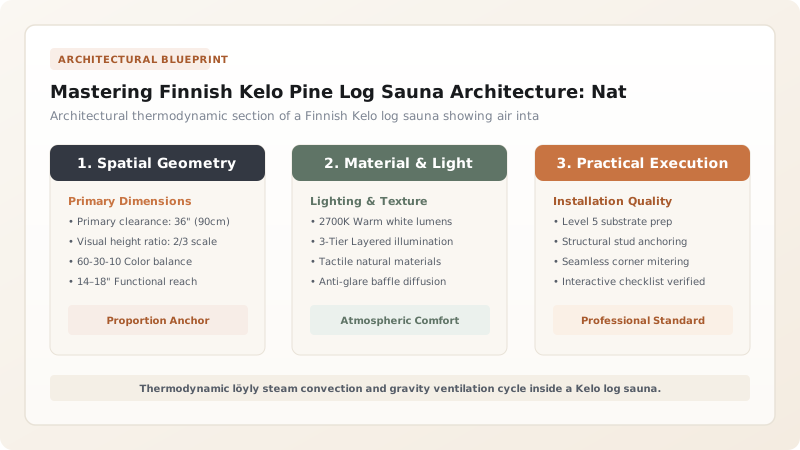
Kelo Pine Biology & Natural Sub-Arctic Dehydration
In the extreme sub-Arctic climate of Finnish Lapland and Russian Karelia, Scots pine trees (Pinus sylvestris) grow with extreme slowness, often requiring 300 to 400 years to reach a trunk diameter of 35 to 45 cm. When an ancient pine dies of natural age, it does not immediately fall or rot. Instead, sustained sub-zero temperatures, low atmospheric humidity, and high resin (pinene) concentrations prevent fungal colonization.
The tree remains standing dead on its roots for another 50 to 100+ years. Over decades of blizzards and summer midnight sun, the outer bark dries, shrinks, and falls away cleanly. The exposed sapwood is polished by wind-blown snow crystals and bleached by solar ultraviolet radiation, developing a magnificent, permanent silver-gray surface patina (kelopinta). Internally, the cellular sapwood dehydrates completely, leaving an ultra-dense, resin-hardened timber core with equilibrium moisture content below 10%. Because the cellular micro-structure has already stabilized over a century of natural weathering, freshly hewn Kelo logs undergo virtually zero shrinkage, warping, or twisting when incorporated into heated sauna walls.
Satulanurkka Saddle-Notch Joinery & Zero-Settlement Framing
Conventional green-log construction requires elaborate sliding screw jacks and wide settling gaps above windows and doors to accommodate the 5% to 8% vertical shrinkage of fresh timber. Kelo log saunas eliminate this structural vulnerability entirely. Because Kelo wood has already completed its volumetric contraction in the wild forest, carpenters can build tightly tolerance-fitted walls that maintain dimensional stability from day one.
Corner intersections are crafted using the classical satulanurkka (saddle notch) or koiranurkka (dog notch). Scribed with precision iron compasses, the upper and lower bevels form a self-wedging saddle profile. Along horizontal log joints, a parabolic concave groove (varaus) is carved into the underside of each log. The knife-like outer lips of the varaus bed firmly against the lower log, while the hollow interior provides an insulated pocket. The logs are held in vertical alignment with square birch or oak dowels (vaarnat), creating an impervious structural log wall capable of withstanding extreme thermal gradients: +100°C at ceiling height and -30°C on the exterior log face.
Flax Fiber Chinking & Wall Vapor Permeability Physics
A quintessential quality of an authentic Finnish sauna is its interior air quality. Modern insulated frame saunas lined with foil vapor barriers and fiberglass insulation often produce a stuffy, oxygen-depleted microclimate. In a solid Kelo log sauna, the massive timber walls act as a dynamic thermodynamic and hygroscopic buffer.
Logs absorb excess steam humidity during bathing sessions and slowly release it back into the room during cooling, preventing stagnant condensation. To maintain airtightness without compromising breathability, horizontal log seams are chinked with 100% natural carded flax fiber (pellavanauha) or wild dried Sphagnum peat moss. Flax fiber contains natural waxes and pectin, remaining completely elastic and rot-resistant under cyclic temperature and humidity swings. Air passes microscopically through the wood cellular structure, continuously refreshing indoor oxygen levels while keeping thermal heat trapped securely inside.
Kiuas Hearth Thermodynamics & The Physics of Löyly
The beating heart of any Finnish sauna is the kiuas—a heavy masonry or steel stove crowned by hundreds of kilograms of dense igneous stones. In traditional Kelo saunas, the stove is loaded with high-density, heat-storing rocks such as volcanic olivine diabase or peridotite. These rocks possess high volumetric heat capacity and low thermal expansion, withstanding thousands of cycles of cold water splashing without cracking or exploding.
When clean water is thrown onto the heated rocks (which are maintained between 250°C and 350°C), an instantaneous phase transition occurs, generating löyly—an invisible, expanding cloud of superheated water vapor. The Kelo log walls interact with the löyly: the massive dry timber absorbs radiant heat from the kiuas and re-radiates gentle, long-wave far-infrared heat (wavelength 8-14 microns) into the bathers' bodies. Coupled with gravity-fed ventilation (fresh cold air entering beneath the stove and rising over the stones, with stale air exhausting through low vents beneath the bathers' footbenches), the Kelo sauna delivers soft, deeply penetrating, oxygen-rich heat that relieves joint pain and restores spiritual serenity.
Kelo Log Sauna Specifications vs Modern Frame Saunas
Use this reference table to calculate exact physical dimensions, ratios, and specifications before purchasing:
| Feature / Component | Authentic Kelo Log Sauna | Modern Timber Frame Sauna | Thermodynamic / Health Impact |
|---|---|---|---|
| Wall Substructure | Solid 250-350 mm aged Kelo pine logs | Stud frame + rockwool + foil barrier | Kelo provides 100% breathable thermal mass vs artificial foil box |
| Timber Shrinkage | Zero shrinkage (< 0.2% dimensional change) | High log shrinkage (5-8% in green logs) | Kelo allows rigid door/window framing with zero settlement |
| Chinking / Insulation | Carded flax fiber (pellavanauha) / moss | Synthetic fiberglass or rockwool | Flax is hypoallergenic, non-toxic, and vapor permeable |
| Interior Surface Finish | Raw, natural silver-gray kelopinta | Chemical paraffin oil or synthetic wax | Kelo releases natural aromatic pinene with zero toxic off-gassing |
| Löyly Steam Character | Soft, long-wave radiant, oxygen-rich | Harsh, dry, sharp convective heat | Massive Kelo timber absorbs moisture shocks, stabilizing humidity |
Practical Constraints
Every successful decoration project must account for physical and environmental constraints:
Extreme Scarcity and Strict Forestry Protection of Kelo Trees
Dead-standing Kelo pines take centuries to form and are strictly protected in many Nordic national parks, making authentic Kelo expensive. Solution: Source exclusively from licensed sustainable thinning concessions in northern Finland and Karelia with certified chain-of-custody documentation.
Heavy Dead Load of Massive Log Walls and Stone Stoves
A large Kelo log sauna with a masonry chimney can weigh over 20 tons, requiring engineered reinforced concrete or bedrock foundations. Solution: Pour steel-reinforced concrete strip footings down to undisturbed bedrock or frost-insulated gravel sub-bases below the frost line.
Execution Blueprint & Craftsmanship Sequence
Execute this professional sequence to achieve flawless results without backtracking:
Kelo Log Sourcing and Quality Grading
Select dead-standing Scots pine logs from certified sustainable sub-Arctic forests. Inspect logs for continuous silver-gray weathered patina, dense heartwood, and absence of insect borings.
Foundation and Sill Log (Alahirsi) Bedding
Construct ventilated granite pier footings. Lay heavy resinous Kelo sill logs (alahirsi) bedded over natural birch bark damp-proof strips, truing corners with laser levels.
Saddle-Notch Scribing and Carving
Position logs over the wall. Scribe bottom contours and corner saddle notches (satulanurkka) using traditional iron scribers. Carve interlocking bevels and concave varaus grooves with adzes.
Flax Ribbon Chinking and Dowel Pinning
Unroll 100% natural carded flax ribbon (15 mm thick) along the carved groove. Seat the log with wooden mauls. Drill vertical dowel holes and drive square birch pins (vaarnat) every 1.5 meters.
Heavy Kiuas Stove and Ventilation Installation
Construct a firebrick hearth. Install a heavy stone-capacity kiuas stove loaded with 150 kg of washed olivine diabase stones. Install fresh air intake beneath the stove and exhaust vent beneath benches.
Ergonomic Aspen Bench Construction
Frame comfortable, multi-tiered bathers' benches from splinter-free, low-thermal-conductivity European aspen (haapa) or black alder (tervaleppä), mounted to log walls with concealed stainless brackets.
Common Mistakes & Countermeasures
Avoid these costly errors that compromise aesthetics, ergonomics, and budget:
Applying Varnish, Stains, or Petrochemical Sealers to Kelo Wood
Using Fluvial River Stones or Granite with Quartz Veins in the Kiuas
Installing Air Exhaust Vents High in the Ceiling
Project Execution Checklist
Track your physical progress. Checkboxes persist automatically on this device:
Frequently Asked Questions
What exactly is 'Kelo' wood and why is it so prized for saunas?
Kelo is Scots pine from northern Lapland that died naturally while standing upright and seasoned naturally in sub-Arctic weather for 50 to 100+ years. The tree lost its bark and sapwood moisture over decades, resulting in an ultra-dense, stable timber with zero drying shrinkage, an exquisite silver-gray patina, natural rot resistance, and a faint sweet resinous pine fragrance that enhances the therapeutic sauna experience.
What is 'löyly' in Finnish sauna culture?
Löyly is the soul of the Finnish sauna. It refers specifically to the hot, humid steam cloud produced when clean water is thrown onto the superheated stones of the kiuas stove. In a well-designed Kelo sauna, the löyly is soft, enveloping, and aromatic, creating a gentle wave of heat that opens pores and induces deep sweating without scorching the skin or drying out airways.
Why shouldn't Kelo wood logs be painted or treated with wood preservers?
Kelo wood has already survived a century of harsh Arctic blizzards without rotting; its high resin content and natural dehydration provide permanent biological preservation. Painting or sealing Kelo with chemicals destroys its ability to absorb and release steam, clogs its aromatic pores, and causes hazardous chemical vapors to off-gas when heated to 80°C-100°C during bathing.