The internal longevity and domestic hygiene of the traditional Ethiopian Gurage tukul depend upon two ancient vernacular technologies: unvented hearth smoke seasoning and hand-burnished earthen flooring. The central hearth (midijja), burning daily without a chimney, fills the high conical roof cavity with warm wood smoke rich in pyroligneous acids, creosote, and formaldehyde. This smoke condenses onto the bamboo rafters and ensete thatching, forming an impenetrable biocidal coating that permanently repels termites and fungal rot. Below, the earthen floor is compounded from subsoil clay, fine sand, and fermented cow dung, hand-burnished with smooth river stones and oiled with ensete sap to create an impermeable, mirror-smooth living surface.
At a Glance: Key Takeaways
- Hearth Mechanism: Midijja: unvented central open hearth flanked by three volcanic stones
- Chemical Preservative: Pyroligneous acids, creosote, and wood tar deposited by unvented acacia smoke
- Biological Target: Permanent biocidal protection against subterranean termites, powder-post beetles, and mold
- Floor Composition: Gura: 50% subsoil clay, 30% fine river sand, 20% fermented bovine manure
- Burnishing Technique: Hand-polished with smooth basalt river stones and oiled with ensete leaf extract
Midijja Thermodynamics: The Unvented Hearth as a Domestic Engine
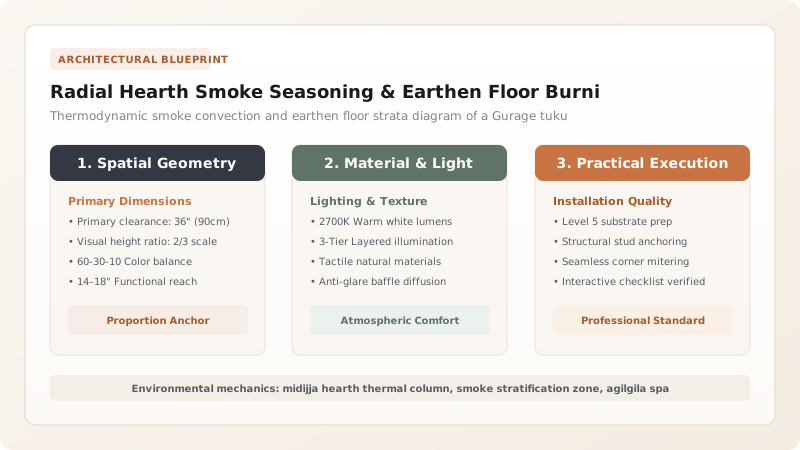
At the center of the Gurage tukul, nestled at the base of the sacred wuker kingpost, sits the midijja. In its physical form, the midijja is an unadorned circular hearth bounded by three large volcanic basalt stones (gulcha) that support the heavy earthenware griddle (mitad) used to bake the clan’s ensete flatbread (kocho). To the uninitiated modern observer, the complete absence of a chimney or smoke flue might appear to be an architectural oversight. In reality, the unvented hearth is the thermodynamic and preservation engine of the entire building.
The operation of the midijja relies upon natural thermal stratification within the soaring conical space. The roof of the tukul rises to a height of seven to eight meters above the floor. As the fire burns, the heated air and wood smoke rise rapidly in a concentrated thermal column, accumulating in the high, unoccupied upper dome of the cone. The lower two meters of the space—the domestic living zone where family members sit on low wooden stools, dine, and sleep—remains remarkably clear and breathable. Suspended approximately two meters above the hearth is the agilgila—a large, circular tray woven from split bamboo. The agilgila catches rising sparks and burning embers, preventing them from reaching the thatch, while allowing the aromatic smoke to billow upward into the roof cavity.
Pyroligneous Chemistry: The Biocidal Armor of Wood Smoke
The primary reason for maintaining an unvented hearth is not merely heating; it is the chemical preservation of the building envelope. The highland bamboo rafters, ensete fiber cordage, and koba thatching that compose the roof are organic materials that would normally be devoured by subterranean termites, powder-post beetles (Lyctus species), and wood-rotting fungal spores within two to three years in the humid tropical highland climate.
Daily combustion of mountain acacia wood and dried ensete biomass generates smoke rich in volatile chemical compounds: pyroligneous acids (chiefly acetic acid), creosote, formaldehyde, phenols, and complex wood tars. As this smoke circulates through the upper conical roof space before slowly percolating out through the porous thatch, these chemical compounds condense onto the surfaces of the bamboo and ensete fibers. Over months of continuous occupancy, a black, glossy, resinous coating builds up over every structural member. This creosote film acts as a permanent, broad-spectrum natural biocide. It penetrates deep into the bamboo pores, crystallizing into an unpalatable, toxic barrier that makes the organic structure completely immune to insect attack and rot, extending the lifespan of the bamboo roof to over thirty years.
Compounding the Gura Floor: Clay, Sand & Bovine Biochemistry
Beneath the seasoned bamboo canopy lies the living floor, known in the Gurage language as gura. In traditional rural architecture, bare dirt floors are often dusty, damp, and prone to harboring parasitic jigger fleas and bacteria. The Gurage solved this problem through a sophisticated application of natural composite chemistry, formulating an earthen floor that functions like a polished, seamless ceramic tile.
The construction begins with the excavation of 150 millimeters of loose topsoil, followed by the compaction of the underlying subgrade using heavy wooden rammers. The floor compound is mixed in a dedicated pit: 50% sticky subsoil clay is blended with 30% washed fine river sand and 20% fresh cow manure. The inclusion of cow dung is an ancient biological masterstroke. Cattle digestion breaks down plant matter into millions of microscopic, enzyme-coated cellulose fibrils. When mixed with clay, these microfibers knit the mineral particles together, preventing shrinkage cracks during drying. Furthermore, the bile salts, natural enzymes, and casein proteins in the manure act as natural plasticizers and hydrophobic water-repellents, transforming the clay into a supple, workable mortar that dries into an ultra-dense, crack-free slab.
River Stone Burnishing & Ensete Sap Polishing
The final, exquisite transformation of the floor is achieved through manual burnishing. When the newly laid earthen slab has dried to the "leather-hard" stage—firm to the touch but retaining enough plastic moisture to yield under pressure—the women of the household begin the burnishing ritual. Using smooth, oval river stones (alalo) harvested from mountain stream beds, they rub the floor under intense downward body pressure in tight, overlapping circular patterns.
The mechanical friction of the stone exerts intense pressure, compressing the porous clay platelets and aligning them parallel to the surface. This physical compaction eliminates all surface micro-voids, creating an extraordinarily dense, impervious skin. To complete the finish, fresh green ensete leaves are crushed to extract their astringent, resin-rich sap. This liquid is rubbed into the burnished floor with a wool cloth. The organic sap reacts with the clay and bovine enzymes, drying into a hard, non-porous, dark olive-brown glaze. The finished floor is cool underfoot, completely dust-free, naturally antibacterial, and gleams with a soft, silky luster in the warm light of the central hearth, reflecting the timeless elegance and ecological harmony of Gurage domestic life.
Smoke Chemistry & Floor Matrix Formulations in the Gurage Tukul
Use this reference table to calculate exact physical dimensions, ratios, and specifications before purchasing:
| Process / Component | Material Reagents | Chemical / Physical Action | Target Domestic Surface | Durability Benefit |
|---|---|---|---|---|
| Smoke Seasoning (Tus) | Acacia wood & ensete leaf smoke | Deposits creosote, formaldehyde, pyroligneous tar | Bamboo rafters, ensete lashings, thatch | Immunizes organic materials against termites & mold (25+ yrs) |
| Spark Arrester (Agilgila) | Woven split-bamboo basket screen | Blocks burning embers; permits smoke passage | Suspended 2 m over midijja hearth | Eliminates thatch fire hazard in living quarters |
| Earthen Base Substrate | 60% subsoil clay + 40% sand | Compacted with heavy wooden rammers | Lower 100 mm floor foundation | Prevents subterranean settling and groundwater rise |
| Finish Floor Layer (Gura) | Clay, sand, fermented cow manure | Bovine enzymes plasticize clay; fibers knit | Upper 50 mm walkable floor slab | Crack-free, resilient, naturally thermal buffering |
| Stone Burnishing Polish | Basalt river stone + ensete sap | Friction aligns clay platelets; sap seals pores | Top 2 mm polished floor surface | Waterproof, dust-free, velvety sheen; easily swept clean |
Practical Constraints
Every successful decoration project must account for physical and environmental constraints:
Respiratory health concerns associated with indoor particulate matter and wood smoke exposure
Prolonged inhalation of dense smoke can cause chronic respiratory irritation. Mitigation: The high conical ceiling (7+ meters) allows smoke to rise into the upper roof zone, keeping the living level clear.
High seasonal livestock traffic inside the tukul causing wear on earthen floor surfaces
Calves and sheep housed in perimeter stalls can scuff and erode burnished floor finishes. Mitigation: Re-apply a light cow dung and ensete sap wash annually, re-burnishing high-traffic areas with river stones.
Execution Blueprint & Craftsmanship Sequence
Execute this professional sequence to achieve flawless results without backtracking:
Midijja Hearth Setting & Stone Geometry
Dig a shallow 10 cm circular pit at the center of the tukul; bed three large volcanic basalt stones in clay to hold clay cooking pans (mitad).
Agilgila Spark Arrester Installation
Weave a large circular basketwork tray from split bamboo; suspend it horizontally 2 meters directly above the hearth to catch rising embers.
Continuous Smoke Seasoning Initiation
Kindle a slow-burning fire with dry acacia wood and ensete fibers, maintaining a gentle smoldering draft that fills the upper roof with dense smoke.
Floor Excavation & Subgrade Tamping
Excavate 150 mm of loose topsoil within the circular perimeter; tamp the subsoil firm using heavy wooden rammers until compacted.
Compounding the Gura Floor Matrix
Mix sticky subsoil clay, fine river sand, water, and fresh cow dung in a shallow pit, treading the mixture with bare feet until uniform and plastic.
Earthen Layer Application & Leveling
Spread the earthen mix across the floor in two 50 mm courses, leveling the surface with wooden straightedges toward the central hearth.
River Stone Hand-Burnishing
When the floor reaches leather hardness, rub the surface vigorously with a smooth, water-worn basalt stone, exerting firm downward pressure.
Ensete Sap Rubbing & Curing
Extract fresh sap from crushed green ensete leaves; rub the liquid across the burnished floor with a cloth, curing into a hard, glossy sheen.
Common Mistakes & Countermeasures
Avoid these costly errors that compromise aesthetics, ergonomics, and budget:
Venting the midijja hearth through a modern roof chimney pipe
Omitting cow dung from the earthen floor compound
Burnishing the earthen floor while it is still too wet or completely bone-dry
Project Execution Checklist
Track your physical progress. Checkboxes persist automatically on this device:
Frequently Asked Questions
How does the high conical roof keep the living area smoke-free despite having no chimney?
The Gurage tukul operates on the thermal stratification principle. The conical roof rises to an immense height of 7 to 8 meters above the floor. As the wood smoke rises from the central hearth, it is warm and buoyant, naturally gathering in the upper third of the conical dome (the smoke reservoir). The lower living zone—from floor level up to two meters, where people sit, sleep, and cook—remains remarkably clear and breathable, while the smoke slowly filters out through the porous thatch at the apex.
What chemical compounds in wood smoke preserve the bamboo and ensete thatch?
Wood smoke produced by the combustion of acacia and ensete biomass contains hundreds of active chemical compounds. Foremost among these are pyroligneous acids (acetic acid), creosote (phenolic compounds), formaldehyde, and guaiacol. These volatile compounds condense onto the cool bamboo rafters and thatch, creating a dark, bitter, water-insoluble resinous film that is toxic to wood-destroying fungi, lethal to termite digestion, and repels rodents.
Why is cow dung an essential ingredient in traditional earthen floors?
Cow dung is one of nature's most effective natural building binders. The digestive tract of cattle breaks down grass into microscopic, enzyme-coated cellulose microfibers that act as high-tensile reinforcement inside the clay matrix, preventing shrinkage cracks. Additionally, the bile salts and natural casein proteins in the dung act as plasticizers and natural hydrophobic waterproofing agents, producing a hard, smooth, dust-free surface that is naturally insect-repellent.