
Pargeting is the historic English craft of applying decorative ornamental lime plaster to the exterior timber-framed facades of East Anglia, Essex, Suffolk, and Hertfordshire. Dating back to the 16th and 17th centuries, pargeting ranges from incised geometric comb patterns (stickwork) to elaborate freehand high-relief modeling of heraldic beasts, strapwork, and flora. Executed over cleft oak lath using non-hydraulic fat lime putty reinforced with long ox hair, pargeting creates a breathable, flexible exterior skin protected by periodic coats of sacrificial limewash.
At a Glance: Key Takeaways
- Fiber Reinforcement: Washed, Scoured Ox or Goat Hair (5-8 kg/m³)
- Plaster Binder: Non-Hydraulic Fat Lime Putty (Calcium Hydroxide, CL90-S)
- Protective Coating: Sacrificial Hot-Mixed Pure Limewash
- Substrate: Riven/Cleft Oak Lath with Stainless/Copper Nails
In-Depth Guides in this Directory
Explore specialized subtopic blueprints, technical dimensions, and execution checklists:
Non-Hydraulic Lime Putty, Animal Hair Binders, and Comb Scratching Tools for Pargeting
Technical manual on slaked fat lime putty compounding, ox hair fiber distribution, and carved wooden comb tooling for incised English pargeting.
Freehand High-Relief Lime Modeling, Armatures, and Timber Lath Anchorage in Pargeting
Comprehensive manual on three-dimensional freehand lime modeling, stainless/copper armatures, timber stud tie-ins, and parging spatula tools.
East Anglian Floral Friezes, Heraldic Beasts, and Sacrificial Limewash Maintenance
Architectural survey of East Anglian pargeting motifs, heraldic iconographies, and cyclic sacrificial limewash maintenance protocols.
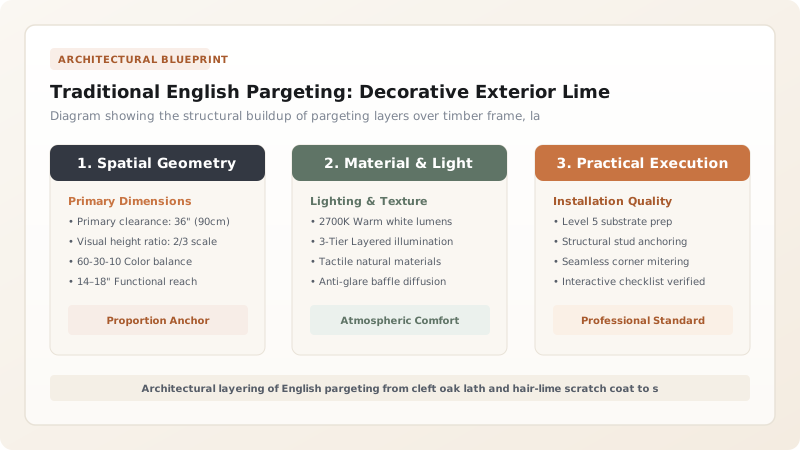
Vernacular Origins and Architectural Typologies of East Anglian Pargeting
Emerging during the Tudor and Elizabethan eras, pargeting developed as an aesthetic and weatherproofing evolution of vernacular wattle-and-daub. In the claylands of Essex, Suffolk, and Cambridgeshire, where building stone was scarce, timber-framed oak structures dominated. Plasterers discovered that exterior lime coats could insulate heavy oak frames while providing an expressive canvas for decorative storytelling.
Historic pargeting divides into two primary techniques: incised or flat pargeting, where wooden combs or stamps imprint repetitive geometric motifs (herringbone, guilloche, fan scales) into wet finish plaster; and modeled or bas-relief pargeting, where high-relief figures, heraldic shields, date stones, and floral swags are sculpted directly onto the facade or cast from wooden molds.
Material Chemistry: Slaked Non-Hydraulic Fat Lime and Fiber Reinforcement
Authentic pargeting must never incorporate modern Portland cement or hydraulic lime (NHL 3.5/5), which are excessively rigid, impermeable to water vapor, and promote devastating timber rot behind the plaster plane. The standard binder is pure calcium hydroxide (CL90 fat lime putty) slaked from high-calcium chalk or limestone and aged in wet pits for a minimum of 3 to 12 months.
Tensile reinforcement is provided by long ox, horse, or goat body hair. Thoroughly washed and combed to remove natural oils, the animal fibers form an interlocking microscopic matrix throughout the mortar. This fiber matrix counteracts drying shrinkage, bridges movement across flexing oak studs, and supports cantilevered three-dimensional sculpted ornaments without cracking.
Substrate Engineering: Cleft Oak Lath, Counter-Battening, and Anchorage
Pargeting requires a flexible, mechanically keyed substrate. Hand-riven or cleft oak and chestnut laths are preferred over modern sawn lath because riven laths follow the natural grain fissures of the wood, offering vastly superior flexural strength and natural split resistance.
Laths are spaced with finger-width gaps (8mm to 10mm) and secured using hand-forged rosehead or modern non-ferrous copper/stainless steel ring-shank nails. A coarse 'pricking coat' of hair-lime mortar is firmly troweled between the laths, curling over the rear edges to form structural 'nibs' or keys. Once partially set, it is deeply scratched with a lath comb to provide mechanical grip for intermediate floats and modeling coats.
Sculptural Execution, Incised Combs, and Sacrificial Limewash Maintenance
For relief pargeting, the artisan builds up thickness in progressive layers, securing heavy projecting elements (such as mythical green men, lions, or fruit swags) with copper wire armatures or stainless steel wood screws set directly into timber framing members. Small spatulas, boxwood modelling tools, and fingers are used to tool fine anatomical and floral details.
To seal and protect the soft lime relief from freeze-thaw erosion, the entire elevation receives four to six coats of sacrificial hot-mixed pure limewash. This micro-crystalline calcium carbonate skin breathes continuously, expelling absorbed wind-driven rainwater as benign vapor while reflecting solar thermal radiation.
Pargeting Mortar Mix & Application Specification
Use this reference table to calculate exact physical dimensions, ratios, and specifications before purchasing:
| Plaster Coat | Binder to Sand Ratio | Hair Inclusion (kg/m³) | Nominal Thickness | Surface Keying Method |
|---|---|---|---|---|
| Pricking / Scratch Coat | 1 : 2.5 (CL90 Putty : Sharp Well-Graded Pit Sand) | 6.0 to 8.0 kg ox hair | 9mm – 12mm | Deep diagonal lath scratch comb |
| Floating / Intermediate Coat | 1 : 2.75 (CL90 Putty : Clean Sharp Sand) | 3.5 to 5.0 kg cattle hair | 8mm – 10mm | Wood float scour / light devil float |
| Incised Finish Coat (Stickwork) | 1 : 2 (CL90 Putty : Fine Silver Sand / Chalk) | Nil or minimal fine goat fleece | 4mm – 6mm | Hand-carved boxwood geometric combs |
| High-Relief Modeling Mortar | 1 : 1.5 (Aged CL90 Putty : Fine Marble Dust/Pumice) | Long horse hair + copper armature wire | Up to 50mm in layers | Direct hand modeling & spatulas |
Practical Constraints
Every successful decoration project must account for physical and environmental constraints:
Vulnerability to Severe Frost During Autumn and Winter
Non-hydraulic lime relies on atmospheric carbonation (absorbing CO2), which halts below 5°C; pargeting work must cease between late October and April.
Listed Building Consent and Heritage Officer Approvals
Historic England or local conservation officers must approve historic mortar analyses, comb pattern tracings, and heraldic motifs prior to site work.
Execution Blueprint & Craftsmanship Sequence
Execute this professional sequence to achieve flawless results without backtracking:
Timber Frame Inspection and Counter-Battening
Assess historic oak timber framing for movement or decay; fix untreated cleft oak counter-battens over uneven timber planes to create a plumb plane.
Riven Oak Lath Installation
Nail hand-riven oak laths with 9mm keys, breaking joint courses every 600mm to distribute stresses; dampen laths before plastering.
Pricking Coat Application and Nib Formation
Trowel hair-rich coarse lime mortar firmly through lath apertures to form robust back-keys; scratch cross-hatch grooves into the face before setting.
Floating Coat and Panel Demarcation
Apply the intermediate float coat, levelling with a straightedge; scribe decorative panel borders, frieze bands, and architectural margins.
Comb Scratching or Freehand Relief Sculpting
Execute geometric comb patterns across damp plaster, or model three-dimensional heraldic beasts and floral swags onto tied copper armatures.
Slow Carbonation Curing and Limewash Application
Protect the curing plaster with damp hessian burlap for 14–21 days to prevent rapid dehydration; finish with 5 coats of hot-mixed pure limewash.
Common Mistakes & Countermeasures
Avoid these costly errors that compromise aesthetics, ergonomics, and budget:
Adding Portland Cement or Gypsum to Accelerate Setting
Applying Relief Plaster Over Dry, Thirsty Substrates
Using Sawn Pine Laths with Electro-Galvanized Nails
Project Execution Checklist
Track your physical progress. Checkboxes persist automatically on this device:
Frequently Asked Questions
What is the difference between pargeting and roughcast or harling?
Roughcast (harling) is a protective, weather-deflecting slurry thrown against stone masonry containing small pebbles. Pargeting is an artisan plastering tradition applied over timber laths featuring deliberate decorative ornamentation, incised patterns, or sculpted reliefs.
How long does authentic lime pargeting last on exposed facades?
When maintained with periodic coats of sacrificial limewash every 5 to 7 years, authentic hair-lime pargeting lasts over 300 to 400 years on exterior English timber frames.
Can damaged or missing pargeting panels be patched in situ?
Yes. Conservation plasterers can re-anchor sagging panels using stainless steel washers set beneath relief details, consolidating loose backing with hydraulic lime grouts and repairing surface modeling in matching fat lime.


