
Traditional Dutch timber crafts unite monumental millwright engineering with intimate footwear carving. At monumental scale, Dutch drainage (polder) and industrial watermills utilize monumental octagonal bent timber frames constructed from massive European oak (Quercus robur) with mortise-and-tenon scarf joints, heavy cross-girders, and replaceable hornbeam (Carpinus betulus) gear cogs engineered to withstand extreme wind and hydraulic torsional loads. In vernacular footwear, Dutch clogs (klompen) are carved from single green billets of native black poplar (Populus nigra) or white willow (Salix alba) using draw knives, hollow spoon gouges, and curved pairing knives to create watertight, orthopedically protective, breathable wooden boots capable of insulating farmers and polder drapers against saturated North Sea peat soils.
At a Glance: Key Takeaways
- Clog Billet Material: Green Black Poplar (Populus nigra) or White Willow (Salix alba)
- Gearing & Cog Wood: European Hornbeam (Carpinus betulus, ironwood grain density)
- Joint Engineering: Tapered oak pegged mortise-and-tenon, under-squinted stop scarf joints
- Millwright Timber: Heartwood European Oak (Quercus robur, air-seasoned 5-7 years)
In-Depth Guides in this Directory
Explore specialized subtopic blueprints, technical dimensions, and execution checklists:
Dutch Wind & Watermill Bent Timber Framing: Cross Girders, Octagonal Bents & Heavy Oak Joinery
Structural engineering analysis of traditional Dutch octagonal windmill bents, heavy oak cross-girders, tie-beams, and scarf joints under dynamic wind loads.
Willow & Poplar Wood Selection for Dutch Klompen: Hand Gouging, Knife Carving & Drying Ergonomics
Master guide to selecting green poplar and willow logs for traditional Dutch wooden clogs, specialized hand gouges, bench knife carving, and crack-free curing.
Water Wheel Gear Teeth & Hornbeam Cogs: Sluice Gate Oak Joinery, Cam Beams & Mill Mechanical Alignment
Comprehensive engineering guide to crafting hornbeam mill cogs, brake wheel gear mortises, undershot water wheel floats, and heavy oak sluice gate joinery.
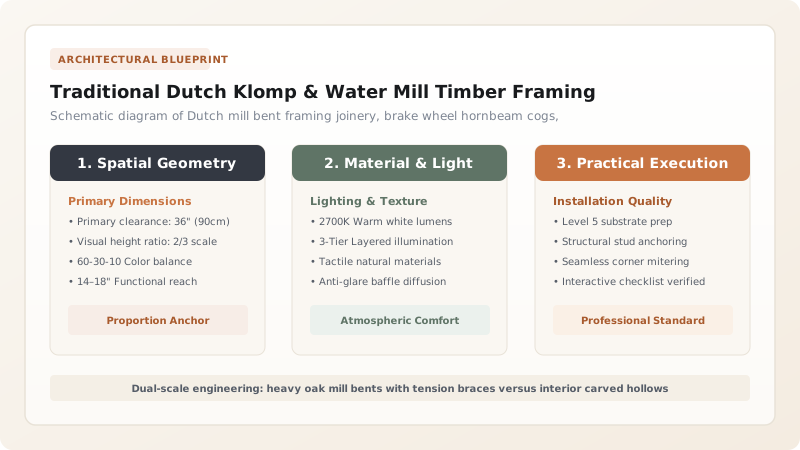
The Hydraulic Heritage: Wind, Water, and Lowland Timber Mastery
In the Netherlands, wood was the primary engine of survival and land reclamation. Below sea level, peat bogs and saltwater tides necessitated monumental hydraulic machines—wind-powered drainage mills (poldermolens), tidemills, and industrial watermills along the Veluwe rivers. Dutch millwrights (molenmakers) developed some of the most sophisticated heavy timber structures in Europe, capable of transforming dynamic kinetic wind and water forces into mechanical work such as timber sawing, oil pressing, and Archimedean screw water pumping.
In parallel, the waterlogged mud and cold peat soils required footwear that could resist puncture, rot, and moisture saturation while providing thermal insulation. The wooden clog (klomp, plural klompen) became the ubiquitous protective gear of polder laborers, farmers, and artisans. The symbiotic relationship between heavy mill carpentry and delicate clog gouging shaped Dutch vernacular timber identity from the Middle Ages through the Industrial Revolution.
Millwright Architecture: Octagonal Bents, Corner Posts, and Scarf Joints
Dutch watermills and thatched drainage smock mills (bovenkruier and wipmolen) rely on a rigid timber framework known as the achtkant (octagonal bent frame). Eight massive oak corner posts (hoekstijlen), often measuring 350x350 mm and rising up to 15 meters in height, slope inward at an angle of 75 to 80 degrees to resist horizontal overturning moments caused by gale-force North Sea winds.
These posts are braced by horizontal tie-beams (bintbalken) and cross-bracing struts (kruisschoren). Because timber of such colossal lengths was scarce, millwrights joined timbers using halved stop scarf joints with under-squinted abutments and tapered oak draw-bore pegs (toognagels). The heavy cross-girders carry the millstone floors and withstand severe vibrational harmonics caused by multi-ton water wheels turning against hydraulic sluice surges.
Mechanical Woodcraft: Brake Wheels, Lantern Pinions, and Hornbeam Cogs
Unlike modern cast metal gearing, traditional Dutch mills utilize all-timber transmission trains. The primary brake wheel (vangwiel) or pit wheel (spoorwiel) contains hundreds of individually hand-shaped wooden teeth (kammen). These cogs mesh with the cylindrical staves (drijfronden) of lantern gear pinions.
For these wear-intensive friction surfaces, millwrights exclusively selected European Hornbeam (Carpinus betulus, known in Dutch as haagbeuk). Hornbeam possesses an extraordinarily dense, interlocked grain that does not splinter under heavy shear loads and wears to an ultra-smooth, glass-like burnished patina under constant friction. The cogs are carved with a tapered tenon shank that wedges tightly into mortises on the rim of the oak wheel, secured from behind with split hazel keys for quick field replacement.
Vernacular Clog Carving: Billets, Hollow Spoon Gouges, and Air Seasoning
Traditional Dutch clogs are carved exclusively from green (unseasoned) logs of Black Poplar (Populus nigra) or White Willow (Salix alba). Seasoned dry wood is too hard and brittle to carve by hand and will split under impact; green timber retains high moisture content, allowing the clog maker (klompenmaker) to slice through the fibers cleanly.
Using a large pivoted bench slicing knife (paalmes), the craftsman rough-shapes the exterior toe, instep, and heel profile. The billet is then clamped in a wooden vise, and the interior cavity is systematically excavated using curved spoon borers (lepels) and bottom scrapers (bodemijzers). Precision thickness walls—ranging from 12 mm at the instep to 25 mm at the sole—provide impact resistance and foot-conforming arch support. Once carved, the wet clogs are air-dried in breezy sheds for three to four weeks before final sanding and water-resistant linseed oil varnishing.
Dutch Millwright & Clog Craft Material Specifications
Use this reference table to calculate exact physical dimensions, ratios, and specifications before purchasing:
| Application Component | Primary Wood Species | Grain Density / Properties | Primary Hand Joinery Tool | Expected Service Life |
|---|---|---|---|---|
| Mill Octagonal Corner Posts | European Oak (Quercus robur) | High tannic heartwood, decay resistant | Tapered auger & draw-bore broadaxe | 150-250 years |
| Gear Teeth & Cogs (Kammen) | Hornbeam (Carpinus betulus) | Ultra-dense, interlocked grain, self-lubricating | Tenon back-saw & spoke-shave | 15-25 years (replaceable) |
| Mill Sluice Gates & Buckets | Larch / Pitch Pine / Oak | Resistant to continual water immersion | Tongue-and-groove plane & iron trunnels | 40-60 years |
| Traditional Clogs (Klompen) | Black Poplar / White Willow | Lightweight (450 kg/m³), splinter-free, shock absorbent | Pivoted bench knife (Paalmes) & spoon gouges | 2-5 years working wear |
Practical Constraints
Every successful decoration project must account for physical and environmental constraints:
Hydraulic Mill Fluctuation & Timber Rot in Splashing Zones
Water wheel axle journals and breast wall timbers experience continuous alternating wet-dry cycles accelerating brown rot fungus. Solution: Utilize submersed green oak or swamp-cured larch below water level, and treat splash-zone bents with pine tar and beeswax sealants.
Rapid Drying Shrinkage and Radial Cracking in Freshly Carved Klompen
Direct sunlight or forced heat during initial curing causes rapid surface evaporation, splitting the toe cap along longitudinal growth rings. Solution: Cure rough-carved shoes in cold, dark drying racks stacked heel-to-toe with wood-shavings floor bedding to buffer humidity decline.
Execution Blueprint & Craftsmanship Sequence
Execute this professional sequence to achieve flawless results without backtracking:
Green Timber Harvesting and Log Sectioning
Fell mature poplar or willow trees in late winter; immediately crosscut green logs into billets matching clog length plus 40mm allowance.
Axe Billet Cleaving and Exterior Roughing
Split the cylindrical log radially into wedge halves; rough-hewn the heel, toe curve, and sole using an offset clog-maker's hatchet.
Bench Knife Exterior Contouring (Paalmes)
Mount the billet against the workbench fulcrum; sweep the 800mm pivoted bench knife downward to slice smooth exterior curves and arch profiles.
Interior Cavity Excavation with Spoon Gouges
Clamp the shoe in the hollow bench dog; drill preliminary depth holes with T-handle augers, then hollow out foot-bed using curved spoon chisels.
Calibrated Wall Thickness and Sizing Check
Gauged inner wall thickness using double-calipers (14mm instep, 24mm heel); test foot ergonomic clearances with curved horn gauges.
Slow Shed Drying and Linseed Burnishing
Stack fresh clogs in well-ventilated, shaded drying racks for 21 days; burnish exterior with fine wood shavings and apply raw cold-pressed linseed oil.
Common Mistakes & Countermeasures
Avoid these costly errors that compromise aesthetics, ergonomics, and budget:
Carving Clogs from Kiln-Dried or Fully Seasoned Timber
Using Oak or Beech for Gear Wheel Cogs Instead of Hornbeam
Project Execution Checklist
Track your physical progress. Checkboxes persist automatically on this device:
Frequently Asked Questions
Why are Dutch clogs made from poplar and willow rather than hardwoods like oak?
Oak is far too dense, heavy, and brittle for footwear, causing foot fatigue and severe splitting under walking impact. Black poplar and white willow are lightweight, elastic, impact-absorbent, and easily carved when green. Their cellular structure acts as a natural thermal insulator, trapping tiny pockets of air that keep feet warm in freezing winter mud.
How do traditional wooden gear cogs survive heavy mill torque without snapping?
European Hornbeam (Carpinus betulus) features an exceptionally high Janka hardness and interlocked grain. Individual cogs are cut so grain runs parallel to the direction of tooth thrust. Each cog's tapered shank is fitted with a fraction of a millimeter tolerance into the wheel rim, allowing load to transfer across the massive oak rim rather than bending the tooth neck.
Can modern steel fixings replace wooden pegs in historic Dutch mill restoration?
No. Rigid steel bolts produce localized point stresses and condensation inside oak timbers, leading to accelerated iron-tannin corrosion and timber rot. Traditional tapered oak pegs (toognagels) flex in harmony with seasonal timber expansion and wind-induced mill sway without loosening.
How do farmers and workers prevent blisters when wearing wooden clogs?
Authentic klompen are sized with 10mm of perimeter toe clearance and are traditionally worn with thick, hand-knitted woolen socks (geitebreiers). The wool acts as a friction buffer and moisture wicking layer, while the wooden footbed molds gently to the sock profile over weeks of daily use.


