
Delft tile decoration is an exacting freehand discipline executed on raw, unfired tin glaze. Artists transfer guide contours using perforated paper cartoons (spons/spolvero) and charcoal dust, then paint with finely mulled cobalt oxide using long-bristled ox-hair brushes (trekkers). The composition incorporates standardized corner motifs (witjes, ossekoppen, spinnekoppen) that form secondary geometric medallions when tiles are installed in multi-unit grids.
At a Glance: Key Takeaways
- Unfired Substrate: Powdered, chalk-like dry tin glaze that instantly absorbs pigment without margin for error.
- Drawing Transfer: Spons (spolvero) cartoons pounced with charcoal dust through needle-perforated lines.
- Brush Types: Long ox-hair liner brushes (trekkers) and soft squirrel-hair wash mops (wassers).
- Pigment Chemistry: Roasted cobalt ore (zaffre) and smalt glass powder, firing from dull grey to brilliant blue.
- Corner Motifs (Hoekmotieven): Ox-heads (ossekoppen), spiders (spinnekoppen), carnations (anjers), and scrolls.
- Tonal Gradients: Shading achieved by varying water dilution of cobalt, creating watercolor-like wash depth.
The Challenge of Raw Glaze: The Unforgiving White Powder
A defining technical aspect of authentic Delftware is that it is painted in-glaze (op glazuur) before the final glost firing. The dipped tile presents a delicate, chalky white coating of unfired tin enamel. Touching it with fingers rubs the glaze off, and dropping water ruins the face.
The painter rests their forearm on a bridge-like wooden slat called a schildersstok to avoid contacting the fragile surface. The moment the brush touches the glaze, the porous powder sucks moisture out of the bristles within a split second. The painter must work with fluid, confident strokes; hesitant hesitations leave dark, unsightly blotches of cobalt that can never be wiped away.
Cobalt Oxide Mineralogy: From Dull Grey to Imperial Blue
When applied to the tile, the paint appears as a dull, lifeless purplish-grey paste. The transformation into radiant royal blue occurs entirely inside the 1,000°C inferno of the glost kiln.
The pigment is derived from roasted cobalt arsenide minerals (erythrite or cobaltite) mined in Saxony, known as zaffre. To prevent the cobalt from running or blistering under the molten lead glaze, artisans mull the roasted ore with 50% pulverized potash glass powder (smalt). At peak kiln temperature, the cobalt ions (Co²⁺) dissolve into the liquid silicate network, forming tetrahedral coordination complexes that absorb red and green light while transmitting pure, deep cobalt blue.
Hoekmotieven: The Mathematical Architecture of Corner Motifs
In single-tile museum displays, corner decorations are often overlooked. In architectural wall revetments, however, the hoekmotief (corner motif) is the primary visual engine that binds hundreds of individual 13cm tiles into a cohesive mural.
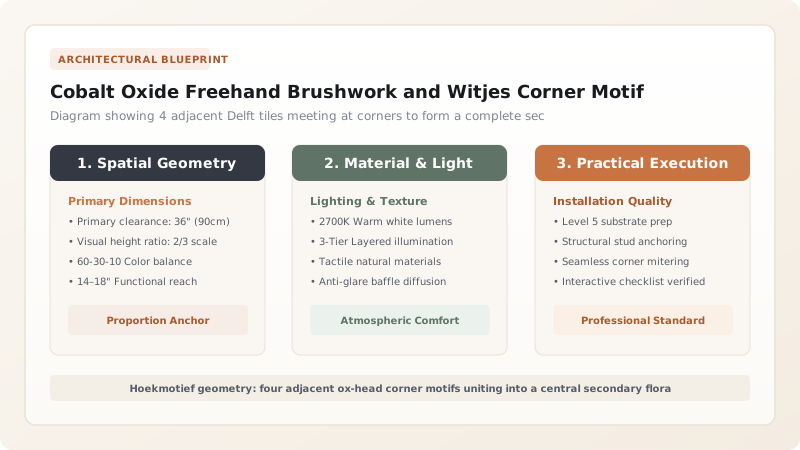
When four tiles are installed with hair-thin joints, their four triangular corner motifs converge to form an intricate secondary square medallion. The most famous historic variations include:
- Ossekop (Ox-Head): Two curved horns with ears, forming an eight-petaled flower when joined.
- Spinnekop (Spider-Head): Concentric curved lines resembling a long-legged spider, popular in 17th-century rural farmhouses.
- Franse Lelie (Fleur-de-Lis): Stylized heraldic lily corners designed for aristocratic salons.
Canonical Corner Motifs (Hoekmotieven) on Dutch Delft Tiles
Use this reference table to calculate exact physical dimensions, ratios, and specifications before purchasing:
| Motif Name | Visual Description | Historic Era | Converged Pattern (4 Tiles) | Architectural Setting |
|---|---|---|---|---|
| Ossekop (Ox-Head) | Stylized horns and ears | 1620 – 1680 | 8-petaled stylized floral rosette | Formal canal-house fireplaces & salons |
| Spinnekop (Spider) | Radiating delicate curved legs | 1640 – 1720 | Concentric diamond star medallion | Farmhouse hearths, dairies, cellars |
| Franse Lelie (Lily) | Classic 3-pronged fleur-de-lis | 1660 – 1740 | Maltese cross with floral tips | Aristocratic dining rooms & town halls |
| Witje (Plain / No Corner) | Zero corner painting (pure white) | 1630 – 1780 | Unbroken white border grid | Kitchen work walls, sculleries, basements |
Practical Constraints
Every successful decoration project must account for physical and environmental constraints:
Speed required: historic guild painters painted up to 60 to 80 tiles per day to maintain economic viability
Mitigation: Master confident, fluid single-stroke calligraphic brush movements without second-guessing or slow hesitations.
Execution Blueprint & Craftsmanship Sequence
Execute this professional sequence to achieve flawless results without backtracking:
Prick Paper Cartoon Stencils (De Spons)
Trace central medallion and corner motifs onto thick paper; prick lines with fine sewing needle every 0.8mm.
Pounce Charcoal Dust over Unfired Tin Glaze
Hold stencil gently over dipped raw tile; tap charcoal dust pounce bag to leave faint dotted guide lines.
Mull Cobalt Oxide Pigment on Glass Plate
Grind roasted cobalt zaffre and smalt glass frit with gum water using glass muller to sub-micron silky paste.
Paint Fine Boundary Contours with Trekker Brush
Rest hand on schildersstok arm-rest and paint crisp outline strokes using long ox-hair liner brush.
Apply Washes for Cloud and Fabric Shading
Dilute cobalt paste with distilled water and apply broad, fluid wash strokes using soft squirrel-hair mop brush.
Paint Symmetrical Corner Hoekmotieven
Execute four identical corner motifs (ox-heads or spiders) using wooden corner alignment template blocks.
Common Mistakes & Countermeasures
Avoid these costly errors that compromise aesthetics, ergonomics, and budget:
Resting palms or fingers directly on the dry unfired glaze face while painting
Painting with heavily concentrated, thick un-milled cobalt paste
Project Execution Checklist
Track your physical progress. Checkboxes persist automatically on this device:
Frequently Asked Questions
Why does the charcoal pounce dust disappear after firing?
Charcoal is pure carbon; at temperatures above 600°C inside the kiln, it completely oxidizes into carbon dioxide gas and evaporates, leaving only the permanent cobalt blue glass behind.
What is a 'Witje' tile?
A 'Witje' (literally 'little white') is a plain, unpainted white tin-glazed Delft tile. In 17th-century interiors, witjes were used by the thousands to fill broad wall areas, framing smaller decorative narrative picture panels.


