River quartz and black basalt grading is the foundational material preparation process that dictates the visual sharpness, structural integrity, and planar uniformity of Cordoban empedrado pavements. Fluvial pebbles (cantos rodados) harvested from the Guadalquivir River basin are washed and passed through calibrated mechanical sorting sieves to classify stones into precise dimensional groups (25–35 mm for intricate rosettes, 35–50 mm for structural borders). Master artisans then hand-sort stones by morphology—selecting almond-shaped, double-convex ellipsoids while discarding flat shales and spherical cobbles—and organize them by chromatic purity to achieve high-contrast black-and-white graphic precision.
At a Glance: Key Takeaways
- Geological Origin: Guadalquivir River Basin Alluvial Sandbars, Andalusia
- White Mineral Phase: Hydrothermal Vein Quartz (Silicon Dioxide SiO2 > 98%)
- Black Mineral Phase: Alkaline Basalt, Dolerite, & Dense Dark Amphibolite
- Optimal Pebble Geometry: Elliptical Almond / Kidney Shape (Double-Convex Profile)
- Dimensional Calibration: Class 1: 20–30 mm (Fine Detailing); Class 2: 35–50 mm (Field Beds)
Geological Sourcing in the Guadalquivir River Basin
The exceptional quality of Cordoban empedrado is inseparable from the unique sedimentology of the Guadalquivir River basin. Descending from the mountains of Cazorla and cutting across the ancient metamorphic and volcanic massifs of the Sierra Morena, the Guadalquivir transports an extraordinary variety of high-hardness rock fragments. Over millions of years of fluvial transport, rock debris was mechanically abraded, rounded, and polished by water-borne sands, naturally filtering out brittle, soft, or fractured rock species.
Historic empedradores (master stone setters) prospected specific alluvial gravel bars (graveras) upstream and downstream from Córdoba. In these depositional zones, the river naturally sorted aggregates by weight and density, leaving concentrated deposits of pure, water-smoothed river pebbles (cantos rodados). By harvesting these pre-polished fluvial stones, Andalusian artisans secured a construction aggregate that possessed peerless compressive hardness, low water absorption, and centuries of natural weathering resilience.
Mineralogical Discrimination: Quartz vs. Basalt Petrography
The striking visual drama of Cordoban empedrado relies upon strict binary chromatic separation: pure white and deep black. Achieving this high-contrast aesthetic requires rigorous petrographic discrimination during raw material harvesting. The white stones (chinos blancos) are selected exclusively from crystalline vein quartz. Composed of over 98% pure silicon dioxide (SiO2), metamorphic vein quartz possesses a Mohs hardness of 7, completely resisting surface scratching and abrasion under abrasive street grit.
The black stones (chinos negros) require even stricter mineralogical vigilance. Master craftsmen seek out ultra-dense volcanic basalt, dolerite, or amphibolite rocks rich in iron-magnesium silicates. These dark minerals exhibit exceptional toughness and zero porosity. Artisans strictly reject soft carbonaceous shales, laminated slates, or dark limestones: under the intense freeze-thaw cycles of Iberian winters and the grinding shear of foot traffic, sedimentary shales split along cleavage planes, causing catastrophic pitting across the mosaic floor.
Morphological Criteria: The Almendrilla Ellipsoid
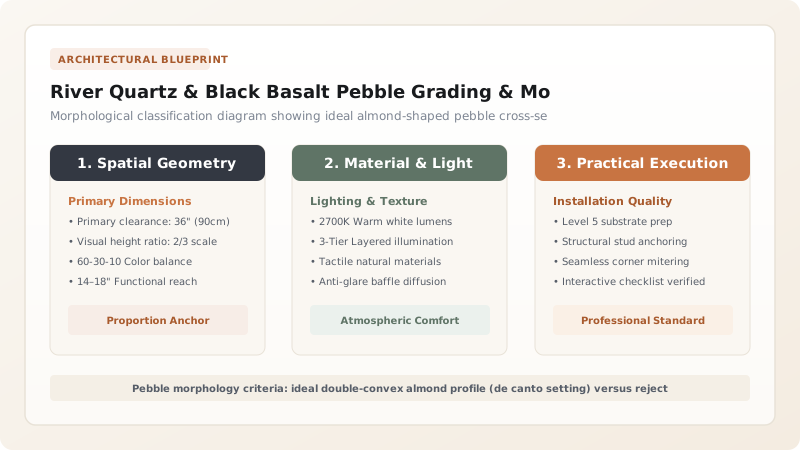
Beyond mineral type and color, the decisive factor in sorting is the three-dimensional geometric morphology of each stone. Traditional artisans classify river stones into three physical archetypes: spherical cobbles, flat discs (lajas), and almond-shaped ellipsoids (almendrillas). Spherical stones are immediately culled because they roll underfoot and cannot interlock; flat discs are rejected because they lack sufficient structural depth when set on edge.
The ideal empedrado stone is the almendrilla—a flattened, double-convex ellipsoid resembling an almond or pumpkin seed. This morphology exhibits an aspect ratio of roughly 2:1 length-to-width, with smooth, gently curved lateral flanks. When these almond stones are placed vertically on edge, their flat flanks align seamlessly against neighboring stones, creating continuous surface-to-surface mechanical friction that locks the entire pavement into a rigid, monolithic masonry carpet.
Dimensional Sizing and Caliper Quality Control
The final stage of preparation is rigorous dimensional calibration. An empedrado mosaic cannot achieve a flat, comfortable walking surface if pebble heights vary wildly. While modern projects utilize motorized rotary drum sieves with square mesh screens, historical master workshops sorted pebbles through series of perforated leather sheets and wooden sieves (cribas).
For master decorative medallions, rosettes, and heraldic emblems (empedrado fino), stones are sorted down to a strict tolerance of 25 mm to 35 mm in length and 12 mm to 16 mm in width. Larger stones (40 mm to 55 mm) are segregated for perimeter curbs, drainage gutters, and broad background fields. By establishing absolute dimensional uniformity within each design register, the artisan ensures that when the entire floor is tamped, the wooden beater strikes every stone with identical mechanical force, driving all crowns into a single, perfectly unified horizontal plane.
Empedrado Pebble Grading Categories & Dimensional Standards
Use this reference table to calculate exact physical dimensions, ratios, and specifications before purchasing:
| Grading Class | Length Range | Width Range | Thickness Range | Architectural Role |
|---|---|---|---|---|
| Clase Fina (Miniature) | 18 mm to 25 mm | 12 mm to 16 mm | 8 mm to 12 mm | Fine lettering, coats of arms, floral centers, and eyes |
| Clase Media (Standard) | 28 mm to 38 mm | 18 mm to 24 mm | 12 mm to 18 mm | Geometric field infill, repeating rosettes, and diamonds |
| Clase Gruesa (Structural) | 40 mm to 55 mm | 25 mm to 35 mm | 18 mm to 25 mm | Perimeter framing bands, perimeter curbs, and gutter channels |
| Clase Rústica (Heavy) | 55 mm to 80 mm | 35 mm to 50 mm | 25 mm to 40 mm | Driveways, carriage lanes, and heavy service courtyards |
Practical Constraints
Every successful decoration project must account for physical and environmental constraints:
Environmental Restrictions on Direct Riverbed Gravel Dredging
Modern ecological regulations prohibit uncontrolled gravel extraction from active Spanish riverbeds. Mitigation: Source raw materials from certified commercial alluvial floodplain quarries operating in historic river terrace zones.
Extremely High Rejection Rate During High-Precision Sorting
Up to 60% of raw river gravel fails morphological or color criteria, generating significant culled aggregate volume. Mitigation: Repurpose rejected non-uniform pebbles as sub-base drainage aggregate and foundation concrete ballast.
Execution Blueprint & Craftsmanship Sequence
Execute this professional sequence to achieve flawless results without backtracking:
Raw Alluvial Extraction and De-Silting
Extract raw river gravel from alluvial deposit terraces. Discharge gravel into a high-pressure rotary drum washer to scour away adhering clay colloids, organic mud, and iron oxide films.
Mechanical Multi-Deck Screening
Feed washed stones across three successive inclined vibrating screens with square mesh openings of 20 mm, 35 mm, and 50 mm to achieve preliminary dimensional fractionation.
Manual Chromatic Separation
Pass the sized fraction along an illuminated inspection belt. Sorters hand-pick stones into two primary batches: stark milky-white quartz and dense midnight-black basalt.
Mineralogical Integrity Testing
Inspect black stones for basaltic crystallinity. Discard friable carbonaceous shales, porous gray limestones, and sedimentary mudstones that show laminar micro-fractures.
Morphological Sieve Sorting (The Almond Profile)
Sort the stones by 3D shape factor. Retain only 'almond-shaped' (almendrilla) stones exhibiting smooth, double-convex elliptical profiles with flat lateral flanks suitable for edge-to-edge contact.
Caliper Calibration and Dimensional Culling
Use two-jaw go/no-go caliper gauges to verify length and depth parameters for high-precision master medallions, culling any stone that exceeds ±3 mm of target project specification.
Site Storage in Compartmentalized Bins
Transport sorted stones to the patio jobsite in dedicated moisture-free bins labeled by color and grade class, covering with tarpaulins to prevent dust contamination prior to setting.
Common Mistakes & Countermeasures
Avoid these costly errors that compromise aesthetics, ergonomics, and budget:
Accepting sedimentary shale or laminated slate pebbles in the black stone mix
Mixing disparate pebble lengths within the same geometric motif register
Using crushed angular gravel rather than genuine water-tumbled river pebbles
Project Execution Checklist
Track your physical progress. Checkboxes persist automatically on this device:
Frequently Asked Questions
Why are almond-shaped (almendrilla) pebbles considered ideal?
The almond-shaped pebble has an elliptical cross-section with two relatively flat parallel flanks and a rounded top crown. When set vertically on edge, the flat flanks allow neighboring stones to rest tightly against each other with maximum surface contact, creating a solid stone-to-stone friction lock that resists lateral rotation under foot pressure.
What gives the black basalt pebbles their deep color?
The black pebbles are igneous volcanic rocks (basalt or dolerite) rich in iron and magnesium silicates, pyroxenes, and magnetite. Unlike sedimentary stones that fade to dull gray when dry, high-density basalt retains an intense, dark charcoal or obsidian hue that deepens to glossy jet-black when wetted during evening patio watering.
How do artisans ensure white quartz pebbles do not yellow over time?
Artisans cull any quartz pebble exhibiting yellow, brown, or reddish veins. These discolored veins indicate iron oxide (rust) inclusions that will oxidize further when exposed to ambient moisture and lime, causing unsightly staining. Only pure, milky-white metamorphic vein quartz with zero mineral inclusions is selected for master mosaics.