Traditional Cordoban Empedrado (empedrado cordobes) is a world-renowned Andalusian architectural pavement tradition that transforms courtyard patios into elaborate, walkable stone carpets. Developed in Cordoba across Roman, Moorish, and Renaissance eras, this vernacular masonry craft utilizes smooth, water-worn fluvial pebbles gathered from the Guadalquivir River basin. By sorting white quartz and black basalt stones and setting them strictly on edge (de canto) into a dry lime-sand bedding matrix, artisans create complex geometric, heraldic, and floral tapestries. Tamp-compacted with wooden beaters and grouted with slaked lime slurry, empedrado pavements deliver exceptional compressive durability, natural permeability, and evaporative cooling when hosed with water (el riego).
At a Glance: Key Takeaways
- Artisan Heritage: Cordoba & Andalusia, Spain (Roman-Moorish to Baroque Continuity)
- Primary Aggregates: Fluvial Quartz (Blanco) & Basalt/Dolerite (Negro) River Pebbles
- Setting Orientation: De Canto (Vertically on Edge for Maximum Compressive Interlock)
- Bedding & Grout: Hydraulic Lime (NHL 3.5 / 5) & Washed Silica Sand Slurry
- Thermal Role: Evaporative Cooling Reservoir for Andalusian Courtyard Patios
In-Depth Guides in this Directory
Explore specialized subtopic blueprints, technical dimensions, and execution checklists:
River Quartz & Black Basalt Pebble Grading & Morphological Sorting
Technical manual on sourcing, sieving, grading, and sorting river quartz and basalt pebbles for Cordoban empedrado mosaic paving.
Dry Sand-Lime Edge Setting & Wooden Block Tamping Techniques
Comprehensive technical guide to dry sand-lime bedding, vertical edge setting (de canto), and wooden block tamping in Cordoban empedrado paving.
Slaked-Lime Slurry Grouting & Acid-Wash Burnishing Finishing
Technical manual on slaked-lime slurry grouting, hydration curing, and acid-wash burnishing for traditional Cordoban empedrado pebble mosaics.
Historical Provenance and the Cordoban Courtyard Patio Culture
In the historic heart of Córdoba, Andalusia, domestic architecture is organized around the sacred sanctuary of the casa-patio (courtyard house). Inscribed on the UNESCO Representative List of the Intangible Cultural Heritage of Humanity, the Cordoban patio is an urban oasis designed to buffer inhabitants against the blistering summer temperatures of the Guadalquivir River valley. Central to the architectural identity, microclimatic performance, and visual splendor of these courtyards is the ancient art of the empedrado cordobés—a masterwork of decorative stone carpet paving.
Arising from Roman opus barbaricum floor traditions, refined under the Umayyad Caliphate of Córdoba (where pebble courtyards adorned the Great Mosque and Madinat al-Zahra), and perfected during the Spanish Renaissance, empedrado is a living craft. Master masons transformed ordinary river cobbles into breathtaking, high-contrast monochrome tapestries. Featuring complex geometric interlaces, eight-pointed Islamic stars, heraldic crests, and classical scrollwork, empedrado elevates humble geology into monumental architectural floor art.
Material Geology: Fluvial Quartz, Basalt, and Hydraulic Lime
The authentic material palette of Cordoban empedrado is strictly geologic and local. For centuries, artisans sourced their aggregates directly from the gravel bars and sandbanks of the Guadalquivir River. Over millennia, continuous hydraulic tumbling had polished these river stones into smooth, flattened ellipsoids (known as chinos peladillas or cantos rodados), completely stripping away friable outer rinds and leaving behind ultra-dense, non-porous stone cores.
The chromatic palette is uncompromisingly binary: brilliant milk-white stones derived from metamorphic river quartz (cuarzo blanco) provide luminous reflectivity, while deep charcoal-black and blue-gray stones cleaved from volcanic basalt and dolerite (basalto negro) supply deep visual contrast. These stones are bedded not in modern Portland cement, but in a traditional matrix of natural hydraulic lime (NHL 3.5) and washed silica sand. This lime-based binder provides vital mechanical elasticity, allowing the paved floor to absorb thermal expansion and minor soil settlements without cracking.
The De Canto Technique: Engineering Compressive Interlock
The defining structural characteristic of authentic Cordoban empedrado is the de canto (on edge) setting technique. While naive contemporary imitations lay flat river stones like stepping stones, traditional Andalusian artisans orient every single pebble vertically on its narrow edge. This vertical orientation requires three to four times more stones per square meter, but it fundamentally alters the physics of the pavement.
When set on edge, more than two-thirds of the pebble's physical height is embedded deep within the semi-dry sand-lime bedding layer. The stones are packed so tightly that their flanks touch in continuous compression, creating a self-locking masonry arch effect across the horizontal floor plane. When heavy loads (such as horses, carriages, or heavy courtyard planter pots) pass overhead, compressive forces are distributed vertically through the dense stone cores and transferred directly into the aggregate sub-base, preventing stone dislodgement and eliminating surface shearing.
Microclimatic Function: El Riego and Evaporative Cooling
Beyond its decorative elegance, empedrado cordobés is an active environmental cooling apparatus. In the intense heat of Andalusian summers, when exterior street temperatures exceed 42°C, Cordoban families perform the evening ritual of el riego: washing down the courtyard walls, hanging potted geraniums, and pebble-paved floors with buckets or hoses of water.
Because the slaked lime grout and compacted sand bed remain microporous, the empedrado pavement behaves like an expansive ceramic sponge. The mortar absorbs a calibrated reservoir of water into its capillaries without forming standing surface puddles. As nocturnal breezes circulate through the shaded patio, the moisture evaporates, absorbing sensible atmospheric heat and triggering an immediate temperature drop of 8°C to 12°C. The dense quartz and basalt pebbles remain cold to the touch well into the following afternoon, functioning as a radiant thermal cooling slab that conditions the surrounding domestic chambers entirely through passive physics.
Andalusian Empedrado Typologies & Technical Specifications
Use this reference table to calculate exact physical dimensions, ratios, and specifications before purchasing:
| Empedrado Typology | Pebble Selection | Setting Pattern | Structural Depth | Recommended Architectural Space |
|---|---|---|---|---|
| Empedrado Fino Cordobes | Hand-calibrated 20–35 mm select quartz & basalt | Fine geometric rosettes, diamonds, and heraldry | 180 mm total depth | Main entrance zaguán, central fountain surrounds, and arcades |
| Empedrado Rustico / Espiga | Mixed 35–60 mm grey quartzite and river cobbles | Herringbone (espiga) and diagonal chevron bands | 220 mm total depth | Spacious patio service lanes, carriage drives, and stable yards |
| Empedrado Granadino | Bicolor pebbles combined with terracotta brick bands | Polychromatic Moorish knots and pomegranate motifs | 200 mm total depth | Terraced garden courtyards, miradors, and fountain steps |
| Empedrado de Riego | High-porosity rounded river stones with open joints | Interlocking circular swags for water drainage | 250 mm permeable bed | Outdoor courtyard zones dedicated to nightly hose watering (riego) |
Practical Constraints
Every successful decoration project must account for physical and environmental constraints:
Labor-Intensive Manual Sorting and Hand-Setting of Thousands of Stones
Pebble mosaic installation is slow (typically 0.5 to 1.0 square meters per artisan day), requiring high labor allocation. Mitigation: Pre-sort pebbles into graded bins off-site and assemble intricate centerpieces on mesh transfer panels.
Algae and Moss Growth in Constantly Moist, Shaded Courtyard Corners
Organic slime can render polished quartz surfaces slippery underfoot in wet winter months. Mitigation: Ensure a minimum 1.5% patio surface drainage slope toward central drains and apply annual biological wash treatments.
Execution Blueprint & Craftsmanship Sequence
Execute this professional sequence to achieve flawless results without backtracking:
Subgrade Excavation and Compaction
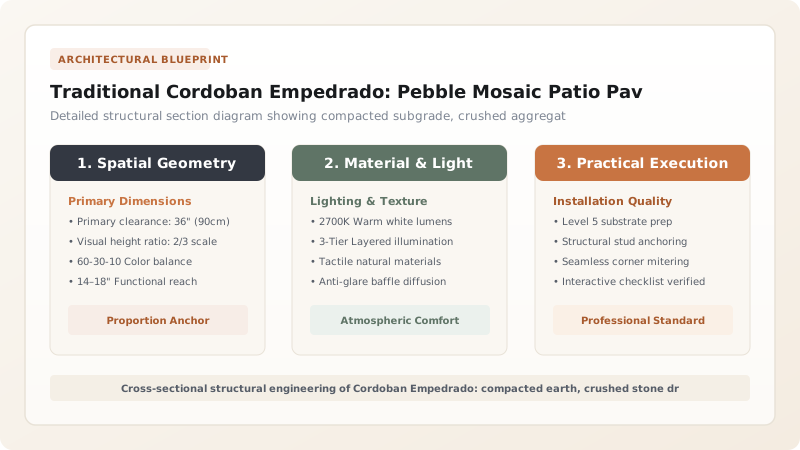
Excavate the courtyard patio subgrade to a uniform depth of 220 mm below finished floor level. Compact the native subsoil thoroughly using a mechanical tamper to achieve 95% standard Proctor density.
Permeable Crushed Stone Sub-Base Installation
Install a 100 mm layer of graded crushed limestone aggregate (size 20–30 mm). Compact and grade to establish a 1.5% fall toward patio drainage sumps or central fountain channels.
Fluvial Pebble Sizing and Color Sorting
Wash raw Guadalquivir river stones. Sieve pebbles through calibrated grading screens, sorting into uniform 25–40 mm size classes and separating pure white quartz from deep charcoal-black basalt.
Dry Sand-Lime Bedding Layer Distribution
Spread a 60 mm thick layer of semi-dry bedding mortar formulated with 1 part Natural Hydraulic Lime (NHL 3.5) and 3 parts sharp washed river sand. Screed flat without compacting.
Pattern Layout and Edge-Setting (De Canto)
Trace full-scale geometric patterns onto the dry bed. Press pebbles vertically on edge (de canto) into the sand-lime matrix, placing stones touching flank-to-flank along design contours.
Wooden Block Tamping (Apisonado)
Lay a heavy, flat oak tamping board (pison) over the standing pebbles. Strike the board rhythmically with a wooden mallet, driving the pebbles uniformly into the bed until tops align in a flawless plane.
Slaked Lime Slurry Grouting
Mix a fluid slurry of slaked lime putty (cal en pasta) and fine marble flour. Pour over the patio, sweeping the liquid into all interstitial voids with a soft broom until joints are completely filled.
Acid-Wash Burnishing and Sealing
Allow lime grout to cure for 48 hours. Wash the surface with a dilute 5% sulfamic or citric acid wash to dissolve the white lime haze from pebble crowns, exposing the glistening polished stones.
Common Mistakes & Countermeasures
Avoid these costly errors that compromise aesthetics, ergonomics, and budget:
Setting pebbles flat (de plano) rather than vertically on edge (de canto)
Using modern Portland cement mortar for setting and grouting Andalusian pebble mosaics
Tamping pebbles directly with a steel sledgehammer or mechanical vibrating plate
Project Execution Checklist
Track your physical progress. Checkboxes persist automatically on this device:
Frequently Asked Questions
Why must pebbles be set on edge (de canto) rather than flat?
Setting pebbles vertically on edge provides structural depth and superior frictional interlock. When a pebble is oriented on edge, over 60% of its body is embedded within the hydraulic lime bed, while only its narrow top crown is exposed. This prevents the stone from pivoting, dislodging, or shearing under heavy foot traffic or rolling wheeled loads, ensuring a lifespan of centuries.
How does an empedrado patio contribute to cooling Andalusian homes?
In Cordoba, where summer temperatures regularly reach 40°C to 45°C, courtyard patios are hosed down with water every evening—a ritual known as 'el riego.' The porous lime grout and permeable pebble bed absorb water without puddling. As dry desert air moves across the patio, the moisture evaporates rapidly, cooling the courtyard floor and dropping ambient air temperatures by 8°C to 12°C.
What is the difference between Cordoban and Granadan empedrado?
Cordoban empedrado (empedrado cordobes) is celebrated for its dense, rigorous, two-tone geometric precision, utilizing strictly white quartz and black basalt stones laid in tight, razor-sharp diamonds, rosettes, and linear borders. Granadan empedrado (empedrado granadino) frequently incorporates bands of terracotta clay floor tiles (olambrillas) to divide stone panels and features more fluid, botanical motifs like pomegranates and scrolling leaves.
How are broken or loose pebbles restored in historic patios?
Restoration requires matching the geological origin, size, and elliptical curvature of the surrounding stones. Conservators excavate the deteriorated lime bed around the missing stone, vacuum debris, damp the void, and bed a new pebble into a fresh hydraulic lime (NHL 3.5) mortar, tapping it level with the existing surface and grouting with matching lime-marble slurry.