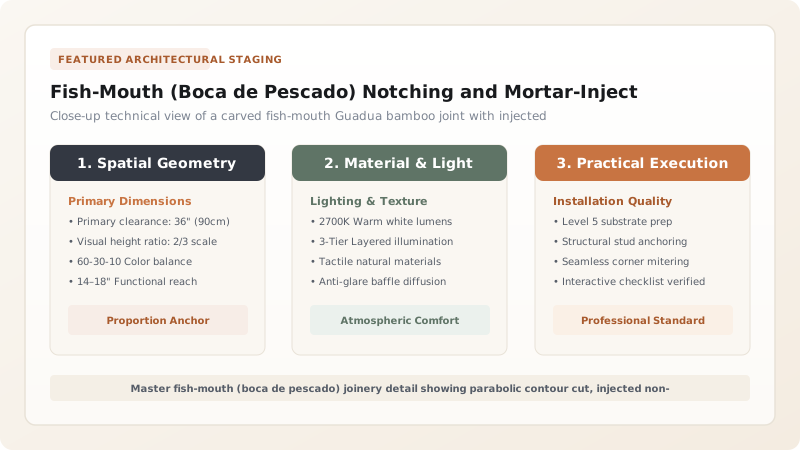
Fish-mouth notching (boca de pescado) is the foundational connection technique used to join intersecting round Guadua bamboo culms at 90-degree and 45-degree angles. A parabolic saddle is precisely carved into the end of a bamboo beam using gouge chisels or hole saws to match the cylindrical curvature of the mating column. To prevent crushing of the hollow bamboo wall and to transfer high tension and shear forces, a threaded steel dowel is installed through the joint, and the hollow internode chamber is completely filled with high-fluidity sand-cement injection mortar, creating an artificial solid composite node capable of bearing immense structural loads.
At a Glance: Key Takeaways
- Joint Name: Boca de Pescado (Fish-Mouth / Saddle Cope)
- Intersection Angles: 90° (T-joints) and 45° to 60° (diagonal braces)
- Mortar Mix Ratio: 1:2 (Portland cement to clean washed fine sand)
- Mortar Fluidity: Pourable grout with superplasticizer (zero bleed)
- Connector Hardware: Grade 5 / ASTM A307 galvanized threaded rod (1/2" to 5/8")
The Mechanical Challenge of Joining Hollow Cylinders
In structural engineering, joining tubular members has always presented formidable geometric and mechanical challenges. When building with cylindrical timber or steel pipes, welders and carpenters must shape complex saddle copes to achieve full-perimeter contact. With Guadua angustifolia, the problem is intensified: the material is hollow, thin-walled (typically 12 mm to 20 mm thick), anisotropic, and brittle under perpendicular point compression. Simply drilling a hole through a hollow bamboo stalk and torquing a steel bolt through it creates intense point-bearing stresses that inevitably split the culm along its longitudinal cleavage planes.
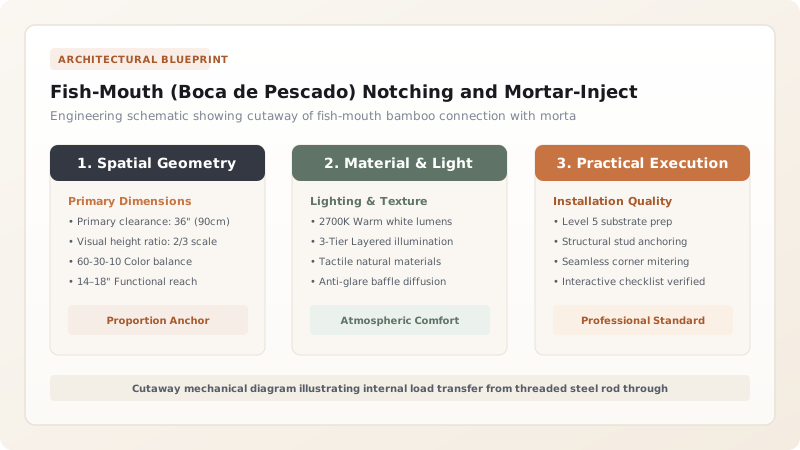
To overcome this inherent limitation, Colombian master builders and engineers developed the boca de pescado (fish-mouth) connection coupled with internal mortar injection. This hybrid joint transforms the vulnerable hollow bamboo end into a solid, reinforced composite socket. The fish-mouth cut provides 360-degree perimeter contact that distributes compressive gravity loads across the entire circumference of the receiving column, while the internal mortar plug absorbs the concentrated bearing forces of the steel tension rod, transferring stress smoothly into the culm wall through interface friction.
Geometry and Layout of the Parabolic Fish-Mouth Saddle
The geometry of an authentic fish-mouth joint is an intersection between two cylinders. When a circular cylinder of diameter D1 intersects another cylinder of diameter D2 at a 90-degree angle, the resulting intersection curve is not circular; it forms a 3D saddle curve characterized by two symmetrical parabolic peaks and two valleys. If the intersection angle is diagonal (such as a 45-degree knee brace), the intersection curve elongates into a complex asymmetric ellipse.
Achieving a zero-tolerance fit requires meticulous craftsmanship. Master carpenters layout the cut by snapping reference centerlines along the culm, transferring the column diameter using curved contour gauges, and cutting the profile with curved gouges, coping saws, or specialized hole-saw jigs. A loose or poorly fitted fish-mouth joint concentrates all compressive loads onto the tips of the saddle cheeks, inducing localized bending stresses that will shear off the bamboo fibers under dynamic live loading.
Internal Mortar Injection: Engineering the Artificial Node
The true structural breakthrough in modern Colombian bamboo architecture—formalized into standard practice during the reconstruction of the Coffee Axis following the 1999 earthquake—is the injection of a fluid cementitious core into the connection internode. This technique effectively converts the hollow culm chamber into an artificial solid node. Before mortar is pumped, a 1/2-inch or 5/8-inch threaded galvanized steel rod is passed transversely through the joint, fitted with heavy square plate washers that distribute tension across the bamboo exterior.
A fluid, non-shrink micro-concrete (composed of 1 part Portland cement, 2 parts washed fine silica sand, and polycarboxylate superplasticizers) is then injected under low pressure through a port drilled in the upper surface of the culm. The mortar flows effortlessly around the steel rod, filling every microscopic crevice up to the natural nodal septum. Once cured, the mortar plug prevents the bamboo walls from collapsing inward under washer pressure and prevents the steel rod from bending or ovalizing the bolt holes under violent seismic shear cycles.
Performance Under Cyclic Dynamic Loading and Seismic Shear
Extensive full-scale laboratory testing conducted at the Universidad de los Andes in Bogotá and international testing facilities has proven the remarkable structural capacity of mortar-injected fish-mouth joinery. Under monotonic tensile loading, an un-injected bolted bamboo joint fails catastrophically at loads as low as 2 to 4 kN due to longitudinal fiber cleavage. In contrast, an identical joint reinforced with an injected mortar core routinely achieves tensile capacities between 15 and 28 kN—a five- to seven-fold increase in structural capacity.
Furthermore, during cyclic reverse loading simulating severe earthquake ground motion, the mortar plug displays high ductility. Rather than suffering sudden brittle cleavage, the connection dissipates energy through micro-frictional slippage along the interface between the cured mortar plug and the textured internal bamboo wall. The ductile steel threaded rod yields progressively, absorbing tremendous seismic energy and providing the visible and audible warning signs required by modern structural life-safety codes before ultimate structural failure.
Bamboo Jointing Methodologies: Injected Fish-Mouth vs Pinned Through-Joint vs Metal Band Collars
Use this reference table to calculate exact physical dimensions, ratios, and specifications before purchasing:
| Performance Factor | Mortar-Injected Fish-Mouth (Boca de Pescado) | Un-injected Bolted Pin Joint | External Steel Clamping Collar |
|---|---|---|---|
| Allowable Tensile Load Capacity | Very High (15–28 kN); steel dowel transfers load directly to cast-in-place mortar plug | Extremely Low (2–4 kN); pin crushes bamboo wall and induces fatal longitudinal splitting | Moderate to High (10–18 kN); relies on friction clamping along culm exterior |
| Compressive Bearing Transfer | 100% Perimeter Contact; coped saddle bears continuously on receiving culm | Point Contact Only; high risk of crushing and localized indentation | Distributed Clamp Contact; effective but prone to slipping under wet-dry culm shrinkage |
| Seismic Energy Dissipation | High; ductile yielding of internal threaded rod combined with micro-frictional mortar interface | Dangerous; brittle shear failure through bamboo wall fibers | Moderate; friction slip provides damping but requires frequent retorquing |
| Aesthetic Integration | Seamless and Traditional; hardware is concealed inside the natural culm geometry | Visible protruding bolt heads and unrefined gaps | Industrial; visible heavy exterior metal collars disrupt organic vernacular look |
| Labor and Tooling Intensity | High; requires custom contour carving, dowel alignment, and grout pumping equipment | Low; simple hand drilling and bolt insertion | Moderate; requires custom-fabricated steel hardware and torquing wrenches |
Practical Constraints
Every successful decoration project must account for physical and environmental constraints:
Volumetric Shrinkage of Bamboo During In-Service Curing
As green or semi-dry Guadua loses equilibrium moisture, culm diameters shrink by 3% to 5%, creating looseness around hardened mortar plugs. Mitigation: Use only fully seasoned culms with moisture content below 15% and formulate injection grout with non-shrink expansive cement admixtures.
Clogging of Mortar Injection Funnels Inside Narrow Bamboo Chambers
Aggregate bridging blocks grout flow before the cavity around the threaded dowel is completely encapsulated. Mitigation: Screen fine sand through a No. 16 sieve (1.18 mm maximum aggregate size) and tap the bamboo culm exterior with a rubber mallet during pouring to release entrapped air.
Execution Blueprint & Craftsmanship Sequence
Execute this professional sequence to achieve flawless results without backtracking:
Joint Geometry Layout and Scribe Marking
Position the intersecting Guadua culm at the specified design angle (90° for horizontal beams, 45° for diagonal knee braces). Use an adjustable contour gauge or a heavy cardstock template to scribe the exact elliptical curve of the receiving column onto the cut end of the beam.
Rough Cutting the Fish-Mouth Saddle
Make two relief cuts into the bamboo end using a fine-toothed Japanese pull saw or coping saw. Cut away the opposing parabolic cheeks to rough-in the saddle, taking care not to splinter the delicate outer silica-rich cuticle layer of the culm.
Precision Rasping for Perimeter Fit
Refine the concave saddle profile using a half-round wood rasp and coarse 60-grit abrasive paper. Test-fit the coped beam against the receiving column repeatedly until zero light passes through the joint perimeter under hand pressure.
Drilling Through-Dowel Clearance Holes
Clamp the mated joint securely. Using an extra-long brad-point drill bit, bore a clean 14 mm hole through both walls of the coped beam and directly through the center diameter of the receiving column, locating the hole within 50 mm of a solid internal nodal septum.
Inserting Hardware and Setting Temporary Spacers
Thread a 1/2-inch (12.7 mm) hot-dipped galvanized steel rod through the aligned holes. Install 50 mm square structural washers and nuts on both ends, snugging them gently by hand without crushing the hollow bamboo casing.
Boring Grout Injection and Breather Ports
Drill a 20 mm diameter injection port through the top face of the horizontal beam internode, positioned 50 mm back from the fish-mouth cope. Drill a secondary 6 mm breather hole on the underside or far edge of the chamber to permit trapped air to vent during grout placement.
Mortar Preparation and Chamber Pumping
Mix an injection grout of 1 part Type I Portland cement to 2 parts fine silica sand, adding water and a superplasticizing admixture to achieve a thick cream consistency. Funnel or pump the fluid grout into the injection port until it discharges continuously from the breather hole.
Moist Curing and Final Torque Calibration
Seal the injection port with a damp cloth plug and allow the internal mortar core to hydrate undisturbed for 14 days. Once the grout achieves a minimum compressive strength of 20 MPa, use a calibrated torque wrench to tighten the exterior nuts to 35 Nm, permanently locking the joint.
Common Mistakes & Countermeasures
Avoid these costly errors that compromise aesthetics, ergonomics, and budget:
Over-tightening connection nuts before injecting and curing the internal mortar plug
Using dry or standard stiff masonry mortar for the internode injection
Cutting the fish-mouth cope far away from a natural nodal diaphragm
Project Execution Checklist
Track your physical progress. Checkboxes persist automatically on this device:
Frequently Asked Questions
Why is it called 'boca de pescado' (fish-mouth)?
The term comes from the visual appearance of the carved bamboo end. When the opposing curved notches are cut into the cylindrical hollow culm to fit over another round culm, the two pointed cheeks and open hollow center strongly resemble the open jaws of a fish.
Can non-shrink grout be substituted with standard sand-cement mortar?
Standard sand-cement mortar contracts slightly during hydration curing, which can cause it to pull away from the internal bamboo walls and loosen its grip on the threaded steel rod. Using non-shrink structural grout or adding an expansive admixture (such as aluminium powder or specialized shrinkage-compensating agents) ensures the mortar plug expands slightly, locking tightly against the micro-ridges of the bamboo interior.
How many internodes should be filled with mortar at a connection?
Typically, only the single internode chamber directly housing the structural steel dowel is injected with mortar (extending from the joint cut to the nearest internal nodal diaphragm). Injecting multiple adjacent internodes is unnecessary, adds excessive dead weight to the roof frame, and reduces the natural seismic flexibility of the bamboo structure.
What tools are used to cut accurate fish-mouth joints quickly on construction sites?
While traditional carpenters carve fish-mouth saddles using curved hand gouges and rasps, modern bamboo fabrication workshops utilize drill-press-mounted hole saws (bi-metal hole cutters matched to the receiving culm's diameter) mounted on angled jigs, enabling precise saddles to be cut in seconds with microscopic tolerances.