
Cantonese opera figurines on Shekwan roof ridges bring Chinese theatrical mythology into architectural space. Sculpted with exaggerated facial expressions, sweeping operatic sleeves, and historical armor, each figure is hollow-built to withstand kiln firing. The master artisan applies deliberate perspective adjustments—enlarging the head and angling the torso downward—so ground spectators see lifelike, heroic proportions. The finished sculptures are fired in traditional climbing dragon kilns, where wood stoking schedules create intense chromatic variations.
At a Glance: Key Takeaways
- Firing Fuel: Split aged red pine branches (high resin content)
- Kiln Structure: Climbing Dragon Kiln (Longyao, 40–60m long on 15° slope)
- Operatic Roles: Sheng (Scholars/Generals), Dan (Heroines), Jing (Painted Faces), Chou (Clowns)
- Optical Compensation: 10° to 15° forward tilt; 1.15x head proportion multiplier
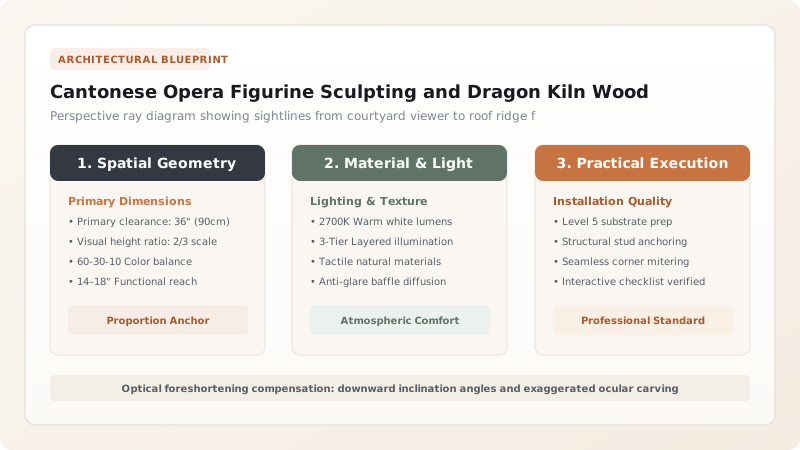
Cantonese Operatic Iconography and Role Archetypes
The sculptural repertoire of Shekwan roof ridges directly mirrors the costumes, gestures, and moral codes of classical Cantonese opera (Yueju). The narrative bands feature celebrated scenes such as 'General Guo Ziyi’s Banquet', 'The Legend of the White Snake', and the heroic defense of borders from the Song Dynasty.
Characters are divided into strict operatic role types: the Wen Sheng (civilian scholar) with flowing robes and restrained gestures; the Wu Sheng (military general) adorned with pheasant feathers, layered dragon breastplates, and four battle flags (kao); the Dan (female heroine) with delicate floral hairpins; and the Jing (painted face) displaying bold, ferocious facial paint symbolizing martial valor or cunning.
Optical Engineering: Raking Sightlines and Downward Inclination
A sculpture designed for eye-level viewing in a gallery appears deformed, squat, and emotionless when mounted atop a temple roof 10 meters overhead. Shekwan sculptors mastered sophisticated optical corrections centuries before modern ergonomics codified anamorphic perspective.
To overcome severe vertical perspective compression, artisans increase the head-to-body ratio from the natural 1:7 to an emphatic 1:5. The eye sockets are carved 30% deeper to cast sharp shadows under bright tropical sunlight, while the neck and chest are pinned at a forward tilt of 12 to 15 degrees, directing the character’s gaze straight down into the eyes of worshipers in the central courtyard.
Dragon Kiln Architecture and Wood-Firing Choreography
The Foshan dragon kiln represents an ingenious thermodynamic engine. Built from refractory brick along a natural hillside slope of 12 to 18 degrees, the kiln acts as its own chimney. The thermal draft naturally pulls combustion gases up through the tunnel, preheating unfired wares ahead of the flame front.
Firing is an athletic, non-stop 48-hour endurance test. Teams of stakers feed bundles of split Masson pine wood through small side stokeholes (touhuoyan) spaced along the kiln roof. As the fire advances up the hill, the temperature is judged purely by the color of the glowing ceramics and the translucency of the flame, cycling between bright orange oxidation and smoky gray-white reduction.
The Bisque Flesh Aesthetic: Glazed Raiment vs Matte Skin
The quintessential technical hallmark of Shekwan figurative sculpture is the selective resist technique. While robes, armor, clouds, and architectural pavilions are thickly coated in high-gloss crystalline glazes, the facial skin, ears, and expressive hands are left completely unglazed.
During firing, the natural iron-rich stoneware body vitrifies to produce a soft, warm satin-matte terracotta surface that uncannily mimics living human flesh. This dramatic textural juxtaposition between glossy vitrified glazes and warm, matte facial planes gives Shekwan opera figurines their arresting emotional realism.
Figurine Sculptural Proportion & Viewing Geometry
Use this reference table to calculate exact physical dimensions, ratios, and specifications before purchasing:
| Roof Mounting Height | Sightline Distance | Forward Tilt Angle | Head-to-Body Ratio | Eye Carving Depth |
|---|---|---|---|---|
| Low Eave Ridge (5m – 7m) | 6m – 8m courtyard | 8° to 10° tilt | 1 : 6.0 proportion | 6mm undercut depth |
| Main Temple Ridge (8m – 11m) | 10m – 15m courtyard | 12° to 15° tilt | 1 : 5.0 proportion | 9mm undercut depth |
| Grand Ancestral Hall (12m – 15m) | 18m – 25m courtyard | 16° to 20° tilt | 1 : 4.5 proportion | 12mm undercut depth |
| Lateral Gable Crest (Wen-Zao) | Close side alleys | 5° downward tilt | 1 : 6.5 proportion | 5mm undercut depth |
Practical Constraints
Every successful decoration project must account for physical and environmental constraints:
Kiln Atmosphere Fluctuations During Tropical Rainstorms
Heavy rain cools dragon kiln roofs suddenly, altering internal draft pressures and demanding instant counter-stoking to avoid thermal shock.
Long Production Cycles for Custom Temple Restorations
Sculpting, slow air-drying, glazing, and wood-firing of a complete 20-meter theatrical ridge requires 6 to 12 months of atelier production.
Execution Blueprint & Craftsmanship Sequence
Execute this professional sequence to achieve flawless results without backtracking:
Character Conception and Wire-Free Armature
Establish the operatic scene; sculpt a hollow conical clay plinth that acts as structural support without internal metal wires that would melt in the kiln.
Anatomical Building and Perspective Pitching
Model the torso and limbs with hollow clay slabs, angling the head and chest forward by 15 degrees to calibrate viewing angles from the ground.
Costume Drapery and High-Relief Tooling
Roll thin clay sheets to drape realistic opera sleeves (shui xiu) and helmet crests, tooling fine dragon scales and brocade trims with boxwood gouges.
Wax Resist Coating on Facial Planes
Paint molten beeswax over the face, neck, and hands to repel liquid glazes during ladle application, ensuring flesh areas remain unglazed bisque.
Kiln Loading and Sagger Stacking
Place finished figures inside refractory fireclay saggers (chahu) or open kiln shelves, orienting faces away from direct pine wood ash fly-ash blasts.
48-Hour Stoking Schedule and Slow Annealing
Stoke pine wood progressively up the dragon kiln slope to 1220°C; seal all dampers and stoke ports, allowing the kiln to cool over 72 hours.
Common Mistakes & Countermeasures
Avoid these costly errors that compromise aesthetics, ergonomics, and budget:
Leaving Enclosed Air Pockets Inside Sculpted Heads or Torso
Modeling Heads in Standard 1:7 Academic Ratios
Project Execution Checklist
Track your physical progress. Checkboxes persist automatically on this device:
Frequently Asked Questions
Why are metal armatures never used inside clay figurines before firing?
Stoneware must be fired to 1200°C, a temperature at which steel, copper, and iron melt or severely deform, while ceramic shrinks by 8% to 12%. Any internal metal skeleton would expand, rupturing the clay body into fragments.
How do artisans achieve the delicate flowing look of opera sleeves (shui xiu) in rigid clay?
Master sculptors use aged clay formulated with high plasticity, rolling thin uniform ribbons and supporting them with temporary dried clay crutches that burn out or fall away during initial firing stages.


