
Lingnan Shekwan pottery roof ridges (Shiwan Waji / 瓦脊) are monumental polychrome stoneware crestings crowning ancestral halls, Cantonese temples, and lineage shrines across Guangdong, Hong Kong, Macau, and Southeast Asia. Originating during the Ming and Qing dynasties, these glazed ceramic installations depict dramatic scenes from Cantonese opera, celestial deities, and auspicious beasts. Engineered to survive subtropical monsoons and typhoons, Shekwan ridges combine high-fire iron-rich stoneware bodies, flowing wood-ash glazes, interlocking hollow-cavity ceramic modules, and concealed iron-wire anchoring rods bolted through timber roof purlins.
At a Glance: Key Takeaways
- Anchorage System: Continuous internal wrought-iron tie rods & copper strapping
- Clay Body: Iron-rich semi-stoneware clay from Shiwan (Foshan)
- Firing Technology: Long wood-fired dragon kilns (1180°C–1240°C)
- Glaze Type: High-alkaline wood ash & copper/cobalt reduction glazes
In-Depth Guides in this Directory
Explore specialized subtopic blueprints, technical dimensions, and execution checklists:
Shekwan Stoneware Clay Mineralogy and High-Fire Wood-Ash Glazes
Technical analysis of Shiwan semi-stoneware clay mineralogy, natural wood-ash flux formulations, and copper/iron reduction glazes for architectural ceramic ridges.
Cantonese Opera Figurine Sculpting and Dragon Kiln Wood Firing
Master artisan guide to sculpting Cantonese operatic figurines, dramatic facial modeling, perspective foreshortening, and dragon kiln wood-firing choreography.
Typhoon-Resistant Iron Wire Anchorage and Ridge Cresting Joinery
Structural installation handbook on typhoon-resistant mounting, wrought-iron internal spine tie rods, copper straps, and oyster-shell mortar joinery for Shekwan ridges.
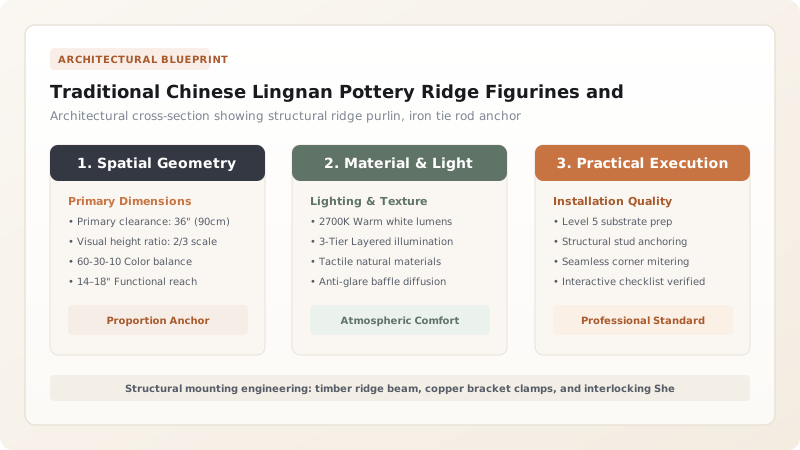
Architectural Significance and Narrative Theaters of Shekwan Roof Ridges
In traditional Lingnan architecture—the distinctive vernacular idiom of southern China's Pearl River Delta—the roofline serves as the ultimate communal stage. Unlike northern Chinese imperial yellow glazed roofs that emphasized hierarchical uniformity, southern ancestral shrines and temple associations competed in dramatic visual opulence through Shiwan Waji (glazed ceramic roof ridges).
These monumental crestings, often stretching 15 to 30 meters along the main roof ridge (zhengji), function as elevated horizontal narrative scrolls. Placed 8 to 12 meters above the courtyard, dynamic high-relief ceramic figurines enact popular Cantonese operas, legendary battle sagas (such as The Romance of the Three Kingdoms), and auspicious mythological protections (dragons, phoenixes, and carps transforming into dragons), providing civic storytelling visible from the ground.
Material Science: Iron-Rich Clays and Dragon Kiln Pyrotechnology
The unique durability of Shekwan pottery derives from the geologic deposits around Dongping River in Foshan. The raw body combines plastic, iron-stained red sedimentary clays with weathered pegmatitic kaolin and river silts. When fired to stoneware temperatures (1180°C to 1240°C), this matrix forms abundant mullite and cristobalite crystals, conferring exceptional mechanical strength and thermal shock resilience.
Firing historically occurred in colossal Dragon Kilns (Longyao)—sloping brick tunnels up to 60 meters in length climbing natural hillside gradients. Fueled by dense local pine wood, the variable reducing and oxidizing atmospheres within the kiln produced the famed 'jun-type' transmuted glazes (yaobian), featuring thick dripping pools of pomegranate red, peacock green, deep cobalt blue, and iron yellow.
Sculptural Engineering: Hollow-Core Modeling and Slip Assembly
Shekwan figurines and architectural panels are never solid. Solid clay masses would crack explosively during rapid moisture expulsion in the kiln and overload the timber roof framing with unsupportable dead weight. Sculptors build each figurine and pavilion hollow, maintaining a strictly uniform wall thickness between 12mm and 18mm.
Figures are sculpted with expressive, exaggerated facial grimaces, tilted forward at a 15-degree down-angle so ground-level viewers perceive natural proportions without foreshortening distortion. Individual elements are slab-built, press-molded, and hand-tooled before being joined using sticky deflocculated slip, creating interconnected ceramic chambers that promote free hot gas circulation during firing.
Typhoon Anchorage, Seismic Stabilization, and In Situ Conservation
Coastal Guangdong and Hong Kong face seasonal Category 4 and 5 typhoons with wind gusts exceeding 240 km/h. To prevent catastrophic wind uplift, Shekwan ridges utilize a dual-anchoring engineering system. The bottom ridge tiles form an inverted U-channel locked directly over the clay roof tiles with hydraulic oyster-shell lime mortar.
Simultaneously, a continuous wrought-iron or marine-grade 316 stainless steel spine rod runs horizontally through pre-cast hollow sleeves within each ceramic module. Vertical non-ferrous tie rods clamp this horizontal spine directly into the heavy structural pine timber ridge purlin below, distributing hurricane wind-drag across the entire building frame.
Shekwan Roof Ridge Component & Structural Engineering Specs
Use this reference table to calculate exact physical dimensions, ratios, and specifications before purchasing:
| Ridge Level | Ceramic Element | Nominal Height | Internal Thickness | Anchoring Mechanism |
|---|---|---|---|---|
| Base Plinth (Zhengji Base) | Hollow Glazed Ceramic Troughs | 250mm – 350mm | 20mm – 25mm | Oyster lime mortar bed + mortar keys |
| Narrative Stage (Story Frieeze) | Opera Figurines & Pavilions | 600mm – 900mm | 12mm – 16mm | Continuous horizontal internal spine rod |
| Crest Top (Ji Guan) | Pierced Floral Strapwork & Clouds | 200mm – 300mm | 15mm – 18mm | Interlocking ceramic tenons + brass wire |
| Terminal Acroteria (Wen Shou) | Aoluyu (Horned Dragon-Fishes) | 800mm – 1400mm | 18mm – 22mm | Through-bolted stainless steel vertical studs |
Practical Constraints
Every successful decoration project must account for physical and environmental constraints:
Typhoon Wind Uplift Pressures Exceeding 3.5 kPa
Ridge mountings must be engineered and certified by structural specialists to withstand subtropical hurricane-force winds.
Scarcity of Traditional Wood-Fired Dragon Kilns
Environmental smoke regulations have decommissioned historic kilns; modern certified restorations utilize gas-fired shuttle kilns with reducing burners.
Execution Blueprint & Craftsmanship Sequence
Execute this professional sequence to achieve flawless results without backtracking:
Clay Blending and Aging
Blend Foshan red sedimentary stoneware clay with 20% weathered pegmatite kaolin; pug and sour in dark aging cellars for 30 days to maximize plasticity.
Hollow-Core Sculpting and Venting
Model theatrical figures and pavilion backgrounds over hollow plaster formers, piercing internal baffle walls with 10mm venting holes for kiln draft.
Glaze Formulation and Partial Glazing
Apply high-fire pine ash and feldspar glazes to costumes and architectural elements while leaving human faces unglazed to expose bisque flesh tones.
Dragon Kiln Wood Firing
Load stoneware modules into the stepped dragon kiln; fire with pine wood for 48 hours to cone 6–8 (1200°C), cooling slowly over 3 days.
Ridge Spine Assembly and Iron Anchorage
Thread a continuous 20mm stainless steel tie rod through the ceramic modules on the roof ridge, bolting brackets to timber purlins at 1.2m intervals.
Oyster Shell Lime Mortar Bedding
Bed all module joints and base troughs in flexible oyster-shell lime mortar enriched with sticky rice slurry, tooling flush weather-tight joints.
Common Mistakes & Countermeasures
Avoid these costly errors that compromise aesthetics, ergonomics, and budget:
Using Solid Ceramic Modeling for Ridge Figures
Relying Solely on Surface Mortar Without Mechanical Spine Rods
Glazing Figurine Faces and Hands
Project Execution Checklist
Track your physical progress. Checkboxes persist automatically on this device:
Frequently Asked Questions
What is the cultural purpose of placing Cantonese opera scenes on temple roofs?
In Lingnan folklore, deities and ancestral spirits were believed to view temple grounds from the heavens. Opera scenes depicted on roof ridges served as continuous divine entertainment, invoking heavenly blessings and civic protection.
Why are Shekwan figurine heads angled downward?
Master sculptors deliberately inclined the figures' necks forward by 10 to 15 degrees and enlarged the eyes and foreheads so that visitors looking up from temple courtyards would perceive natural human facial proportions without foreshortening distortion.
How do conservators clean centuries of soot and salt encrustation from Shekwan ridges?
Conservators use warm low-pressure deionized water misting with non-ionic neutral surfactants, followed by micro-poultices of sepiolite clay to extract atmospheric sulfates without abrading delicate wood-ash glazes.


