
The Three Huizhou Carvings (Huizhou San Diao) represent the pinnacle of Chinese decorative architectural sculpture. Comprising brick carving (zhuan diao) on entrance gatehouses, stone carving (shi diao) on courtyard arches, and wood carving (mu diao) across interior camphor beam frames, these crafts utilize up to seven layers of deep undercut openwork to illustrate Confucian parables and auspicious legends.
At a Glance: Key Takeaways
- The Three Media: Brick (water-milled blue clay), Stone (tea-garden granite/slate), Wood (aged camphor)
- Carving Technique: Tou diao (undercut openwork) featuring up to 7 distinct spatial planes
- Primary Placement: Entrance portals (mentou), column plinths (zhuchu), ceiling beam brackets (que ti)
- Aesthetic Ethos: Confucian moral allegories, scholarly modesty, and imperial merchant prestige
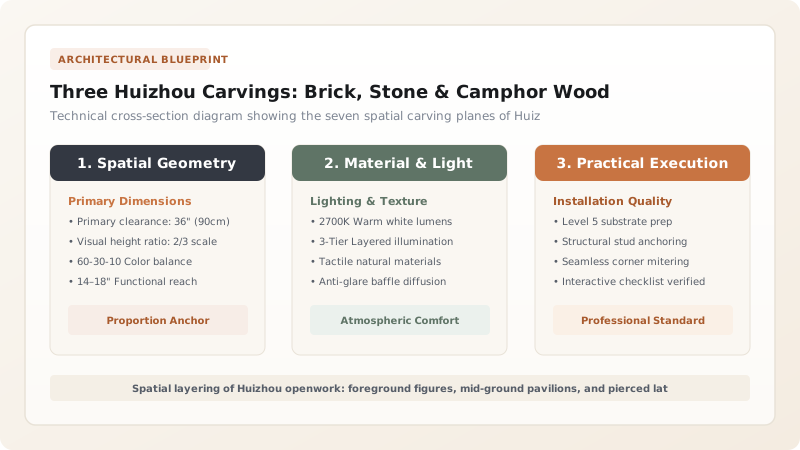
The Cultural Synthesis of Huizhou San Diao
In traditional Chinese society, merchants were legally ranked at the bottom of the four social classes (below scholars, farmers, and artisans). Despite amassing staggering wealth, Huizhou merchants were prohibited by imperial sumptuary laws from building palaces with yellow-glazed tiles or golden pillars reserved for the Emperor.
To channel their wealth without incurring imperial wrath, merchants embraced Confucian scholarship, investing heavily in the finest artists to adorn their humble white-and-grey dwellings with San Diao (Three Carvings). The exterior remained understated, but stepping through the portal revealed an astonishing three-dimensional world of microscopic architectural sculpture.
Brick Carving (Zhuan Diao) and the Gateway Mentou
Brick carving was displayed prominently over the main entrance gatehouse (mentou or badazi). The medium was not ordinary red brick, but specialized water-milled blue clay bricks (qingzhuan) kiln-fired with rice-husk fuels to achieve uniform density comparable to fine slate.
Carvers worked with tiny curved chisels, gouging scenes of historical dramas, imperial examinations, and bustling markets. Up to five layers of relief were carved into the brick face: foreground figures barely 2 cm tall possessed individualized facial expressions, flowing silk robes, and miniature swords held in free-standing undercut openwork.
Stone Carving (Shi Diao) and Memorial Arches
Stone carving was reserved for elements requiring monumental permanence: foundation pillar bases (zhuchu), threshold lintels, courtyard balustrades, and monumental commemorative arches (paifang)—such as the famous Eight-Arch Cluster of Tangyue in Shexian.
Artisans utilized local fine-grained green tea stone (chayuan shi) and hard grey granite. Unlike soft limestone, granite is intensely abrasive and brittle. Masons executed crisp relief carvings of kylins, coiled dragons, and carp leaping over the dragon gate, utilizing bas-relief (qian fu diao) and pierced openwork that has withstood six centuries of weathering without losing edge sharpness.
Wood Carving (Mu Diao) and Camphor Openwork
Inside the residence, wood carving enveloped the entire structural timber framework. Because of high regional humidity and termites, artisans selected decades-seasoned camphor wood (zhangmu)—which naturally repels insects—alongside fine-grained southern cypress and ginkgo wood.
Carvers transformed functional structural elements—corbel brackets (que ti), beam struts (tuo duo), and horizontal tie-beams (yue liang)—into breathtaking three-dimensional panoramas. Utilizing tou diao (complete undercut pierced carving), master carvers created up to seven overlapping planes of depth, allowing viewers to see through pavilion windows into inner chambers where carved figures engaged in tea ceremonies.
Huizhou San Diao: Media Specifications and Applications
Use this reference table to calculate exact physical dimensions, ratios, and specifications before purchasing:
| Carving Medium | Material Sourcing | Architectural Location | Key Carving Technique |
|---|---|---|---|
| Brick Carving (Zhuan Diao) | Fine loess clay water-milled blue bricks (Qingzhuan) | Entrance gatehouse friezes and courtyard eave cornices | High relief with 3-5 planes; delicate miniature figures |
| Stone Carving (Shi Diao) | Local green tea stone (Chayuan shi) & grey granite | Column plinths, threshold door-gods, paifang arches | Deep bas-relief and rounded sculptural relief (Yuan diao) |
| Wood Carving (Mu Diao) | Old-growth camphor (Zhangmu), cypress, ginkgo | Ceiling brackets, screen partitions, horizontal moon beams | 7-layer pierced undercut openwork (Tou diao) with zero glue |
Practical Constraints
Every successful decoration project must account for physical and environmental constraints:
Extreme fragility of multi-layered undercut openwork during transport.
Delicate 1 mm carved swords, branches, and horse legs can snap under minor vibration during moving. Mitigation: Pack intricate carvings with expanding biodegradable foam or custom velvet cushions supported by rigid timber cradles.
Vandalism and illicit salvage theft of antique architectural carvings.
High market value among antique collectors has led to the theft of historic door panels and brick friezes. Mitigation: Install concealed vibration sensors, discrete security cameras, and register all historic village carvings in national cultural registries.
Execution Blueprint & Craftsmanship Sequence
Execute this professional sequence to achieve flawless results without backtracking:
Camphor Wood Aging and Desiccation
Submerge felled camphor logs in running river water for 12 months to leech out sap, followed by 3 years of shaded air drying.
Full-Scale Ink Cartoon Drafting
Draw complex historical or landscape scenes on thin rice paper, pasting the cartoon directly onto the planed timber or brick face.
Outlining and Waste Material Drilling
Drill clearance holes through negative-space areas with manual spoon drills, removing bulk waste using flat gouges.
Layered Rough Carving (Cu Diao)
Establish the multiple spatial planes with heavy chisels, blocking out foreground figures, midground architecture, and background clouds.
Deep Undercutting (Tou Diao)
Sever background connections beneath figures using angled undercut chisels, creating free-standing limbs and flying garments.
Microscopic Detail Detailing (Xi Diao)
Carve delicate facial expressions, woven textile patterns, and individual tree leaves using miniature razor-sharp V-tools.
Natural Wax and Oil Finishing
Clean wood carving with soft bristle brushes, applying a light coat of natural beeswax or camellia oil without artificial lacquer.
Structural Pegging and Installation
Mount carved timber corbels and brick panels into mortise housings, securing with concealed bamboo pins.
Common Mistakes & Countermeasures
Avoid these costly errors that compromise aesthetics, ergonomics, and budget:
Applying synthetic polyurethane or chemical varnish over historic Huizhou wood carvings.
Using power rotary carving tools (Dremel) for delicate restorations.
Project Execution Checklist
Track your physical progress. Checkboxes persist automatically on this device:
Frequently Asked Questions
Why didn't Huizhou merchants paint their beautiful wood carvings?
Huizhou aesthetics celebrated the natural grain, warm amber tone, and natural scent of fine woods like camphor and cypress. Leaving the wood unpainted also signaled scholarly restraint, distinguishing their homes from the gaudy painted palaces of Beijing imperial officials.
How long did it take a master carver to complete a single beam bracket?
A complex, multi-layered undercut camphor wood corbel bracket (que ti) depicting an entire opera scene could take an experienced master carver between four and six months of continuous, meticulous hand chiseling.
Can antique Huizhou brick carvings survive rain and freezing temperatures?
Yes. Historic blue bricks (qingzhuan) were fired with high-density clay and water-quenched inside the kiln, giving them a vitrified structure similar to ceramic tile. As long as they are protected from direct gutter overflow, they easily last 500 years.
What is the most famous theme depicted in Huizhou woodcarving?
The most celebrated themes are 'The Twenty-Four Filial Exemplars', scenes from the 'Romance of the Three Kingdoms', 'Hundred Children at Play', and subtle puns for wealth and harmony (such as bats for blessing and carp for abundance).


