
Stepped matou (horse-head) firewalls and flying eaves carpentry represent the structural hallmark of Huizhou vernacular engineering. Raised in rhythmic stepped tiers (typically three to five steps) above timber roof planes, these non-combustible blue-brick walls starve neighborhood fires of draft while their flared, upswept grey tile corners deflect hurricane mountain winds and create dynamic optical grace.
At a Glance: Key Takeaways
- Firewall Designation: Matouqiang (Horse-head wall) / Fenguogiang (Fire-sealing wall)
- Stepping Hierarchy: San-jie (Three-step) for common houses, Wu-jie (Five-step) for ancestral halls
- Masonry Core: Solid kiln-fired blue-grey clay bricks bedded in lime mortar
- Flying Eave Detail: Flared curved tile cap (chujiao) projecting upward at 30–45 degrees
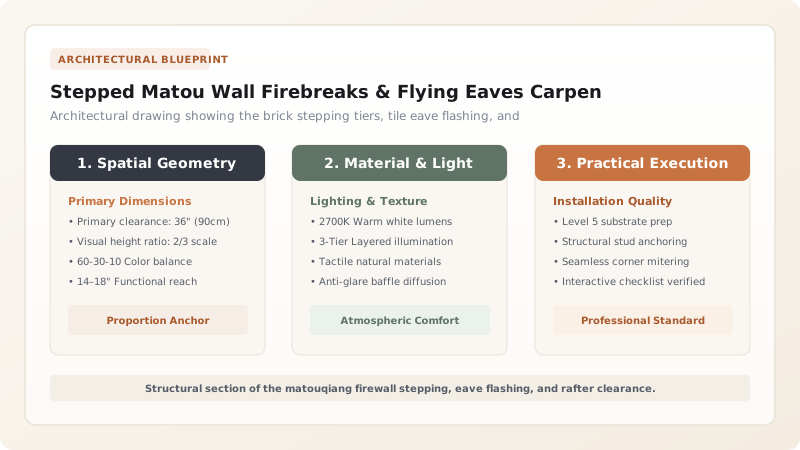
The Urgent Urban Fire Engineering of Huizhou
During the Ming dynasty (1368–1644), commercial prosperity caused Huizhou towns such as Shexian and Xiuning to grow into dense urban labyrinths. Homes were framed almost entirely with seasoned mountain pine and fir timbers, roofed with flammable wooden batten substructures, and packed tightly along alleyways barely two meters wide.
Following catastrophic fires that wiped out entire commercial districts, municipal magistrates and clan elders codified architectural building codes requiring fenguogiang (fire-sealing walls). The exterior gable walls were legally mandated to rise continuously from bedrock to at least three feet above the highest roof ridge, forming an unbroken non-combustible shield.
Anatomy of the Stepped Matou Tiers
A simple flat triangular firewall creates immense wind drag and looks uninvitingly severe. Huizhou masons softened this barrier by stepping the wall down in rhythmic cascades matching the roof pitch. The steps are classified by tier count: san-jie (three steps) for ordinary merchant residences, and wu-jie (five steps) for grand clan shrines and academy libraries.
Each step is capped with double courses of small black clay roof tiles laid with mortar beds. The wall copings terminate at each step corner in a dramatic flared projection called the matou (horse head) or chujiao (horned eave), shaped like an upswept wing that prevents wind-driven rain from washing behind the wall.
Flying Eaves and Wind-Deflection Aerodynamics
The Yellow Mountain region experiences severe seasonal typhoons and mountain downdrafts. High, flat parapet walls would suffer immense wind shear that could topple unbraced masonry. The flared flying corners of the horse-head wall serve an essential aerodynamic purpose.
The curved, upswept eave tiles (qiao jiao) act as aerodynamic spoilers, catching horizontal mountain wind and curling it upward into an air vortex. This upward deflected airflow creates a localized high-pressure cushion that stabilizes the wall crest and prevents wind from tearing loose roof tiles from the main dwelling.
Flashing and Water-Exclusion Interface
The junction where the sloping timber-framed roof meets the vertical masonry horse-head firewall is the most vulnerable point for water penetration in Chinese architecture. Differential movement between timber frames settling on stone plinths and rigid brick firewalls can tear apart standard joints.
Huizhou carpenters solved this by decoupling the structures: the timber roof rafters do not bear directly on the firewall. Instead, the roof sits on independent timber columns 10 cm inside the wall line. The gap is bridged by a stepped counter-flashing of curved clay tiles (panwa) embedded deep into the brick wall mortar, allowing the timber skeleton to flex during seasons without springing water leaks.
Firewall Typologies: Huizhou Matouqiang vs Lingnan Wok-Ear Walls
Use this reference table to calculate exact physical dimensions, ratios, and specifications before purchasing:
| Architectural Parameter | Huizhou Stepped Matouqiang (Horse-Head) | Lingnan Guo'erqiang (Wok-Ear / Cat-Head) |
|---|---|---|
| Profile Geometry | Rhythmic rectilinear steps (3 to 5 tiers) with flared tips | Continuous smooth curvilinear arch resembling iron wok handles |
| Geographic Distribution | Anhui, Jiangxi, Zhejiang (inland mountainous region) | Guangdong, Hong Kong, Guangxi (coastal subtropical region) |
| Roof Water Flow | Channels water inward to central skywell cistern | Channels water outward along eave valleys into street drains |
| Color Contrast | Bright white lime plaster with dark charcoal-grey tiles | Grey exposed brickwork with decorative polychrome plaster friezes |
| Wind Performance | Upswept eave tips curl mountain wind gusts upward | Smooth rounded arches allow coastal typhoons to glide over |
Practical Constraints
Every successful decoration project must account for physical and environmental constraints:
Vulnerability of tall unbraced brick parapets to seismic shear.
Free-standing parapets rising 2 meters above roofs can shear off during earthquake tremors. Mitigation: Install concealed stainless-steel structural tie-plates anchoring the brick wall crest back to timber tie-beams.
Frequent wind damage to delicate flared eave corner tiles.
Severe typhoons can rip projecting tile horns off the wall corners. Mitigation: Secure corner tiles with concealed copper wire ties anchored into solid mortar beds.
Execution Blueprint & Craftsmanship Sequence
Execute this professional sequence to achieve flawless results without backtracking:
Gable Footing and Granite Plinth Laying
Excavate foundation trenches to firm shale bedrock, laying dressed tea-garden granite plinth slabs.
Blue-Grey Brick Masonry Coursing
Lay dense kiln-fired blue-grey clay bricks in running bond using slaked lime-sand mortar, checking vertical plumb.
Stepped Tier Layout (San-Jie or Wu-Jie)
Step the wall profile at 40-degree angles matching the roof rake, forming three or five distinct horizontal platforms.
Tile Coping and Panwa Flashing
Bed two courses of curved black clay tiles across the horizontal wall steps, embedding counter-flashing tiles into wall joints.
Upswept Eave Horn (Chujiao) Cantilevering
Corbel small shaped bricks outward at step edges, capping with curved drip tiles angled upward at 35 degrees.
Rafter Expansion Gap Verification
Ensure timber roof framing maintains a 10 cm clearance from the inner brick wall face to allow independent structural movement.
Slaked Lime Wall Rendering
Trowel three coats of pure white slaked lime putty across both faces of the firewall, feathering neatly around tile copings.
Chimney Stack and Vent Detailing
Incorporate small clay-pipe kitchen exhaust vents through the upper firewall step, capping with miniature tile awnings.
Common Mistakes & Countermeasures
Avoid these costly errors that compromise aesthetics, ergonomics, and budget:
Bearing timber roof purlins directly into the brick horse-head firewall.
Omitting the upswept tile horn (chujiao) at the step edges.
Project Execution Checklist
Track your physical progress. Checkboxes persist automatically on this device:
Frequently Asked Questions
Why is it called a 'horse-head' wall (matouqiang)?
The silhouette of the stepped wall with its flared eave corners resembles the proud, arched neck and head of a galloping horse. In Chinese culture, the horse symbolizes strength, success, and the wish for young men traveling abroad for business to return home victorious.
Can a matouqiang actually stop a major fire?
Yes. Historical records from the Ming and Qing dynasties document numerous instances where catastrophic village fires consuming dozens of homes were halted completely when they reached the tall, non-combustible barrier of a family's matouqiang.
What is the difference between a 3-step and a 5-step horse-head wall?
A 3-step wall (san-jie) was the standard for commercial merchant residences and small family dwellings. A 5-step wall (wu-jie) was reserved for large clan ancestral halls, temples, and homes of scholars who passed the imperial civil service examinations.
How do builders keep the white walls from getting dirty?
The flared tile horns at each step throw rainwater away from the facade. While some natural grey rainwater streaks (called 'ink traces' / mojiji) occur naturally over decades, locals view these not as dirt, but as poetic echoes of traditional Chinese landscape painting.


