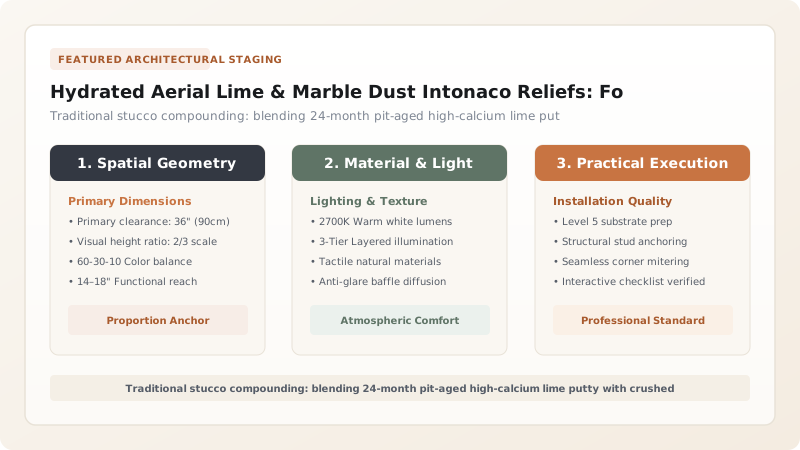
Hydrated aerial lime and marble dust intonaco reliefs form the chemical foundation of durable Alpine Bandlwerk stucco. Formulated with non-hydraulic slaked lime putty (CL90-S) aged over 18 months and sharp crystalline marble flour, the mortar cures exclusively through the absorption of atmospheric carbon dioxide, creating a breathable, flexible calcite matrix capable of enduring severe mountain freeze-thaw cycles.
At a Glance: Key Takeaways
- Lime Specification: Aged non-hydraulic slaked lime putty (EN 459-1 CL90-S, >95% CaO)
- Primary Aggregate: High-purity crystalline white marble flour & dolomitic sand (0.05–1.2 mm)
- Binder-Aggregate Ratio: 1 : 1 for fine relief skim; 1 : 2 for structural background intonaco
- Hardening Mechanism: Atmospheric carbonation: Ca(OH)₂ + CO₂ → CaCO₃ + H₂O
- Water Vapor Permeability: High breathability (vapor diffusion resistance factor µ ≈ 10–12)
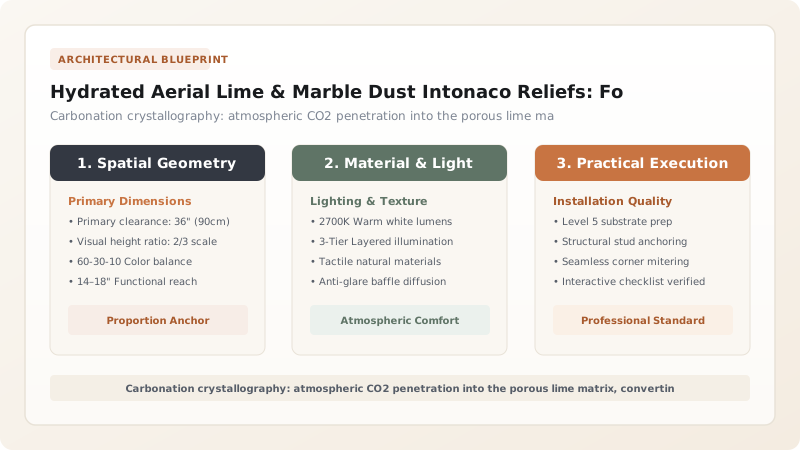
The Superiority of Non-Hydraulic High-Calcium Lime Putty (CL90)
At the center of historical Salzkammergut stucco craftsmanship is an absolute material requirement: the use of non-hydraulic aerial slaked lime putty (CL90-S). Unlike hydraulic limes or modern Portland cements, which harden through chemical reaction with water to form rigid crystalline silicates, aerial lime cures through the slow, gentle absorption of atmospheric gases. High-purity limestone (>95% calcium carbonate, CaCO₃), quarried from the monumental Karst massifs of the Salzkammergut, was calcined in wood-fired shaft kilns at temperatures between 850°C and 900°C to drive off carbon dioxide, producing reactive quicklime (calcium oxide, CaO).
This quicklime was subsequently slaked in timber troughs with an excess of clean alpine mountain water—an exothermic reaction that boils the water and shatters the lime into microscopic particles of calcium hydroxide (Ca(OH)₂). The resulting slurry was drained into subterranean masonry pits and buried beneath water for eighteen months to five years. During this prolonged aging, the calcium hydroxide crystals fracture and transform from coarse hexagonal prisms into sub-micron colloidal platelets. This nanoscale morphology grants aged lime putty its legendary thixotropy: stiff when resting in the tub, yet flowing with silk-like smoothness under the pressure of a plasterer’s spatula.
Crushed Alpine Marble Dust Gradation and Colloidal Cohesion
A high-purity binder cannot function without an equally refined aggregate. For fine Bandlwerk relief ornament, traditional stuccoists rejected coarse silica river sand in favour of crushed crystalline alpine marble flour and dolomitic sands. Marble is metamorphic limestone composed of recrystallized calcite. When crushed, marble particles fracture along natural cleavage planes into sharp, angular rhombohedrons rather than rounded river grains.
The mortar master carefully blends three distinct sieve fractions to achieve maximum packing density: fine flour (<0.1 mm) to fill microscopic voids, medium sand (0.2–0.6 mm) to build body, and coarser grit (0.8–1.2 mm) for underlying structural cores. When mixed with aged lime putty, the crystalline faces of the marble dust interlock mechanically under trowel compaction. Furthermore, because marble is chemically identical to the calcite that forms during carbonation, the marble grains act as active nucleation sites, encouraging new calcite crystals to grow directly onto their crystal lattices, creating a monolithic mineral matrix of extraordinary density and luminous whiteness.
Water-Retention Dynamics and Wet-on-Wet Keying Mechanics
One of the greatest challenges in exterior facade stucco is managing hydrological suction between mortar coats. Non-hydraulic lime mortar contains no chemical setting agents; its cohesion depends entirely on retaining adequate water during application and compaction. If applied over a dry, thirsty substrate, the base coat will instantly suck water out of the fine intonaco relief, causing the binder to freeze into a friable, chalky powder before carbonation can begin.
To overcome this, traditional craftsmen adhere strictly to the wet-on-wet (fresco) methodology. The masonry substrate and coarse base render (arriccio) are soaked with lime water until suction is completely stabilized. The intermediate background intonaco is applied while the base remains receptive, and the relief stucco is modeled directly over the damp intonaco. As the artisan works, the moisture gradients between the layers equalize, allowing calcium hydroxide molecules to migrate across the physical interface. This molecular interdiffusion knits the relief ornament into the substrate render, eliminating weak boundary planes and preventing frost-induced delamination.
Long-Term Carbonation Kinetics and Microcrystalline Calcite Densification
The chemical transformation of wet calcium hydroxide into hard crystalline calcite is known as carbonation: Ca(OH)₂ + CO₂ → CaCO₃ + H₂O. This reaction does not occur in dry air or under water; it requires a delicate micro-climatic equilibrium. Atmospheric carbon dioxide must dissolve into the thin capillary water film coating the lime particles, forming carbonic acid (H₂CO₃), which subsequently reacts with dissolved calcium ions (Ca²⁺) to precipitate insoluble calcite crystals (CaCO₃).
Because atmospheric carbon dioxide constitutes only roughly 0.04% of the ambient air, this chemical conversion progresses inward at a rate of approximately 1 to 2 millimetres per month. Over decades, as rainfall washes across the facade and dissolves minuscule amounts of surface calcite, the mineral redeposits within microscopic pores, gradually densifying the outer 2 millimetres into an impervious, semi-translucent mineral rind. This self-healing, breathable skin sheds liquid rainwater while allowing internal masonry vapour to transpire freely, explaining why authentic Salzkammergut lime stucco facades endure for centuries in extreme alpine environments.
Salzkammergut Lime Stucco Formulations Across Structural Layers
Use this reference table to calculate exact physical dimensions, ratios, and specifications before purchasing:
| Mortar Layer | Binder Specification | Aggregate Composition & Grading | Binder:Aggregate Ratio | Mechanical & Physical Properties |
|---|---|---|---|---|
| Scratch Base (Arriccio) | Aged Lime Putty (CL90) + 10% Trass | Washed sharp quartz river sand (0.5–3.0 mm) | 1 : 2.5 by volume | High shear strength, rough mechanical tooth, moisture buffering |
| Background Intonaco | Aged Lime Putty (CL90-S) | Angular crystalline marble sand (0.2–1.0 mm) | 1 : 2.0 by volume | Uniform suction control, smooth plane, high tensile adhesion |
| Relief Core (Nocciuolo) | Aged Lime Putty + Cattle Hair | Graded dolomitic marble sand (0.1–0.8 mm) | 1 : 1.5 by volume | Fiber-reinforced tensile cohesion, sag resistance, shock absorption |
| Fine Relief Finish (Stucco) | Pit-aged Putty (>24 months) | Micronized Carrara marble flour (0.01–0.2 mm) | 1 : 1.0 by volume | Thixotropic plasticity, sharp edge retention, satin mineral sheen |
| Protective Lime Wash | Aerial Lime Putty + Lime Water | Zero aggregate (pure colloidal calcium hydroxide) | 1 : 4 by volume (gossamer wash) | Breathable sacrificial weather shield, brilliant light refraction |
Practical Constraints
Every successful decoration project must account for physical and environmental constraints:
Inherent Slowness of Atmospheric Carbonation Kinetics
Non-hydraulic lime putty carbonates at a rate of only 1 to 2 mm per month in moderate climates; deep stucco reliefs remain chemically uncarbonated inside for over a year. Mitigation: Structure high-relief masses with fiber-reinforced cores, avoid excessive monolithic depths exceeding 40 mm, and prohibit exterior work after early September.
Soluble Salt Ingress from Ground Masonry Damp
Ground salts (nitrates, sulfates) wicked into exterior stucco crystallize and expand beneath the intonaco, blowing off delicate Bandlwerk relief layers. Mitigation: Install sacrificial porous lime renovation renders on the lower plinth and isolate the upper decorative zone from rising damp using horizontal lime barriers.
Execution Blueprint & Craftsmanship Sequence
Execute this professional sequence to achieve flawless results without backtracking:
Selection and Slaking of Dachstein High-Calcium Quicklime
Select lump quicklime burned from high-calcium Dachstein limestone (>95% CaCO3). Slake in excess spring water inside timber vats with continuous stirring until boiling ceases and a smooth milk-of-lime emulsion forms.
Subterranean Pit Aging and Maturation
Run the liquid lime milk through fine bronze screens into subterranean maturing pits. Store under a continuous layer of standing water for a minimum of 18 months, allowing calcium hydroxide crystals to fracture into colloidal sub-micron platelets.
Aggregate Washing, Drying, and Sieve Fractionation
Wash crushed alpine marble sands to remove silt, clay, and soluble salts. Kiln-dry and separate the aggregates into distinct sieve fractions: coarse grit (1–2 mm), medium sand (0.3–1 mm), and micronized flour (<0.1 mm).
Mechanical Beating and Thixotropic Reactivation
Remove mature lime putty from the pit and beat it vigorously with hardwood clubs or mechanical paddle mixers for ten minutes without adding water. This shear stress breaks inter-particle gel bonds, restoring silky, spreadable fluidity.
Compounding the Relief Intonaco Paste
Combine 1 part reactivated lime putty with 1 part graded marble aggregate (equal parts medium sand and micronized marble flour). Mix until a dense, buttery paste forms that clings securely to an inverted trowel.
Wet-on-Wet Layering Over Prepared Arriccio
Saturate the cured base render with lime water until suction is stabilized. Trowel a 3 mm background intonaco firmly onto the damp substrate, compressing the surface with a stainless steel spatula to eliminate microscopic voids.
Modeling and Compacting the Stucco Reliefs
Build up the decorative Bandlwerk straps and acanthus scrolls over the wet intonaco. Compress the mortar facets firmly during modeling to orient the plate-like calcium hydroxide crystals parallel to the surface plane.
Controlled Atmospheric Carbonation Regime
Enclose the scaffold in breathable windproof burlap. Mist the stucco facade twice daily with fine water spray for 28 days to sustain the aqueous solution necessary for atmospheric carbon dioxide dissolution and calcite crystal growth.
Common Mistakes & Countermeasures
Avoid these costly errors that compromise aesthetics, ergonomics, and budget:
Using dry bagged hydrated lime powder (type N or S) instead of aged slaked lime putty
Using rounded alluvial beach sand or clay-contaminated river gravel
Allowing fresh lime stucco to dry rapidly in direct summer sunshine
Project Execution Checklist
Track your physical progress. Checkboxes persist automatically on this device:
Frequently Asked Questions
What chemical reaction governs the hardening of aerial lime stucco?
The hardening of aerial lime is governed entirely by atmospheric carbonation: Ca(OH)₂ (calcium hydroxide) + CO₂ (atmospheric carbon dioxide) → CaCO₃ (calcite / calcium carbonate) + H₂O (water). Carbon dioxide dissolves into the microscopic moisture film within the plaster pores, forming carbonic acid that reacts with dissolved calcium hydroxide to precipitate insoluble calcite crystals.
Why is marble dust used instead of ordinary quartz sand in decorative intonaco?
Marble dust consists of pure crystalline calcium carbonate. Its angular, rhombic cleavage planes provide superior mechanical interlock compared to smooth quartz sand. Furthermore, during carbonation, the marble particles serve as compatible epitaxial nucleation seeds for new calcite crystal growth, producing an exceptionally dense, luminous, and weather-resistant stucco surface.
What happens if hydraulic lime (NHL) is substituted for aged aerial lime putty?
Natural hydraulic lime sets via hydration with water, developing rigid calcium silicate hydrates within hours. While useful for masonry footings, NHL sets too rapidly for the nuanced, hours-long freehand modeling demanded by Bandlwerk ornament. It also exhibits significantly higher stiffness (elastic modulus), making it more prone to cracking under Alpine thermal expansion.
How can one tell if a historic facade stucco is authentic aerial lime or modern cement?
Authentic historic aerial lime stucco displays a warm, crystalline translucency under sunlight, feels softer when scratched with a copper coin, and reacts vigorously with effervescence when a drop of 10% hydrochloric acid is applied. Modern cement appears dull, cold-grey, feels glassy and dense, and has low water-vapor permeability.