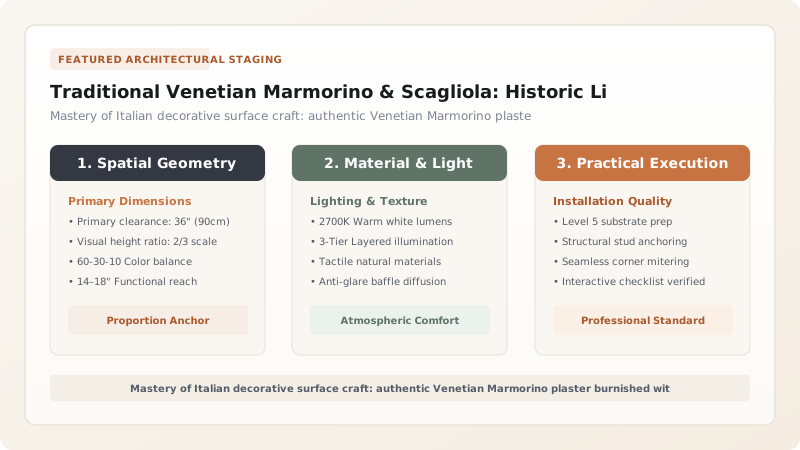
Venetian Marmorino and Scagliola are two supreme pinnacles of Italian historic decorative surface craftsmanship. Marmorino is an authentic Venetian lime plaster developed in the Roman era and championed during the Renaissance by Andrea Palladio; formulated from years-aged slaked lime putty (grassello di calce) and graded Carrara marble dust, it provided Venetian palazzi with the luminous, breathable appearance of solid marble without overloading timber pile foundations in the lagoon. Scagliola is the master art of faux-marble inlay, utilizing calcined selenite gypsum, animal glue, and pigments to simulate rare pietre dure, porphyry, and lapis lazuli.
At a Glance: Key Takeaways
- Origins & Heartlands: Veneto lagoon palaces (Marmorino) & Emilia-Romagna / Tuscany (Scagliola)
- Renaissance Champions: Andrea Palladio, Michele Sanmicheli, and Guido Fassi
- Marmorino Chemistry: Aged slaked lime putty (Ca(OH)2) + graded Carrara marble flour (CaCO3)
- Scagliola Chemistry: Calcined selenite gypsum (CaSO4·0.5H2O) + animal hide glue (colla di carniccio)
- Finishing Regimes: Hot-iron burnishing (stiratura) & Marseille olive-oil soap saponification
In-Depth Guides in this Directory
Explore specialized subtopic blueprints, technical dimensions, and execution checklists:
Aged Slaked Lime Putty (Grassello) & Carrara Marble Dust Layering in Marmorino
Master the layering of aged slaked lime putty (grassello) and Carrara marble dust for authentic Venetian Marmorino: particle sizing, trowel compaction, and carbonation.
Scagliola Selenite Gypsum & Hide-Glue Pigment Inlay: The Art of Faux Marble Inlay
Master the Renaissance art of Scagliola (stucco marmo): calcined selenite gypsum, animal hide glue, mineral pigment pastelli, and intarsio stone inlay.
Hot-Iron Burnishing & Marseille Soap Wax Finishing for Historic Venetian Plaster
Explore hot-iron burnishing (stiratura a ferro caldo) and Marseille soap (saponatura) for Venetian plaster: chemical saponification, heat vitrification, and wax sheen.
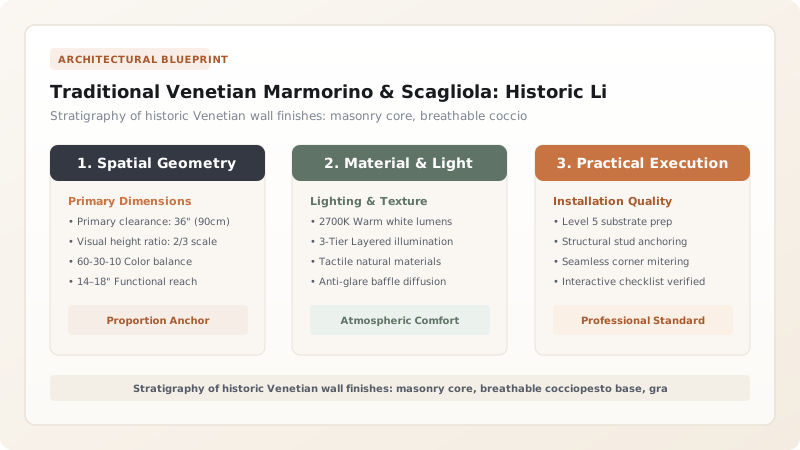
Venetian Origins: Lightness and Luxury in the Lagoon
In the floating city of Venice, architectural engineering was perpetually locked in conflict with geology. Founded amidst the tidal mudflats and shifting silt of the Venetian lagoon, the city's monumental palaces, churches, and civic halls were supported entirely by subterranean forests of submerged alder and larch timber piles. Cladding the cavernous salons of these palazzi in heavy, solid ashlar marble slabs—imported from quarries in Istria, Verona, or Carrara—threatened to overload the fragile timber pile foundations, inducing catastrophic structural subsidence and building collapse.
The Venetian response was an alchemical triumph of materials engineering: Marmorino Veneziano. Documented as early as Roman antiquity by Vitruvius in his De Architectura and passionately revived during the High Renaissance by master architect Andrea Palladio, Marmorino allowed builders to reproduce the monumental, light-reflective splendor of genuine Carrara marble at a mere fraction of the structural deadload. Furthermore, in an environment saturated with salt spray, high humidity, and tidal flooding (acqua alta), lime-based Marmorino offered exceptional vapor permeability, preventing moisture from becoming trapped within the soft brick core of the palace walls.
The Chemistry of Grassello di Calce and Graded Carrara Marble
Unlike contemporary synthetic 'faux finishes' manufactured from petroleum-based vinyl or acrylic polymers, authentic Marmorino is a pure mineral composite governed by the ancient limestone cycle. The binder is grassello di calce (aged slaked lime putty). High-calcium limestone is burned in kilns at 900°C to produce quicklime (calcium oxide, CaO), which is then slaked in water to form calcium hydroxide (Ca(OH)2). To achieve the supreme plasticity required for Marmorino, the putty is aged submerged under clean water in underground cisterns for a minimum of two to five years.
During this prolonged aging, the calcium hydroxide crystal particles naturally fracture into sub-micron hexagonal plates, dramatically increasing workability and cohesive strength. This aged grassello is blended with pure white Carrara marble dust (polvere di marmo). The marble dust is not used as a single uniform powder, but is meticulously sieved into distinct particle grades: medium grains (0.4–0.7 mm) for the intermediate floating coats, and microscopic marble flour (0.05–0.1 mm) for the final skin. When compacted with a trowel, the flat calcite crystals of the marble dust align with the carbonating lime matrix, producing a crystalline stone surface that reflects light with natural, liquid-like specular brilliance.
Scagliola: The Alchemical Art of Imitative Pietre Dure
While Marmorino provided the monumental wall surfaces of Italian palatial architecture, Scagliola (also known as stucco marmo) represented the ultimate virtuoso art of fine faux-marble and gemstone inlay. Developed in the early seventeenth century in Emilia-Romagna and Carpi by master artisans such as Guido Fassi, Scagliola emerged as an ingenious answer to the astronomical cost of pietre dure (Florentine hardstone mosaics of genuine porphyry, agate, and lapis lazuli).
The secret of Scagliola lies in selenite, a crystallized, translucent variety of gypsum known poetically as pietra di luna (moonstone), quarried from the Apennine hills. When calcined at low temperatures (around 150°C), the selenite crystals dehydrate into pure gypsum plaster. This powder is kneaded with warm, clarified animal hide glue (colla di carniccio) and natural mineral pigments into colored loaves of dough known as pastelli. Craftsmen marble, slice, and inlay these dough masses into carved matrix slabs, allowing the animal glue to retard setting time. Once hardened, the surface is scraped, honed with pumice and water, and polished to a flawless, mirror-like finish that perfectly replicates the most exotic and precious marbles on earth.
Thermal and Soap Finishing: The Alchemy of Saponatura
The technical boundary separating raw, powdery lime from a gleaming, weather-resistant architectural gemstone is the finishing regime. Traditional Venetian craftsmen never sealed their work with modern synthetic polyurethane or acrylic clear coats, which would suffocate the breathable lime matrix and peel under moisture pressure. Instead, they perfected the art of saponatura (saponification).
While the final coat of Marmorino is still firming and warm from trowel compression, the artisan applies a liquid wash of pure Marseille olive-oil soap (sapone di Marsiglia). The fatty acids (oleic and stearic acids) in the natural soap penetrate the moist plaster pores and react chemically with free calcium hydroxide to form calcium stearate—an insoluble, hydrophobic natural soap wax. When burnished with a heated steel or brass iron (ferro caldo), the pores vitrify. The finished wall sheds splashing water and resists dirt accumulation effortlessly, while remaining completely open to vapor transmission, preserving the pristine architectural beauty of Venetian interiors across centuries of humid lagoon weather.
Comparison of Venetian Marmorino, Scagliola, Grassello & Cocciopesto Plasters
Use this reference table to calculate exact physical dimensions, ratios, and specifications before purchasing:
| Plaster Typology | Core Binder & Aggregate | Application Method | Surface Optical Finish | Historic Architectural Setting |
|---|---|---|---|---|
| Marmorino Veneziano | Aged grassello + Carrara marble dust (0.3–0.7 mm) | Multi-layer troweled float + polished compression | Smooth, satin to semi-gloss with visible marble grains | Palladian villa interiors, grand Venetian palazzo salons |
| Grassello / Stucco Lucido | Superfine aged lime putty + micronized marble flour | Paper-thin spatula skimming (3–4 passes) | Mirror-reflective, glass-smooth high gloss (Sppatulato) | Ceiling vaults, formal reception columns, altarpiece niches |
| Scagliola / Stucco Marmo | Selenite gypsum + animal hide glue + pigments | Carved inlay (intarsio) or marbled dough slabs | Porphyry-like monolithic gloss, flawless stone replica | Baroque altar frontals, tabletop consoles, palatial pilasters |
| Cocciopesto Plaster | Aged lime putty + pulverized terracotta tile shards | Troweled thick float coat (hydraulic pozzolanic set) | Terracotta-pink, moisture-shedding, breathable matte | Venetian canal water-level ground floors, exterior loggias |
Practical Constraints
Every successful decoration project must account for physical and environmental constraints:
High Groundwater Capillary Rise and Lagoon Salinity (Acqua Alta)
Venice experiences extreme tidal flooding and damp masonry; trapped salt crystals expand behind plaster, spalling the finish. Mitigation: Install a sacrificial base layer of crushed pozzolanic terracotta (cocciopesto) lime mortar to allow continuous vapor breathability and salt passage.
Foundation Weight Limitations on Venetian Timber Mud Piles
Historic Venetian palazzi are supported by wooden alder piles driven into soft lagoon silt; heavy solid marble slabs cause structural sinking. Mitigation: Marmorino provides the authentic visual, tactile, and optical magnificence of solid marble slabs at a mere fraction of structural deadweight.
Execution Blueprint & Craftsmanship Sequence
Execute this professional sequence to achieve flawless results without backtracking:
Substrate Preparation and Dampening
Strip all modern paints, oil, or gypsum residues down to solid brick or stone. Drench the wall thoroughly with clean water to prevent the substrate from sucking water from the plaster.
Arriccio Base Coat Application
Trowel a 10 mm coarse basecoat of aged slaked lime, washed river sand, and crushed terracotta (cocciopesto). Comb the surface horizontally to provide mechanical tooth for finish coats.
First Marmorino Medium Aggregate Coat
Mix 24-month aged grassello with medium Carrara marble dust (0.5 mm). Apply a uniform 2 mm layer with an INOX trowel, leveling flat and allowing 24 hours to firm.
Second Marmorino Fine Aggregate Coat
Trowel a second 1.5 mm coat containing fine marble dust (0.2 mm) over the damp base. Work the material into all hollows, holding the trowel at a 30-degree angle to compact the matrix.
Third Superfine Razor Skim Coat
Apply a whisper-thin skim of superfine grassello and marble flour (0.05 mm), smoothing immediately with overlapping figure-eight strokes before the lime begins to flash-dry.
Mechanical Trowel Burnishing
As the lime begins to firm, increase trowel pressure, holding the stainless steel blade nearly flat against the wall. The intense friction forces calcite crystals to align into a silky sheen.
Saponatura (Marseille Soap Treatment)
While the plaster is still warm from burnishing, brush a warm solution of pure olive-oil Marseille soap across the wall. The soap reacts chemically with calcium hydroxide to form insoluble calcium stearate.
Hot-Iron Finish or Microcrystalline Wax Buffing
Glide a heated brass or steel iron (ferro caldo) across the soaped surface to vitrify the pore structure, or buff with pure beeswax using a soft lamb's wool bonnet.
Common Mistakes & Countermeasures
Avoid these costly errors that compromise aesthetics, ergonomics, and budget:
Using modern synthetic acrylic 'Venetian plaster' products from plastic buckets
Burnishing lime plaster using standard carbon steel trowels
Overheating Scagliola animal glue beyond 65°C during dough mixing
Project Execution Checklist
Track your physical progress. Checkboxes persist automatically on this device:
Frequently Asked Questions
Why did Venetian architects use Marmorino instead of real marble slabs?
Venice is built on millions of wooden timber piles driven into the soft mud of the Venetian lagoon. Solid marble slabs are immensely heavy; cladding entire palace interiors in real marble would have overloaded the delicate timber foundations, causing buildings to crack and sink into the canals. Marmorino offered the exact visual, cool-touch, and light-reflective qualities of Carrara marble at a tiny fraction of the structural deadweight, while naturally breathing in the high humidity of the lagoon.
What is the secret of Scagliola, and how does it mimic rare pietre dure?
Scagliola utilizes selenite (a transparent, crystalline variety of gypsum known as 'pietra di luna' or moonstone). When calcined, ground into powder, and kneaded with warm animal hide glue and mineral pigments, it forms a workable dough (pastelli). Master craftsmen can marble, swirl, and inlay this dough into intricate floral or geometric designs. When sanded with pumice and polished with oil, it develops an astonishing stone-like hardness and optical depth indistinguishable from genuine lapis lazuli, malachite, or porphyry.
How old must slaked lime putty be before it can be used for fine Marmorino?
While basic building lime is used immediately after slaking, authentic Venetian grassello di calce must be aged submerged under water in curing vats for a minimum of 12 to 24 months, with master-grade plasters using lime aged for three to five years. During this prolonged aging, the calcium hydroxide crystal particles naturally fracture into sub-micron hexagonal plates, dramatically increasing plasticity, workability, and crystalline transparency.
Is authentic Venetian plaster waterproof?
In its raw state, lime plaster is hygroscopic and vapor-permeable, meaning it absorbs and releases atmospheric humidity without damage, but is not waterproof against liquid water. However, when treated with the traditional 'saponatura' (pure Marseille olive-oil soap wash) or hot-iron burnishing, the fatty acids in the soap react with the free calcium hydroxide to create an insoluble, hydrophobic calcium soap layer that sheds splashing water while remaining 100% breathable.